
A thief with a pair of shears can dismantle your business operations in minutes. You might think the primary hit is the price of a new condenser, but you're looking at the wrong ledger. The true cost of AC theft downtime commercial property owners endure is measured in broken leases and furious tenants. When the air stops flowing in the middle of an Australian summer, an office building becomes a glass oven. You aren't just paying for copper. You're paying for the silence of a vacant floor.
We know the frustration of dealing with unbudgeted emergency repairs. It's a cycle of vulnerability that drains your maintenance fund and pushes your insurance premiums higher with every claim. You need a strategy that prioritises resilience over simple repair. This guide moves past the surface damage to reveal the systemic impact of equipment failure. It's about protecting your reputation as much as your hardware.
Discover a clear framework for calculating your total downtime losses. We provide a practical checklist to help you build a robust continuity plan. You'll see why investing in a permanent physical barrier is the most cost-effective way to protect your assets. It's time to stop reacting to theft and start securing your property's future.
Key Takeaways
- Understand why the total cost of AC theft downtime commercial property owners face includes tenant turnover and lost business productivity.
- Identify the specific physical vulnerabilities that make large commercial HVAC units a primary target for copper theft.
- Distinguish between immediate repair expenses and the long-term financial impact of insurance premium hikes and emergency call-out fees.
- Access a practical framework to organise a Business Continuity Plan that keeps your building functional during unexpected equipment failure.
- Learn how heavy-duty steel enclosures create a permanent physical barrier that stops criminals from targeting your essential assets.
Beyond the Hardware: Defining the Cost of AC Theft Downtime
Downtime isn't just a gap in your maintenance schedule. It's a full-scale operational crisis. The true cost of AC theft downtime commercial property owners face begins the second a thief touches your condenser. It ends only when the climate control is fully restored. This period often stretches from days into weeks. During that time, your building isn't just uncomfortable. It's often legally or practically uninhabitable for modern business. You aren't just replacing a machine; you're managing a recovery project.
Most property managers focus on the repair bill. This is a mistake. Direct costs are merely the tip of the iceberg in commercial risk management. To find the real number, you must calculate the per-hour cost of a non-functional space. Think about lost productivity for tenants. Consider the risk of lease breaks if the heat becomes unbearable. When the air stops, the revenue often stops with it. Security is an investment in your building's heartbeat.
The Mechanics of a Copper Hit
Thieves work with brutal efficiency. They don't want your air conditioner. They want the high-value metal inside. This surge in copper theft from commercial properties is driven by the scrap value of the internal coils. A thief with a reciprocating saw can disable a commercial unit in under five minutes. They hack through refrigerant lines and electrical conduits without a second thought. This leaves behind a trail of destruction that goes far beyond the missing copper. You're left with severed wiring, leaked gas, and a unit that's often a total write-off. Commercial condensers are prime targets because they contain significantly more copper than domestic split systems. They're the high-stakes prize for organised scrap metal thieves.
Immediate Impact on Property Operations
The aftermath of a hit is expensive and chaotic. Your first expense is the emergency call-out fee. You'll pay premium rates for HVAC tradies to assess the damage and security contractors to guard the now-vulnerable site. Sourcing parts is the next hurdle. If your system uses older components, you may face long lead times for replacement compressors or specialised coils. This extends the cost of AC theft downtime commercial property sites must endure. While you wait, you might need to hire temporary cooling units. These portable chillers are a costly but necessary stop-gap. They're noisy, inefficient, and take up valuable floor space. It's a logistical nightmare that drains your time and your budget.
The Copper Crisis: Why Commercial Properties Are Prime Targets
Thieves don't care about your building's climate control. They care about the scrap yard price of the metal inside your machines. Commercial properties are prime targets because they offer a much higher return on effort than residential areas. A standard home split system contains a relatively small amount of copper. In contrast, high-capacity commercial units are packed with it. Thieves see these units as high-value assets they can liquidate in minutes. They specifically target rooftops or secluded alleyways because these locations provide natural blind spots. Security patrols can't be everywhere at once. A professional crew can strip a unit between patrol rounds and disappear before anyone notices the temperature rising.
The actual theft is only half the story. Vandalism often causes as much damage as the copper extraction itself. Even if a thief is spooked and leaves empty-handed, the damage is usually terminal. They've likely sliced through the condenser coils or hacked the control boards with a reciprocating saw. This results in the high cost of AC theft downtime commercial property managers dread. You're left with a dead system and a massive repair bill regardless of whether the copper was actually taken. One unsuccessful attempt can still lead to a total system replacement.
The Vulnerability of Multi-Bay Systems
Commercial sites often group their HVAC hardware together for efficiency. These banks of condensers are a "one-stop shop" for criminals. Instead of moving from site to site, they can hit five or ten units in a single session. This leads to a catastrophic failure. An entire floor or an entire retail wing goes dark instantly. If you manage a large site, reading a multi unit AC security cage guide is essential for understanding how to group your protection. Protecting these clusters is critical for maintaining your building's operational status.
Why CCTV and Lighting Often Fail
Many owners rely on cameras and floodlights. This is often a waste of resources. Professional thieves know the "hoodie and hat" trick. They keep their faces down and their movements fast. Footage rarely leads to a recovery or a conviction. Speed is their greatest weapon. A unit can be stripped in under four minutes. That's faster than any police or private security response can manage. Visual deterrents are passive; they don't stop a blade. Physical barriers are the only real way to protect your assets. Secure your site with heavy-duty enclosures that turn your units into a "too-hard" basket for opportunistic criminals.
Direct vs. Indirect Costs: The Business Continuity Perspective
Direct costs are just the start. You'll get bills for new hardware, specialised labour, and expensive refrigerant gas. These figures are easy to track on a spreadsheet. The real danger lies in the indirect costs. This is the hidden financial drain that insurance companies often ignore. When you calculate the total cost of AC theft downtime commercial property managers face, you must look beyond the repair invoice. It's about the hours of lost productivity and the stress of managing a building in crisis. The revenue stops, but your overheads don't.
Staff productivity vanishes when the mercury climbs. Modern Australian office blocks are designed for climate control. Without it, they become glass ovens. You'll see a "sweatshop" effect where staff can't focus and server rooms start to overheat. This leads to early departures and missed deadlines. The reputational damage to property managers and body corporates is permanent. It's difficult to maintain a professional image when your building can't provide basic cooling. You're left defending your management fees while the tenants are walking out the door.
Tenant Churn and Lease Abatement
Tenants expect functional amenities. It's part of their legal right to quiet enjoyment. HVAC failure isn't just an inconvenience; it's often a breach of contract. You might face demands for significant rent reductions or immediate lease terminations. Replacing a commercial tenant is a slow, expensive process. You lose months of rent and spend thousands on leasing commissions and new fit-outs. This makes the cost of AC theft downtime commercial property owners suffer far higher than a simple hardware replacement. Protection is cheaper than a vacancy.
Insurance Realities: Premiums and Excesses
Insurance isn't a silver bullet. Every claim you lodge can trigger a significant hike in your annual premiums. You also have to cover the excess, which is often substantial for commercial properties. Some insurers may even refuse cover entirely if you don't have adequate physical security in place. An air conditioner cage insurance discount might be available if you demonstrate proactive risk management. It's about moving from an uninsurable risk to a protected asset. Physical barriers show insurers you're serious about asset protection.
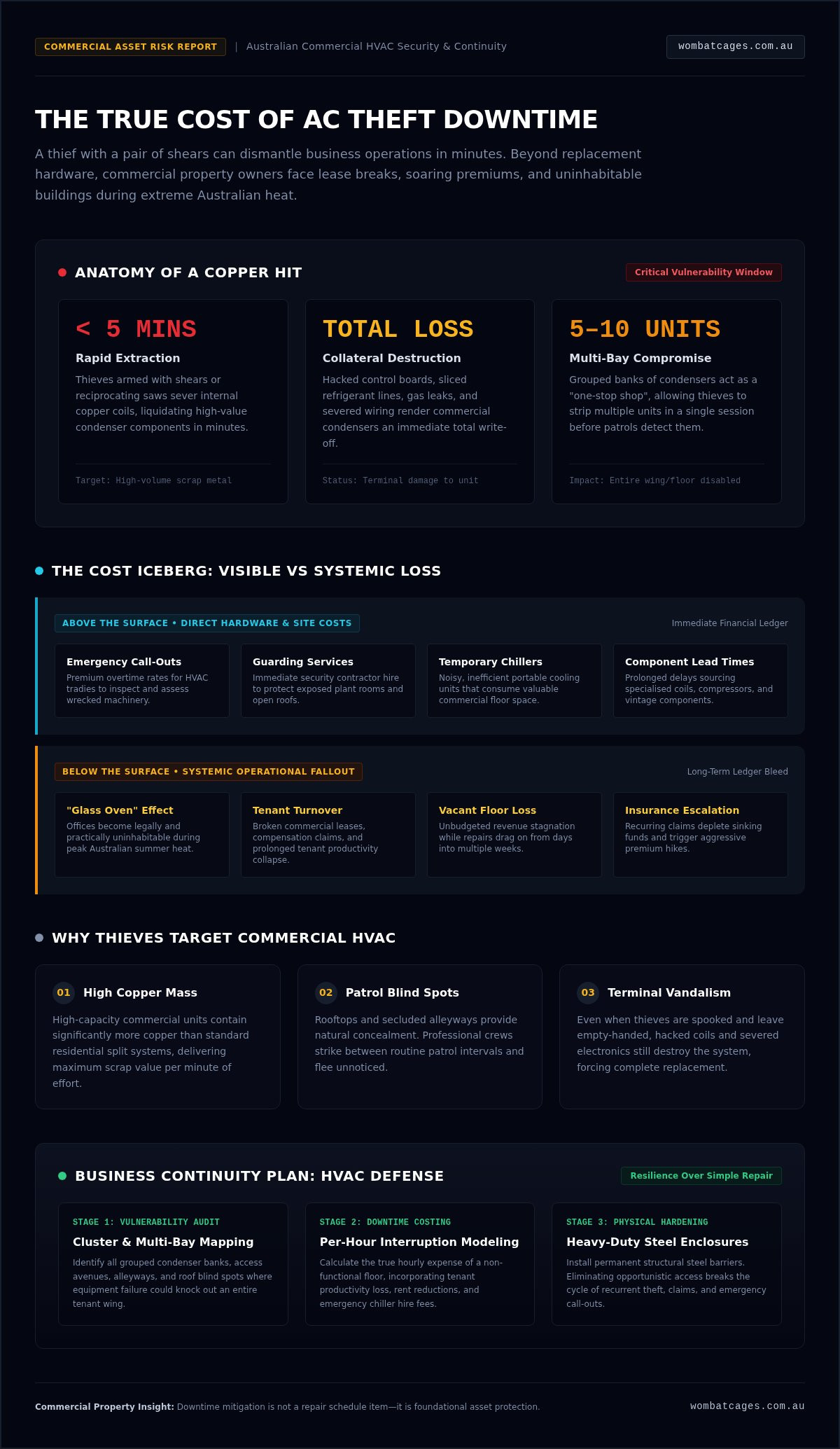
Checklist: Building Your Business Continuity Plan for HVAC Failure
A Business Continuity Plan (BCP) is your building's insurance against chaos. Without one, you're reacting to a crisis instead of managing it. Proactive planning reduces the total cost of AC theft downtime commercial property sites experience by slashing response times. It turns a potential disaster into a manageable repair job. You need a clear roadmap that your team can follow the moment a unit goes offline. This ensures you aren't scrambling for contractors or parts while your tenants are sweltering.
Establish emergency procurement protocols before you need them. Have a preferred HVAC tradie and a security contractor on speed dial. Ensure they understand your building's layout and your specific requirements. Knowing exactly who to call at 3:00 AM saves hours of critical downtime. Physical protection is the core of this strategy. It's about building resilience directly into your infrastructure. You want to make your property an unattractive target so the plan never has to be activated.
Phase 1: Risk Assessment and Audit
Audit every external asset on your property. Walk the perimeter and find the units hidden behind bins or located in dark alleys. These are a thief's first choice. Check the mounting of every condenser. Are they bolted to walls or just sitting loose on brackets? Loose units are easy to tip and strip in seconds. Document everything in a central register. Keep a digital log of serial numbers, model specifications, and high-resolution photos. This documentation speeds up insurance processing and helps tradies source replacement parts without delay.
Phase 2: Prevention and Physical Hardening
Hardening the target is the most effective way to mitigate risk. Don't rely on a single security measure. Use a layered approach that includes sensor lighting and CCTV to monitor the area. However, remember that visual deterrents don't stop a reciprocating saw. Physical barriers are the only definitive solution. Investing in commercial air conditioner protection sends a clear message to criminals that your site is too difficult to hit. Schedule a quick inspection of your security enclosures every month. Check for loose bolts or signs of tampering to ensure your defences remain uncompromised. Ready to harden your site? View our range of heavy-duty security cages to secure your commercial assets today.
The Strength of Hot-Dip Galvanised Steel
Steel is the only material that provides a true defence. It resists standard cutting tools and makes any attempt at entry noisy and time-consuming. Thieves hate attention. A hot dip galvanised condenser cage is built to withstand more than just criminals. The Australian sun and coastal salt air are brutal on metal. Hot-dip galvanising provides a thick, protective layer that prevents rust and corrosion for decades. It's a permanent solution that requires zero maintenance once bolted down. It stays rigid and reliable in the harshest conditions.
Maintaining Operational Efficiency
Security shouldn't be a barrier to regular servicing. Our cages are designed for technician-friendly access. This means your HVAC tradies can perform routine maintenance without dismantling the entire security system. For larger sites, we provide Multi-Bay Security Cages. These custom configurations secure entire banks of condensers under a single, rigid structure. It's a streamlined approach to asset protection that scales with your building's needs. You get maximum security with minimum disruption to your facility's operations. By securing your perimeter, you significantly lower the long-term cost of AC theft downtime commercial property portfolios face.
Secure Your Building's Operational Future
AC theft is a business continuity crisis, not just a maintenance headache. You've seen how the true cost of AC theft downtime commercial property owners face includes lost tenant trust and skyrocketing insurance premiums. Reactive repairs won't stop the cycle. A robust continuity plan combined with a layered security approach is the only way to keep the air flowing and your tenants satisfied.
Real protection requires a physical barrier that thieves can't bypass in minutes. Our rigid hot-dip galvanised steel construction is designed for maximum resistance. It provides long-term resilience in the harsh Australian sun. Whether you have a single unit or require custom multi-bay configurations for entire condenser banks, we provide the heavy-duty security trusted by property managers nationwide. It's about shifting from a state of vulnerability to total protection.
Protect your commercial assets with Wombat Cages today and eliminate the risk of unexpected downtime. Take control of your property's security now and enjoy the peace of mind that comes with a hardened site.
Frequently Asked Questions
How much downtime can I expect after a commercial AC copper theft?
Downtime typically ranges from several days to several weeks. This depends on the availability of replacement parts and the schedule of qualified HVAC technicians. If the unit is an older model or a specialised commercial condenser, sourcing components can take even longer. This extended period significantly increases the total cost of AC theft downtime commercial property owners must manage while tenants wait for climate control to be restored.
Will my commercial property insurance cover the cost of AC theft?
Most commercial policies cover the physical loss of the equipment, but they rarely account for the full financial impact of business interruption. You will likely need to pay a substantial excess before the claim is settled. Repeated claims can also lead to higher annual premiums or even policy cancellation. Proactive security measures are often viewed favourably by insurers and may help maintain your coverage eligibility in high-risk areas.
How do security cages affect the airflow and efficiency of my HVAC units?
Properly designed cages use an open mesh pattern that ensures unrestricted airflow and maintains your system's efficiency. Wombat Cages are engineered to provide a rigid physical barrier without creating a heat trap that forces your compressor to work harder. This balance is critical for preventing premature equipment wear. Avoid using solid boxes or fine-mesh screens that can restrict ventilation and cause your energy bills to spike during summer.
Can a thief still get to the copper if the unit is in a steel cage?
A high-quality steel cage makes it practically impossible for a thief to access the internal copper coils quickly. Criminals look for easy targets they can strip in under five minutes. Breaking through hot-dip galvanised steel requires heavy power tools and creates significant noise. This turns your units into a too-hard basket. Most opportunistic thieves will simply move on to a less protected property rather than risk being caught.
Do I need a special permit to install security cages on my commercial property?
In most cases, installing a security cage is considered a minor building alteration and does not require a formal council permit. However, it is always wise to check your local building codes or body corporate bylaws. If the units are visible from a public street or located on a heritage-listed building, specific aesthetic guidelines might apply. Most property managers find that the security benefits far outweigh any minor administrative checks.
How long does it take to install a commercial AC security cage?
A standard installation for a single split system usually takes between two and four hours. Multi-bay configurations for larger condenser banks may take a full day depending on the site complexity. The process involves bolting the rigid steel frame directly to the ground or the external wall. Professional installation ensures the enclosure is perfectly aligned and won't interfere with existing electrical conduits or refrigerant lines during the setup process.
Are these cages suitable for high-salinity coastal environments?
Yes, our cages are specifically built for the harsh Australian climate. We use a hot-dip galvanising process that coats the steel in a thick layer of zinc. This provides superior resistance to rust and corrosion, even in coastal areas with high salt spray. Unlike painted or powder-coated alternatives, galvanised steel won't peel or flake. It offers a permanent, maintenance-free solution for protecting your valuable HVAC assets for decades.
What happens if a technician needs to service the unit inside the cage?
Our enclosures are designed for easy technician access. They feature removable panels or hinged doors that allow HVAC tradies to perform routine servicing without removing the entire cage. This ensures that security doesn't come at the expense of proper maintenance. Technicians can check refrigerant levels, clean coils, and inspect electrical components while the unit remains protected from external threats. It's a pragmatic design built for the real world.


