
A single night of copper theft can cripple a government facility's HVAC system and cost taxpayers thousands in emergency repairs. It is a harsh reality for site and facility managers across the country. Finding a reliable government building condenser cage solution means balancing extreme physical security with strict mechanical requirements. You need heavy-duty protection that stops a crowbar without choking the compressor. At Wombat Cages, we recognise that safeguarding infrastructure is about more than just installing a locked box; it is about maintaining operational continuity in high-risk public areas.
You have likely dealt with the frustration of poorly designed cages that make routine servicing impossible or cause units to overheat due to restricted airflow. Keeping critical assets safe while adhering to strict departmental mandates is an ongoing challenge. This guide serves as your comprehensive reference for meeting security, ventilation, and compliance benchmarks for government HVAC assets through 2026. We examine vandal-proof designs engineered to Australian Standards, the durability of hot-dip galvanised steel, and why technician-friendly access is an essential feature for any long-term installation.
Key Takeaways
- Protect essential public services from copper theft by installing industrial-grade steel barriers.
- Meet Australian Standards for corrosion resistance by using hot-dip galvanised materials designed for harsh environments.
- Identify the specific requirements for a government building condenser cage Perth to ensure security enclosures do not void HVAC warranties.
- Streamline maintenance with technician-friendly access points that allow for easy gas top-ups and filter cleans.
- Evaluate procurement options for public infrastructure to find the best balance between heavy-duty protection and professional installation.
Why Government HVAC Assets Require Specialist Condenser Cages
External AC units on public assets are vulnerable. They sit in alleys, behind schools, or on rooftops. Thieves see them as easy money. A standard bracket won't stop a determined intruder with basic tools. Installing a robust government building condenser cage Perth facility managers can trust is the only way to harden these targets. It's about physical resistance. It's about making the job too hard for the thief. These units aren't just equipment; they're essential infrastructure that requires industrial-grade defense.
The High Cost of Copper Theft in Public Infrastructure
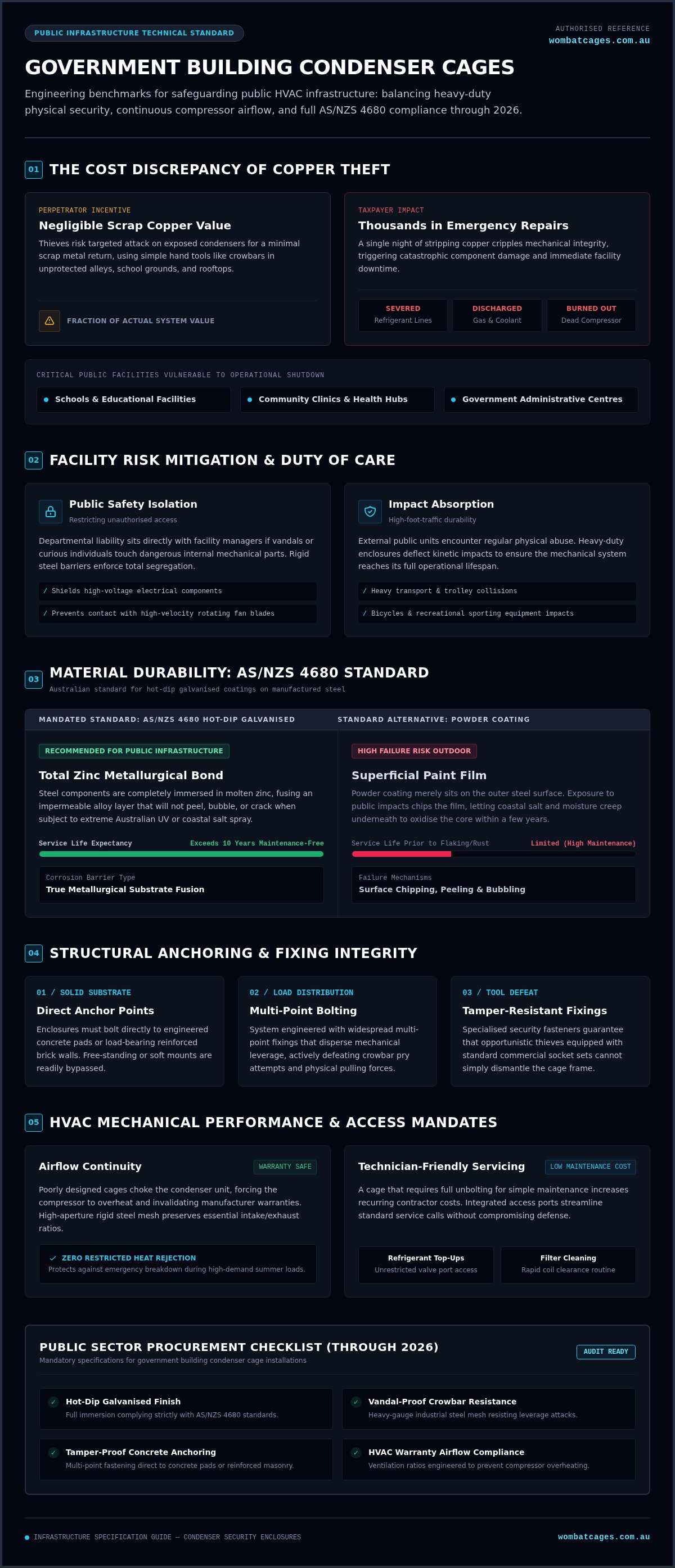
When thieves strip copper, they don't just take the metal. They destroy the mechanical integrity of the entire system. You're left with severed lines, leaked refrigerant, and a dead compressor. The material value of the stolen copper is tiny compared to the massive repair bill that follows. For schools, clinics, and administrative centres, this means operational downtime. Essential services stop. Staff and the public suffer in the heat. Implementing copper theft air conditioner prevention is a proactive financial strategy that protects your budget from these unpredictable spikes. It's a common-sense approach to asset management.
Risk Mitigation and Duty of Care
Facility managers have a responsibility to keep the public safe. Unsecured HVAC units pose a significant risk. High-voltage electrical components and fast-moving fan blades are dangerous. If a vandal or a curious member of the public gains access, the liability sits with the department. A rigid steel mesh cage creates a permanent physical barrier. It keeps unauthorised hands away from internal parts. It's a simple fix for a serious safety concern. You're not just protecting the machine. You're protecting people.
Public spaces see high foot traffic. Accidental damage from trolleys, bicycles, or sport equipment is common. A heavy-duty enclosure absorbs these impacts. It ensures the unit remains functional for its full service life. Durable protection is essential for long-term asset management. It's a one-time investment that prevents years of avoidable damage. Choosing a government building condenser cage Perth solution built from hot-dip galvanised steel provides the structural integrity needed for these high-exposure environments. It's built to last. It's built to defend.
Key Compliance Standards for Government Building Condenser Cages
Compliance isn't just about red tape. It's about building things right the first time. For any government building condenser cage Perth installation, meeting specific Australian Standards is mandatory. It ensures the enclosure can withstand both physical attacks and the local climate. Using the wrong materials or poor fixing methods leads to rusted metal and compromised security within a few years. It's a waste of public funds. You need a solution that stands up to scrutiny from both auditors and vandals.
AS/NZS 4680: The Gold Standard for Durability
Hot-dip galvanising is the only way to protect steel in Australian conditions. Unlike powder coating, which sits on the surface and chips easily, hot-dip galvanising involves dipping the entire cage into molten zinc. This process creates a metallurgical bond. It's far superior for outdoor HVAC security because it doesn't peel or bubble when exposed to harsh UV or coastal salt spray. A hot dip galvanised condenser cage provides a maintenance-free service life that often exceeds ten years. It's a "set and forget" solution for facility managers who don't have time for constant repairs.
Structural Anchoring Requirements
A security cage is only as strong as its connection to the ground. Structural integrity requires the cage to be bolted directly to solid surfaces like concrete pads or reinforced brick walls. We use multi-point bolting systems that spread the load and resist prying forces. Tamper-resistant fixings are essential here. They ensure that even if a thief brings a socket set, they can't simply unbolt the cage from the wall. For larger sites, consider federal energy management standards for government HVAC equipment to ensure that your security layout supports efficient asset operation and long-term stability. This is especially critical for multi-unit banks where weight and vibration are factors.
Local building codes often dictate how equipment enclosures should be designed. You need to balance security with visibility. Mesh aperture sizes must be small enough to block hands and tools but large enough for a technician to perform a visual inspection without opening the cage. This helps identify leaks or debris build-up early. When specifying a government building condenser cage Perth project, ensure the design allows for this transparency. If you're planning a site upgrade, you can explore professional cage installation services to ensure every unit meets these rigid compliance benchmarks. It's the best way to guarantee your security investment actually does its job.
Critical Design Features: Balancing Airflow with Maximum Security
Security shouldn't come at the cost of mechanical performance. A poorly designed enclosure can choke a condenser. High head pressure leads to component failure. A high-quality government building condenser cage Perth installation ensures the unit breathes properly while staying locked down. It's a balance of physical resistance and thermal management. You need a solution that stops a thief but allows the compressor to run at peak efficiency. This is critical for maintaining long-term reliability in public infrastructure.
The Importance of Free Area in Mesh Design
Manufacturers specify the required "free area" for airflow. If the mesh is too tight, heat builds up inside the enclosure. This "heat island" effect forces the fan to work harder. It wastes energy. It shortens the life of the motor. Using open mesh AC security cages maintains the original factory efficiency. It also keeps your manufacturer warranty intact. Most brands will refuse a repair claim if the unit failed due to restricted ventilation. We calculate the aperture size to ensure maximum security without compromising the air volume required by the machine.
Vandal-Proofing via Material Gauge
Vandal-proofing requires heavy-gauge steel. Standard garden fencing or thin aluminium screens are useless against determined intruders. They can be cut with basic handheld snips. We use rigid steel mesh that resists manual cutting tools and blunt force impact. The frame itself must be robust. A flimsy cage will rattle and create vibration noise that echoes through the building structure. A rigid, purpose-built frame stays silent and secure. It provides a level of permanence that lighter alternatives simply can't match.
Visual transparency is another functional requirement. Facility staff need to see the unit. They need to check for oil leaks, debris, or icing without unlocking the cage. This saves time during routine site walks. It's about practical asset management. You get total protection without losing sight of the equipment's condition. Every feature is designed to support the technician while keeping the asset safe from interference. It's an industrial solution for a serious problem.
Technician Access and Servicing Requirements for Secured Units
A security cage must protect the asset without obstructing the people who maintain it. Mechanical contractors charge by the hour. If a cage is difficult to open, maintenance costs skyrocket. A well-designed government building condenser cage Perth solution prioritises technician efficiency. It ensures that routine tasks like gas top-ups or coil cleans don't become major operations. Security and accessibility aren't mutually exclusive. They're both essential for long-term asset health. If the cage makes the job harder, it won't be used correctly.
Hinged doors are common but often problematic. They require a wide swing radius. In tight alleys or narrow plant decks, this space isn't always available. Hinges also represent a structural vulnerability. A heavy-duty pry bar can often snap a standard hinge or a padlock hasp. Removable panel systems are the superior choice for high-risk sites. They allow full access to any side of the unit. Once bolted back into place, the panel becomes part of the rigid structure again. It's a more secure way to manage access while maintaining a smaller footprint.
Designing for Maintenance Efficiency
Authorised personnel need to get in and out quickly. We use secure, multi-point fixings that technicians can manage with the right tools. Ensuring technician access to AC cages meets OHS requirements is a priority. There must be enough room for a person to stand and work safely. If a cage is too cramped, it creates a workplace hazard. Properly designed enclosures minimise downtime. They keep the service schedule on track and the facility running smoothly. It's about practical protection that works with your service team.
Multi-Unit Access Strategies
Large government facilities often have banks of multiple condensers. Managing access for these commercial settings requires a strategic layout. When planning a government building condenser cage Perth installation for a large site, individual panels for each unit are better than one large collective door. It allows a contractor to work on one machine while the others remain fully secured. Clearance zones are also vital. You need enough space for tool operation and manifold gauges. If you're managing a complex site with multiple assets, you can order multi-bay security cages to ensure every unit is protected and accessible. This approach keeps labour costs down and security levels high across the entire facility.
Procuring Heavy-Duty Security Enclosures for Public Infrastructure
Procurement for public assets requires a different mindset. You aren't just buying a metal box; you're investing in an asset protection strategy. Every site has a different risk profile. A school in a high-traffic area needs a different security rating than a fenced administrative compound. Identifying these specific needs early prevents overspending or, worse, under-protecting. A high-quality government building condenser cage Perth project relies on accurate site assessment and clear communication between the facility manager and the fabricator.
Site approval depends on transparency. Professional fabricators provide CAD drawings before a single piece of steel is cut. This allows project managers to verify clearances for technician access and ensure the enclosure won't clash with existing pipework. It's about getting the details right on paper first. When evaluating quotes, consider the total cost of ownership. The cheapest option often uses thinner mesh or inferior coatings. These units rust or fail under pressure, leading to expensive replacements. Long-term value comes from structural integrity and corrosion resistance.
Choosing between supply-only and supply and install packages is a critical decision. Supply-only suits departments with their own maintenance teams. However, professional installation services ensure the cage is bolted correctly to the substrate. An expert installer knows how to handle multi-point fixings and tamper-resistant hardware. They understand the nuances of the local environment. It's the most reliable way to ensure the cage performs as intended during an attempted theft.
Procurement Checklist for Facility Managers
Don't leave compliance to chance. Use a structured approach to verify the quality of your security assets. A robust checklist ensures every unit meets the required standards for public infrastructure. Focus on these three pillars:
- Galvanising Certification: Request proof of hot-dip galvanising to AS/NZS 4680. It's the only way to ensure 10 plus years of rust-free service.
- Mesh Specifications: Confirm the aperture size allows for the manufacturer's required airflow while maintaining a high security rating.
- Installer Experience: Ensure the team understands the specific government building condenser cage Perth requirements for public works and safety protocols.
Future-Proofing Your HVAC Security
HVAC technology changes. Your security should be able to adapt. Scalable designs allow for larger units to be installed in the future without replacing the entire cage. Selecting materials that withstand the Australian climate for decades is a common-sense move. It's about permanence. Partnering with a specialist for consistent security across multiple sites ensures a uniform standard of protection. You get a reliable result every time. It's the hallmark of professional asset management. You aren't just fixing a current problem; you're defending the facility for the next generation.
Defending Your Infrastructure for the Long Term
Securing public assets is a matter of common sense and structural integrity. You've seen how the right materials prevent copper theft while maintaining the critical airflow your HVAC units need to survive. It's about meeting AS/NZS 4680 standards for corrosion resistance and ensuring your service contractors can still do their jobs without a struggle. A permanent, hot-dip galvanised solution removes the vulnerability from your site. It protects the machine, the budget, and the public.
Choosing a government building condenser cage Perth specialist ensures your facility meets every compliance benchmark for 2026 and beyond. We are proudly Australian owned and operated. We provide industrial-grade protection that includes professional installation for total peace of mind. Don't wait for a costly breakdown to harden your site's defences. Take control of your asset management now. Request a custom quote for your government facility today and secure your infrastructure with a guardian that's built to last.
Frequently Asked Questions
What are the Australian Standards for AC security cages?
Security cages must meet AS/NZS 4680 for hot-dip galvanising to ensure long-term corrosion resistance in outdoor environments. While there isn't a single "AC cage" standard, the structural integrity of the steel mesh and the multi-point bolting systems must comply with general Australian building codes for equipment enclosures. This ensures the barrier is permanent and can withstand significant physical force without failing.
Will a security cage void my air conditioner’s manufacturer warranty?
A professionally designed cage won't void your manufacturer warranty. Problems only arise if the enclosure restricts airflow and causes the compressor to overheat. Our open mesh designs maintain the required "free area" specified by HVAC brands. By allowing the unit to breathe naturally, you protect the mechanical components and keep your warranty coverage intact while gaining a high level of physical security.
How do you ensure enough airflow for the condenser unit?
We ensure airflow by using a rigid, open steel mesh that does not restrict the fan's intake or exhaust. Every government building condenser cage Perth installation is checked against the unit's specific ventilation requirements. This prevents the "heat island" effect where warm air is trapped around the condenser. Proper spacing and aperture sizes allow the machine to operate at its original factory efficiency levels.
Can a security cage be installed on an existing AC unit?
Yes, security cages are frequently retrofitted to existing air conditioning units. The modular design of our frames allows them to be built around the condenser and bolted directly to the wall or concrete pad. This provides an immediate security upgrade for assets that were previously left exposed. It's a cost-effective way to harden your site without needing to replace or move your current HVAC equipment.
What is the best material for a long-lasting outdoor condenser cage?
Hot-dip galvanised steel is the superior material for outdoor security enclosures. Unlike powder-coated finishes or aluminium, galvanised steel undergoes a metallurgical process that bonds zinc to the metal. This makes it incredibly resistant to rust, UV damage, and physical impact. It's built to survive for over a decade in harsh conditions. Aluminium is often too soft and easily cut by thieves using basic hand tools.
How do technicians access the unit for repairs if it is caged?
Technicians access the unit through removable panel systems that are secured with multi-point fixings. These panels are designed for efficiency; they allow contractors to perform gas top-ups or filter cleans without dismantling the entire structure. This approach is often better than hinged doors in tight spaces. It ensures your service team has the required working room to operate tools safely while keeping the unit fully protected.
Are these cages effective at stopping professional copper thieves?
These cages are highly effective because they turn an easy target into a difficult one. Professional copper thieves look for quick opportunities. A rigid steel mesh cage bolted to the substrate requires heavy power tools and significant time to breach. Most intruders will abandon the site rather than risk detection. It provides a permanent physical barrier that standard brackets or plastic covers simply cannot match.
Can you secure multiple AC units in a single large cage?
When planning a government building condenser cage Perth layout, you can secure multiple AC units within a single large enclosure using multi-bay security cages. These custom-configured systems protect large banks of condensers while maintaining individual access points for maintenance. This collective approach is more cost-effective for public facilities. It creates a unified security perimeter that keeps your entire fleet of external HVAC assets safe from vandalism.


