
Your outdoor AC unit is a sitting duck for copper thieves and salt-air corrosion. Without a hot dip galvanised condenser cage, it's not a matter of if you'll face a massive repair bill, but when. Most property owners realise that insurance often falls short when copper piping is stripped or a unit is vandalised during a summer heatwave. It's a frustrating, expensive setback that stops your business or home cold. You need a solution that doesn't just slow down a thief but stops them entirely.
This guide shows you why hot-dip galvanised steel is the industry standard for permanent, set and forget protection. We'll explore how these heavy duty steel enclosures defend against theft, meet strict insurance requirements, and survive the harshest Australian weather without rusting away. You'll discover how the right cage keeps your airflow clear while ensuring your investment stays exactly where you bolted it. We'll also look at how compliance with international standards like ISO 1461:2022 ensures your protection lasts for decades. It's about moving from vulnerability to total protection through physical strength and proven durability.
Key Takeaways
- Understand why a metallurgical zinc bond is the only way to stop rust and corrosion from destroying your enclosure in harsh coastal or humid environments.
- Discover how a hot dip galvanised condenser cage acts as a hard physical barrier to deter copper thieves and prevent unit downtime.
- Learn how to maintain peak HVAC efficiency by using an open mesh design that ensures zero airflow restriction for your condenser unit.
- Identify the right configuration for your site, whether you need a single split system security cage or a multi-bay setup for commercial units.
- Realise why bolting directly to the concrete slab with professional fixings is essential for meeting insurance requirements and ensuring total security.
Why Your Outdoor Unit Needs a Hot-Dip Galvanised Condenser Cage
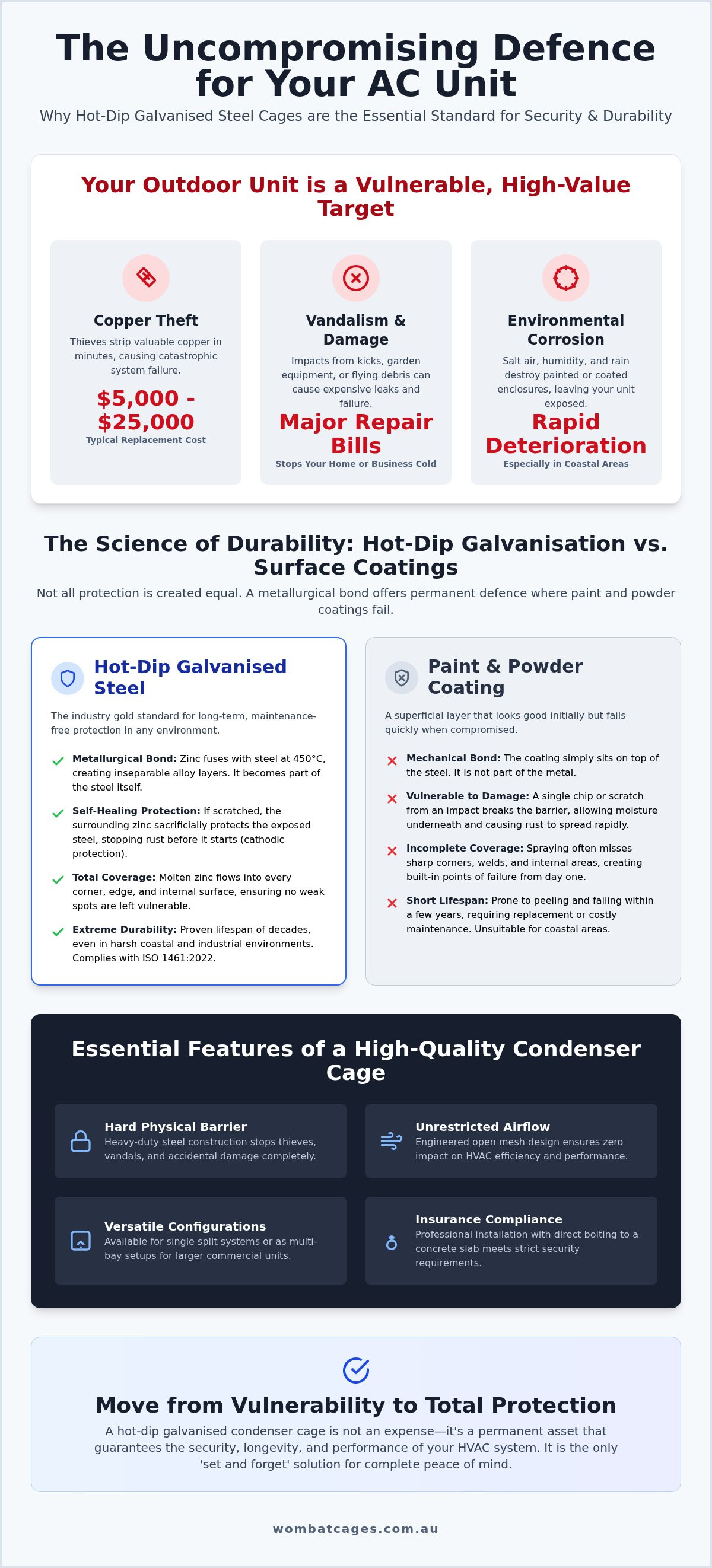
Your outdoor condenser unit is a high-value target sitting in plain sight. It contains expensive copper piping and sensitive components that are easy to access. Copper theft is a rising issue for Australian property owners. Thieves can strip a unit in minutes, leaving you with a useless piece of scrap. A hot dip galvanised condenser cage is a heavy-duty steel enclosure designed to shield HVAC equipment. It provides a physical barrier that stops opportunistic thieves before they can touch your system. This 'Guardian' approach is the only definitive way to secure your assets. Visual deterrents like signs or lights don't work on determined criminals. You need steel.
Vandalism and accidental damage are just as dangerous as theft. A single kick or a heavy impact can lead to expensive refrigerant leaks and compressor failure. Repairing these issues often costs nearly as much as a new installation. By installing a robust barrier, you move from a position of vulnerability to total protection. It is a pragmatic choice for anyone who values long-term resilience and functional value.
The Reality of Copper Theft in Australia
Thieves target AC units because copper has a high scrap value. They don't care about the damage they cause. Stripping the piping often leads to catastrophic system failure. The hidden cost of theft is much higher than just the metal lost. You have to pay for replacement units, specialist labour, and the cost of business downtime during a heatwave. Industry data shows replacement costs for damaged HVAC units can range from $5,000 to $25,000. A hot dip galvanised condenser cage is the ultimate solution to avoid these expenses. It makes the unit too difficult to harvest, forcing thieves to move on to easier targets.
Protection Beyond Security
Security isn't the only benefit. These cages shield units from stray balls, garden equipment, and accidental impact. Mowers and whipper-snippers often kick up rocks that pierce delicate cooling fins. A rigid steel mesh design stops this damage instantly. It also helps prevent debris build-up by maintaining a clear zone around the unit. Well-protected HVAC systems keep your property value high and your cooling reliable. Understanding the process of hot-dip galvanization helps you see why these cages last so long. The zinc coating becomes part of the steel itself. It won't chip or peel when hit by a football or a stray stone. This makes the cage a permanent, maintenance-free part of your building's defence. Whether you need a single split system security cage or multi-bay security cages for a commercial site, the protection remains the same.
The Science of Durability: Why Hot-Dip Galvanisation Wins
Durability isn't about how a cage looks on day one. It's about how it performs after ten years in the sun and rain. A hot dip galvanised condenser cage doesn't rely on a surface layer of paint. It relies on a metallurgical reaction. During the hot-dip galvanizing process, clean steel is submerged in a bath of molten zinc at roughly 450°C. This creates a series of zinc-iron alloy layers. The zinc doesn't just sit on top. It becomes part of the steel itself. This chemical bond is far stronger than any mechanical bond found in paint or powder coating. If the surface is scratched, the surrounding zinc protects the exposed steel through cathodic protection. It's a self-healing shield. This process ensures the structural integrity of the cage remains intact even under heavy use.
Galvanising vs. Powder Coating
Many enclosures use powder-coated aluminium or painted mild steel. These materials look good initially but often fail in high-UV environments. Powder coating can chip and peel. Once the barrier is broken, rust spreads rapidly underneath the surface. Hot-dip galvanisation provides total coverage. The molten zinc flows into every corner and covers the inside of hollow sections. This ensures no part of the steel is left vulnerable. You can expect a lifespan of decades in typical Australian weather. It's a set and forget solution for property owners who value permanence. Choosing a high-quality hot dip galvanised condenser cage ensures your HVAC system remains defended without the need for constant upkeep.
Corrosion Resistance in Harsh Climates
Salt air and high humidity are the primary enemies of metal. For coastal properties, standard enclosures often fail within a few years. Galvanised steel remains the gold standard for these environments. It resists the corrosive effects of salt spray and constant moisture. You won't need to worry about repainting or applying rust treatments. This maintenance-free security is essential for busy commercial sites and residential apartments. It provides peace of mind through physical strength. The heavy-duty nature of the material means it handles the weight and pressure of the elements without buckling. It is the most practical way to secure your investment against the elements. This level of protection is why industry professionals insist on hot-dip galvanised steel for outdoor assets.
Balancing Security with HVAC Performance and Airflow
HVAC technicians often view security enclosures with suspicion. They've seen too many units fail due to poor ventilation. A hot dip galvanised condenser cage must do more than just stop thieves. It has to let the machine breathe. Choking the air intake makes the compressor work harder. It consumes more power. It eventually burns out. Maintaining the 'Service Zone' is not optional. It's a fundamental requirement for heat exchange efficiency. You need a barrier that balances physical strength with thermal performance. A well-designed enclosure protects the unit without sacrificing its operational lifespan.
Technicians need room to work. A cage that's too tight against the unit makes it impossible to access the electrical panels or the valve ports. We recommend a specific clearance between the condenser and the mesh wall. This gap serves two purposes. It allows for tools to be used effectively. It also creates a buffer zone that prevents heat build-up during peak Australian summer days. A rigid steel mesh design won't sag or bend inward over time. It maintains that critical gap for the life of the unit. This ensures the fans can pull in cool air and exhaust heat without resistance.
The 25mm Mesh Standard
The industry standard for these barriers is a 25mm x 25mm open mesh. This spacing is small enough to block hands and heavy tools. It stays large enough to ensure zero airflow restriction. Using solid or decorative covers is a mistake. It leads to 'short-cycling'. This happens when hot exhaust air is trapped and pulled back into the intake. The unit overheats. The compressor dies. The 25mm x 25mm steel mesh provides the ideal balance between high-security physical protection and maximum air movement for the compressor.
Serviceability and Access Panels
Security shouldn't hinder maintenance. If a contractor has to dismantle the entire frame for a simple service, you pay more. Lockable front panels are essential for site contractors. Wombat Cages designs ensure that technician access and servicing caged AC units remains straightforward. This keeps you in compliance with manufacturer warranties. Most brands require units to operate within specific temperature ranges. A well-designed hot dip galvanised condenser cage ensures these parameters are met. It protects your hardware and your coverage. It allows for a 'set and forget' approach to security that doesn't create new mechanical problems.
Configuring Your Cage: Single Units vs. Multi-Bay Systems
Protecting your HVAC asset starts with the right configuration. A cage that doesn't fit properly is a security risk. It also creates mechanical issues. Most residential properties rely on a single split system security cage. Commercial sites often have banks of compressors that require a different approach. You must consider height, width, and depth for every installation. Sizing your hot dip galvanised condenser cage correctly ensures the physical barrier is effective. It keeps the unit secure without interfering with the pipework or electrical conduits. Customisation ensures that the enclosure doesn't just protect the unit but also fits the aesthetic and structural requirements of the building.
Every HVAC brand has different dimensions. Some units are taller and thinner; others are squat and deep. You cannot use a one size fits all approach for high-security environments. A precise fit makes it harder for thieves to use pry bars or cutting tools. It also ensures the cage remains rigid and doesn't vibrate against the unit during operation. This level of detail is essential for maintaining a professional appearance on your property.
Securing the Single Split System
Modern homes and apartments usually have one or two condensers. These units are often mounted on the ground or fixed to external walls. A single split system security cage provides a snug, safe fit for these domestic models. You need to account for the mounting height. Wall-mounted units require cages with specific base configurations to clear the brackets. Ground-level slabs allow for a standard four-sided enclosure bolted directly to the concrete. This prevents the entire unit from being lifted or moved. For more detailed advice on protecting domestic units, read The ultimate guide to split system security.
Commercial Multi-Bay Solutions
Shopping centres and office blocks present a different challenge. They often feature long rows of side-by-side units on rooftops or in service alleys. Multi-bay security cages are the standard solution here. These systems create a unified enclosure for multiple compressors. They maintain structural integrity over long distances using internal support frames. This prevents the mesh from bowing or weakening at the centre points. It is a more efficient and cost-effective way to secure a commercial HVAC plant. You can learn more in our Commercial buying guide for multi-unit cages. If you need to secure a complex site, you can view our range of multi-bay security cages to find the right fit for your project.
Professional Installation: Securing the Barrier to the Property
A cage is only as strong as its fixings. You can have the toughest steel in the world, but if it's held on by standard screws, a thief will just rip it off. Professional installation ensures the barrier stays put. It's about creating a permanent fixture. We focus on rigid, purpose-built solutions. Every hot dip galvanised condenser cage we install is treated as a critical security asset. It's not just a cover. It's a structural defence. Bolting to the slab or tying into the building's structure provides the maximum resistance needed to stop a determined intruder.
Wall-mount security requires even more precision. You have to tie the cage into the building's structure without compromising the wall's integrity. This ensures the cage can't be pulled away from the facade. Our process is no-nonsense. We use heavy-duty masonry anchors to prevent the cage from being lifted. This creates a secure environment for your HVAC equipment. It moves your property from a state of vulnerability to total protection.
Masonry Anchors and Tamper-Proof Fixings
Standard screws aren't enough for high-value asset protection. We use industrial-grade bolts that expand inside the concrete. They make it nearly impossible to lift the enclosure. We also focus on preventing the 'lever effect'. This is where a thief uses a crowbar to pry the frame away from the wall. By using multiple anchor points and a 40mm angle iron backbone, we eliminate these weak spots. The frame provides the necessary stiffness. It resists bending and keeps the mesh taut under pressure. It's a masterclass in essential niche security.
DIY vs. Professional Install
DIY might seem like a way to save money. It often leads to trouble. One wrong drill hole can puncture a refrigerant line. That's a massive repair bill you didn't plan for. You might also damage the building's wall cladding. This leads to water leaks and structural issues. Professional cage installation services handle these risks for you. We know where the lines run. We get the unit secured in a single visit. It's about speed and efficiency. You get peace of mind knowing the job's done right the first time. For more tips on avoiding these pitfalls, check out our guide on how to protect your AC unit from accidental damage. It's a common-sense approach to long-term resilience.
Secure Your HVAC Investment for the Long Term
Protecting your air conditioning system is about more than just a metal box. It's about keeping your site operational when the heat hits. You've seen why hot-dip galvanisation is the only process that creates a permanent, self-healing bond against the Australian climate. You also know that the 25mm mesh standard keeps your unit breathing while stopping thieves from stripping your copper. Investing in a hot dip galvanised condenser cage provides a 'set and forget' security solution that meets insurance requirements.
Our custom-built enclosures feature heavy-duty 40mm angle iron frames. They are hot-dip galvanised for 20+ year durability. Whether you need protection for a single unit or a commercial multi-bay setup, professional installation makes the difference. Don't wait for a theft to realise you're vulnerable. Secure your HVAC assets today with a quote from Wombat Cages and get the peace of mind you deserve. Your equipment is built to last. Your security should be too.
Frequently Asked Questions
Will a hot-dip galvanised cage make my air conditioner rust?
No, a hot dip galvanised condenser cage actually prevents rust from spreading to your unit. The zinc coating is metallurgical, meaning it's bonded to the steel. It won't flake or peel like standard paint. This barrier stops moisture and salt air from reaching the steel frame. Your AC unit's cabinet is made of different materials, but the cage acts as a tough first line of defence against environmental corrosion for decades.
Can a security cage void my air conditioner's warranty?
Not if it's designed and installed correctly. Most manufacturers require specific airflow clearances to maintain the warranty. Our cages use a 25mm open mesh that ensures zero airflow restriction. As long as the technician can still access the service panels and the unit doesn't overheat, your warranty remains intact. Always check your specific brand's manual for their required clearance distances before you commit to an installation.
How much space should be left between the unit and the cage for airflow?
You should generally leave at least 100mm to 150mm of clearance on all sides. This space ensures the fan can pull in enough air and exhaust heat efficiently. If the hot dip galvanised condenser cage is too tight, you risk short-cycling the compressor. This leads to higher power bills and mechanical failure. We size every enclosure to match manufacturer specifications, keeping your system running at peak performance and efficiency.
Are these cages effective against professional copper thieves?
Yes, they are a highly effective deterrent. Professional thieves look for quick and easy targets. Cutting through heavy-duty steel mesh and 40mm angle iron takes time and noisy power tools. Most criminals won't risk the extra exposure. By bolting the frame directly to the concrete slab, you eliminate the possibility of someone simply lifting the unit. It turns a five-minute theft into a major, noisy construction project.
Can I still have my AC unit serviced if it is inside a cage?
Absolutely. We design our enclosures with technician access in mind. Lockable front or side panels allow contractors to reach electrical components and gas valves without removing the entire structure. This saves you money on labour costs during routine maintenance. It's a practical solution that provides security without creating a headache for your HVAC specialist. They can perform all standard checks while the unit remains protected and secure.
What is the difference between hot-dip galvanised and cold galvanised steel?
Hot-dip galvanising involves submerging the steel in 450°C molten zinc to create a permanent chemical bond. Cold galvanising is essentially just applying zinc-rich paint to the surface. The hot-dip process provides much thicker protection and covers the inside of hollow tubes. It's far more durable in the Australian sun. Cold galvanising is prone to scratching and peeling, which leads to rapid rust and structural failure in coastal areas.
Do I need council approval to install a condenser cage on my property?
Generally, you don't need council approval for a standard security cage on a private residential or commercial property. These are considered minor building works or equipment protection. However, if your building is heritage-listed or in a strictly regulated strata scheme, you should check your specific bylaws first. Most strata managers approve them quickly because they protect common property assets and reduce the risk of expensive and annoying insurance claims.
How are the cages secured to the ground or wall?
We use industrial-grade masonry anchors to fix the frame directly to concrete slabs or brick walls. These bolts expand inside the material, making them incredibly difficult to remove without specialised equipment. For wall-mounted units, we tie the cage into the building's structural points. This prevents the 'lever effect' where a thief might try to pry the enclosure away. It's a rigid, permanent fixing method built for maximum resistance.


