
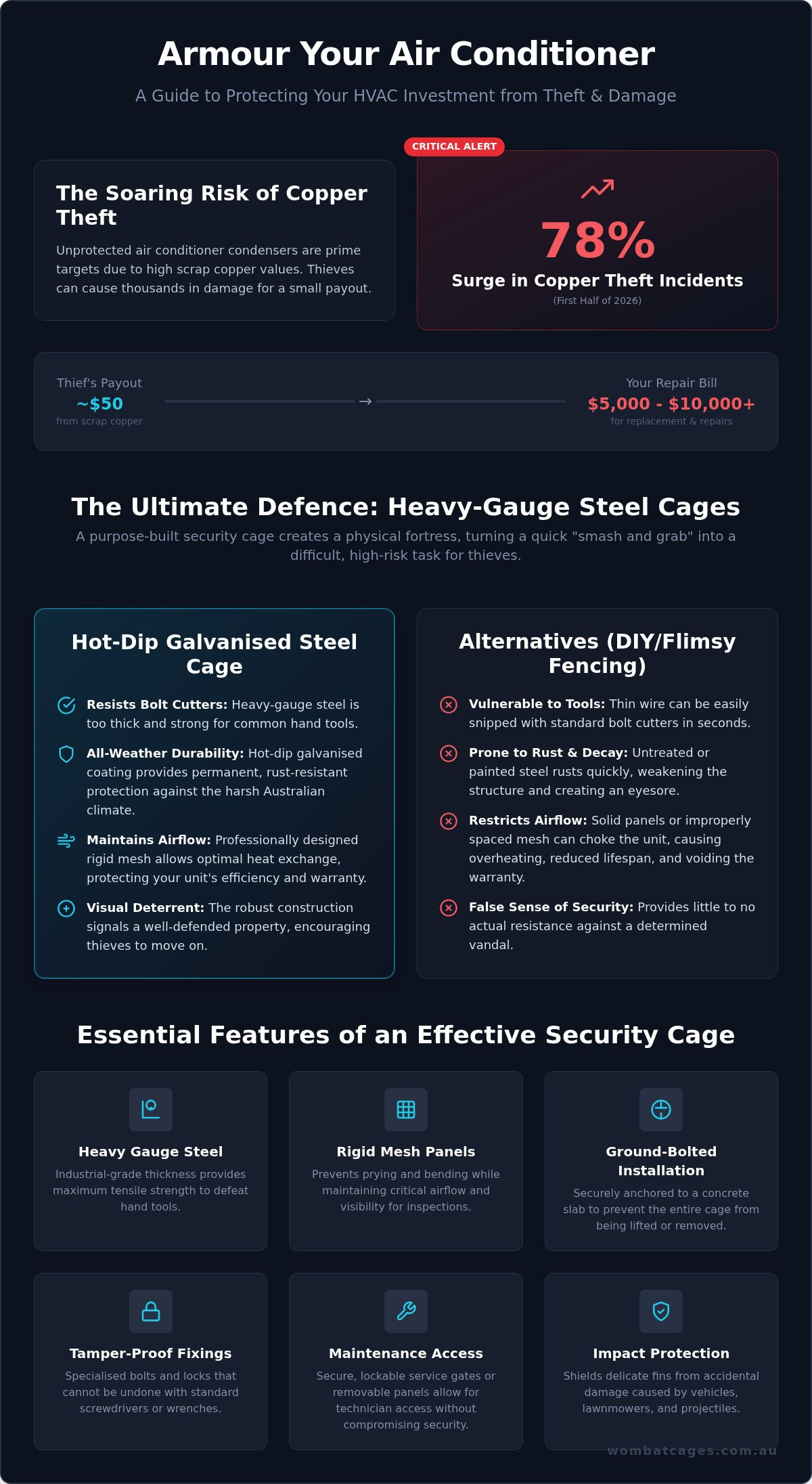
Did you know that copper theft incidents surged by 78 per cent in the first half of 2026? It's a staggering figure that highlights a growing threat to property owners. You've likely felt that knot in your stomach when hearing about local vandals or the latest scrap metal raid. It's frustrating to think a few dollars' worth of copper could lead to a five-figure repair bill. Installing a custom air conditioner security cage is the smartest way to stop thieves before they even touch your outdoor unit.
Heavy gauge steel is the gold standard for resisting both bolt cutters and the harsh Australian climate. You need protection, but you don't want to choke your unit's airflow or void your manufacturer's warranty. This guide explains why hot-dip galvanised steel provides total peace of mind without compromising your system's performance. We will cover everything from material durability to the importance of secure, ground-bolted installation for maximum defence. Discover how to armour your investment against the elements and opportunists alike.
Key Takeaways
- Understand why skyrocketing copper values have turned unprotected condensers into high-priority targets for thieves.
- Learn how the thickness of heavy gauge steel creates a physical time barrier that discourages even the most determined vandals.
- Discover how a custom air conditioner security cage maintains essential airflow to keep your unit running within warranty specifications.
- Identify why hot-dip galvanised steel is the superior choice for permanent, rust-resistant protection in any Australian environment.
- Evaluate whether single split system enclosures or multi-bay configurations offer the best security for your specific site layout.
Why Outdoor AC Units Are Targets for Theft and Vandalism
Outdoor condensers are essentially cash boxes sitting on the side of your building. Thieves don't see a sophisticated cooling system. They see high-grade scrap copper. With copper prices reaching approximately $6.00 per pound on global exchanges in early 2026, the incentive for theft has never been higher. A thief can strip a unit in minutes. They leave you with thousands of dollars in damage for a relatively small payout at the scrap yard. This isn't just about the metal. The theft of components from an Air conditioning system often results in total refrigerant loss and electrical damage. These repair bills often exceed the cost of the original unit.
The Mechanics of Copper Theft
Thieves use basic tools like battery-powered reciprocating saws and bolt cutters. Most standard brackets are flimsy. They offer zero resistance against a determined criminal. A "smash and grab" operation is fast. It's often over before a security patrol or neighbour notices anything is wrong. Because condensers are located outside for heat exchange, they're exposed and easy to access. Without a custom air conditioner security cage, your unit relies on luck rather than physical defence. Thieves target the copper coils and tubing because they're easy to rip out once the outer casing is breached. The speed of these attacks makes traditional alarms less effective than a solid physical barrier.
Beyond Theft: Protecting from Accidental Damage
Theft isn't the only risk to your HVAC investment. In high-traffic areas or commercial sites, physical impact is a constant threat. Stray projectiles, reversing vehicles, or heavy-duty lawnmowers can easily crush the delicate aluminium fins. Once those fins are bent, your unit's efficiency drops. The compressor works harder to compensate, which leads to a shorter lifespan. A custom air conditioner security cage provides a rigid shield against these everyday hazards. It maintains the structural integrity of the unit. This protection is vital in shared spaces where you can't control who has access to the area around your condenser. It's about turning a vulnerable asset into a hardened, permanent fixture.
Defining the Heavy Gauge Steel Condenser Cage
Heavy gauge steel is the backbone of serious HVAC protection. It isn't just about adding a fence around your unit. It's about creating a structural fortress. When you invest in a custom air conditioner security cage, you're buying time. A thief's entire strategy relies on speed. They want to be in and out in under three minutes. Thick steel panels and reinforced frames disrupt that timeline. This material is the industry standard for high-risk environments because it resists the basic hand tools most vandals carry. It turns a quick payday into a difficult, noisy, and high-risk chore for any criminal.
The build quality matters as much as the material itself. A professional enclosure consists of a heavy-duty frame, rigid mesh panels, and tamper-proof fixings. These components work together to distribute force. If a thief tries to pry one corner, the entire structure holds firm. This level of security is especially critical if you need to protect a vacant commercial property where units are left unattended for long periods. A solid cage doesn't just stop theft; it sends a clear message that the property is actively defended.
Gauge Thickness and Tensile Strength
In Australia, gauge measurement refers to the thickness of the steel, where a lower number indicates a thicker and stronger material. Standard wire mesh used in garden fencing is often too thin to stop a pair of hardware-store bolt cutters. Industrial-grade heavy gauge steel has much higher tensile strength. It requires significant force or specialised power tools to breach. This thickness makes it nearly impossible for a thief to "snip" their way into the unit. By choosing a custom air conditioner security cage made from heavy-duty steel, you're ensuring the barrier is as tough as the surface it's bolted to.
The Importance of a Rigid Mesh Design
Rigid mesh is the key to balancing security with functionality. It provides a solid physical barrier while allowing you to see the unit for quick inspections. This design prevents thieves from inserting long pry bars or saws through the gaps. Unlike flexible chain-link options, rigid steel mesh won't bend or warp under pressure. It stays taut and maintains its shape even if someone tries to kick or climb it. This rigidity also acts as a powerful visual deterrent. Most opportunists will see the heavy-duty construction and move on to an easier target. If you're unsure which configuration fits your site, you can explore different cage styles to find the right balance of strength and visibility.
Galvanised Steel vs. Alternative Enclosures
Choosing the right material is the difference between a decorative screen and a genuine security barrier. Many property owners consider aluminium because it's light and easy to handle. In a high-security HVAC application, weight and density are your best friends. Aluminium is a soft metal. It offers very little resistance to a pair of heavy-duty bolt cutters or a cordless saw. A custom air conditioner security cage must be built from heavy gauge steel to provide the necessary impact resistance. Steel doesn't just sit there. It fights back against physical force and attempted breaches.
Maintenance is another critical factor for outdoor assets. Powder-coated alternatives might look good on day one, but they rely on a thin plastic film for protection. Once that film is scratched or chipped, moisture gets underneath. Rust then spreads unseen until the structure is compromised. Galvanised steel handles the Australian environment differently. It provides a permanent solution that doesn't require constant repainting or touch-ups over the 15 to 20 year lifespan of your condenser unit.
The Hot-Dip Galvanising Process
Hot-dip galvanisation isn't just a coat of paint. It's a chemical reaction that creates a metallurgical bond between the zinc and the steel. During this process, the steel panels are submerged in molten zinc at approximately 450 degrees Celsius. This creates a multi-layered shield that's far tougher than any spray-on finish. One of the most practical benefits is its self-healing property. If a thief scratches the cage while trying to break in, the surrounding zinc sacrifice itself to protect the exposed steel. This prevents rust from taking hold in coastal or high-humidity areas where salt air usually destroys metal in months.
Steel vs. Aluminium: A Security Comparison
Weight is a primary security feature for ground-mounted enclosures. A heavy gauge steel cage is significantly harder to lever or dislodge from its fixings than a lightweight aluminium version. This mass provides superior impact resistance. If a vehicle or heavy piece of equipment accidentally strikes the cage, the steel structure is likely to hold its shape. Aluminium often buckles or shears under the same pressure. While the initial cost of steel might be higher, its durability makes it the most cost-effective choice over the long term. You aren't just buying a cage. You're buying a permanent defence that won't need replacing every few years due to wear or vandalism. A custom air conditioner security cage made from hot-dip galvanised steel is a "fit and forget" solution for serious property protection.
Key Features for Maintaining HVAC Efficiency and Access
A security cage is useless if it causes your air conditioner to overheat. High-performance HVAC units need to breathe. Restricting airflow increases static pressure. This forces the fan motor to work harder. It wastes electricity. It eventually burns out the compressor. A well-designed custom air conditioner security cage balances maximum protection with unrestricted ventilation. It ensures your unit operates within the manufacturer's thermal specifications while remaining "armoured" against outside threats. Proper airflow isn't just about performance. It's about protecting your warranty.
Optimising Airflow with Open Mesh
Solid panels or decorative louvres are risky for your AC. They often cause air recirculation. This is where hot exhaust air is sucked back into the intake. It makes the unit think it's 50 degrees outside when it's only 30. Open mesh is the only professional solution. The aperture size must be large enough to allow free air movement but small enough to block tools. Most standard split systems require at least 100mm to 200mm of clearance from the wall and the cage panels. This ensures the heat exchange process stays efficient during a scorching Australian summer. Rigid mesh provides the transparency needed to check the unit's condition without removing the entire structure.
Serviceability and Technician Access
Your HVAC technician needs to get in and out quickly for annual maintenance. If a cage is permanently welded shut, they'll charge you extra for the time spent bypassing it. Professional cages feature removable panels or dedicated access points. Front-side or multi-side access is non-negotiable for most tradies. They need to check refrigerant levels, clean coils, and inspect electrical connections. Secure the cage with heavy-duty fixings that are tamper-resistant but accessible with the right professional tools. This keeps the unit serviceable without compromising security. It's a pragmatic approach that satisfies both the property owner and the service contractor.
The foundation is just as important as the steel. Bolting the structure to solid brickwork or a thick concrete pad ensures it can't be tipped or dragged. This rigid mounting also helps you learn how to protect your AC unit from accidental damage by creating a fixed perimeter. It stops the unit from shifting during high winds or accidental impacts from gardening equipment. If you're managing a commercial site with multiple units, you can view our multi-bay security cages to protect your entire HVAC investment in one go.
Implementing a Long-Term Security Strategy for Your Property
Security isn't a one-size-fits-all job. You need to assess your property's specific risk level. A residential unit in a quiet street faces different threats than a commercial condenser in a secluded alleyway. High-traffic areas and vacant sites are primary targets. Choosing a custom air conditioner security cage is about matching the defence to the threat. For homeowners, it's about stopping opportunistic vandals. For business owners, it's about protecting critical infrastructure that keeps the doors open. It's a pragmatic investment in permanence.
Commercial Multi-Unit Protection
Large sites often have banks of condensers grouped together. This creates a "honey pot" for copper thieves. One breach can disable an entire office floor or apartment complex. You need a solution that scales. Multi-bay cages allow you to secure multiple units under a single, continuous perimeter. This is more efficient than individual cages. It reduces the number of vulnerable edges. If you're managing a large facility, consult our multi-unit AC security cage guide for a deep dive into commercial requirements. You can add more bays as your HVAC infrastructure grows over time. It's a modular approach to asset protection.
Insurance and Risk Mitigation
Insurance companies value proactive protection. A heavy-duty security cage acts as a physical "best practice" for risk managers by demonstrating a clear, documented commitment to loss prevention. It shows you've taken reasonable steps to defend your property. This can be a deciding factor during a claim process. If a unit is stolen while unprotected, you're on the hook for the full excess and the service downtime. Prevention is always cheaper than a payout. Read our AC theft insurance claims guide to understand how physical barriers protect your bottom line. Reducing the likelihood of a claim keeps your premiums stable. It avoids the "excess" payments that eat into your maintenance budget.
The final step in your strategy is the installation. You might be tempted by a DIY flatpack to save a few dollars. Real security depends on how the cage is fixed to the ground. A professional installation ensures the cage is bolted deep into concrete or brickwork using tamper-proof hardware. This prevents thieves from simply lifting the entire structure away. If the cage isn't fixed properly, it's just a handle for a thief. A professional custom air conditioner security cage setup gives you the confidence that your asset is truly armoured. It's about building things that last and staying one step ahead of the scrap metal market.
Secure Your HVAC Investment for the Long Term
Protecting your property shouldn't be a temporary fix. Rising copper values and opportunistic vandals turn unprotected units into easy targets. A custom air conditioner security cage built from heavy-duty hot-dip galvanised steel provides the definitive physical barrier you need. It's about combining structural strength with the airflow required to keep your system running efficiently through every Australian summer.
Investing in a solution designed for local conditions means choosing a "fit and forget" defence. Whether you need to secure a single split system or a large commercial bank, industrial-grade materials make the difference. We offer national delivery and installation support to ensure your assets are truly armoured. Don't wait for a costly repair bill to find out your security is insufficient. Take control of your property's safety today.
Request a custom quote for your heavy gauge steel condenser cage today and get the peace of mind that comes with total protection. It's time to harden your targets and secure your future.
Frequently Asked Questions
Will a heavy gauge steel cage void my air conditioner warranty?
No, a cage won't void your warranty if it follows the manufacturer's airflow guidelines. Most brands require specific clearances to prevent overheating. Our rigid mesh designs ensure the unit breathes properly while staying protected. You should always consult your installer to confirm the cage doesn't interfere with the unit's operation. A professionally installed barrier actually protects the warranty by preventing physical damage to the delicate internal components and coils.
Do I need a different cage for a wall-mounted unit versus a ground unit?
Yes, the mounting style changes based on the unit's location. Ground units are typically bolted directly into a concrete pad or brickwork for maximum stability. Wall-mounted units require a cage that integrates with the existing brackets or anchors firmly to the external wall. Both styles must provide enough room for technician access. The enclosure can be tailored to suit either configuration, ensuring the unit remains immovable and safe from any attempted theft.
How much clearance does a condenser need inside a security cage for airflow?
Most manufacturers recommend a minimum clearance of 100mm to 200mm on all sides. This space prevents air recirculation and allows the heat exchange process to function correctly. If the cage is too tight, the compressor will overwork and fail prematurely. A custom air conditioner security cage is built to maintain these critical gaps. Always check your specific unit's manual to ensure the enclosure meets the required ventilation standards for your particular HVAC model.
Can a thief still cut through a hot-dip galvanised steel cage?
Heavy gauge steel is extremely difficult to breach with standard hand tools. A thief would need heavy-duty power saws and a lot of time to cut through the mesh and frame. The noise and effort required act as a powerful deterrent. Most criminals will see the hot-dip galvanised steel and move to an easier, unprotected target. It turns a three-minute theft into a major operation that they simply don't want to risk.
How often should I check the fixings on my AC security cage?
We recommend inspecting your cage fixings every six to twelve months. Check that the ground or wall bolts remain tight and haven't been tampered with. Vibrations from the condenser can occasionally loosen standard hardware over several years. Look for any signs of attempted forced entry or surface scratches that might need attention. Regular maintenance ensures the structure remains rigid and continues to provide the highest level of security for your outdoor equipment.
Is a custom-built cage better than a standard-sized flatpack?
Custom cages are significantly more secure than adjustable flatpacks. A custom air conditioner security cage is fabricated to the exact dimensions of your unit, which eliminates weak points and sliding joints. Flatpacks often use thinner materials to keep shipping costs down, making them easier to bend or cut. A custom solution provides a tighter fit and a more robust frame. It is a permanent defence built specifically for your property's unique layout.
Does a steel cage make the air conditioner noisier during operation?
A properly installed cage will not increase operating noise. If the cage is bolted securely to a solid base, it won't rattle or vibrate. We use rigid steel mesh that doesn't catch the wind or hum during unit operation. If you notice any noise, it's usually a sign that a fixing has loosened and needs tightening. Using rubber washers during the installation process can further isolate any minor vibrations from the HVAC unit itself.
What is the difference between powder coating and hot-dip galvanising?
Powder coating is a decorative layer of plastic-based paint that can chip and peel over time. Hot-dip galvanising involves dipping the steel into molten zinc to create a permanent metallurgical bond. This zinc layer sacrifices itself to prevent rust, even if the surface gets scratched by a thief. It's the only choice for the Australian climate. Galvanised steel offers decades of protection without the need for constant maintenance or repainting in coastal areas.


