
You step outside on a sweltering 40-degree afternoon and find nothing but severed copper pipes where your outdoor condenser used to be. It's a gut-wrenching discovery that many Australian property owners now face. Copper theft across Australia has seen alarming increases in recent years. This financial headache often leads owners to search for an air conditioner cage insurance discount to offset rising costs. You're forced to choose between a high insurance excess or the fear of your premiums skyrocketing after a single incident.
We understand the frustration of feeling vulnerable. You shouldn't have to pay the price for someone else's greed. This guide walks you through the essential steps for a successful insurance claim while exploring how proactive security measures can help manage your long-term costs. We'll show you why a physical barrier is your most reliable defence against rising premiums and repeat offences.
We'll cover everything from documenting the theft for your assessor to choosing the right security measures. You'll learn how a hot-dip galvanised steel cage, like those from Wombat Cages, provides the permanent protection you need. It's time to stop the cycle of theft and secure your property with a solution that's as tough as the Australian climate.
Key Takeaways
- Document the theft site immediately and obtain a police report number. These are the mandatory first steps for any successful claim.
- Compare your insurance excess against the potential loss of your no-claims bonus. One claim can reset your status and increase your premiums for years.
- Ask your provider about an air conditioner cage insurance discount. Many Australian insurers offer reduced premiums for properties with high-quality security systems.
- Choose hot-dip galvanised steel over flimsy aluminium alternatives. Heavy-duty metal provides a rigid barrier that resists saws and bolt cutters.
- Ensure your security cage allows for easy servicing. This prevents insurers from blaming the protection for any future mechanical failures or efficiency drops.
Understanding Air Conditioner Copper Theft in Australia
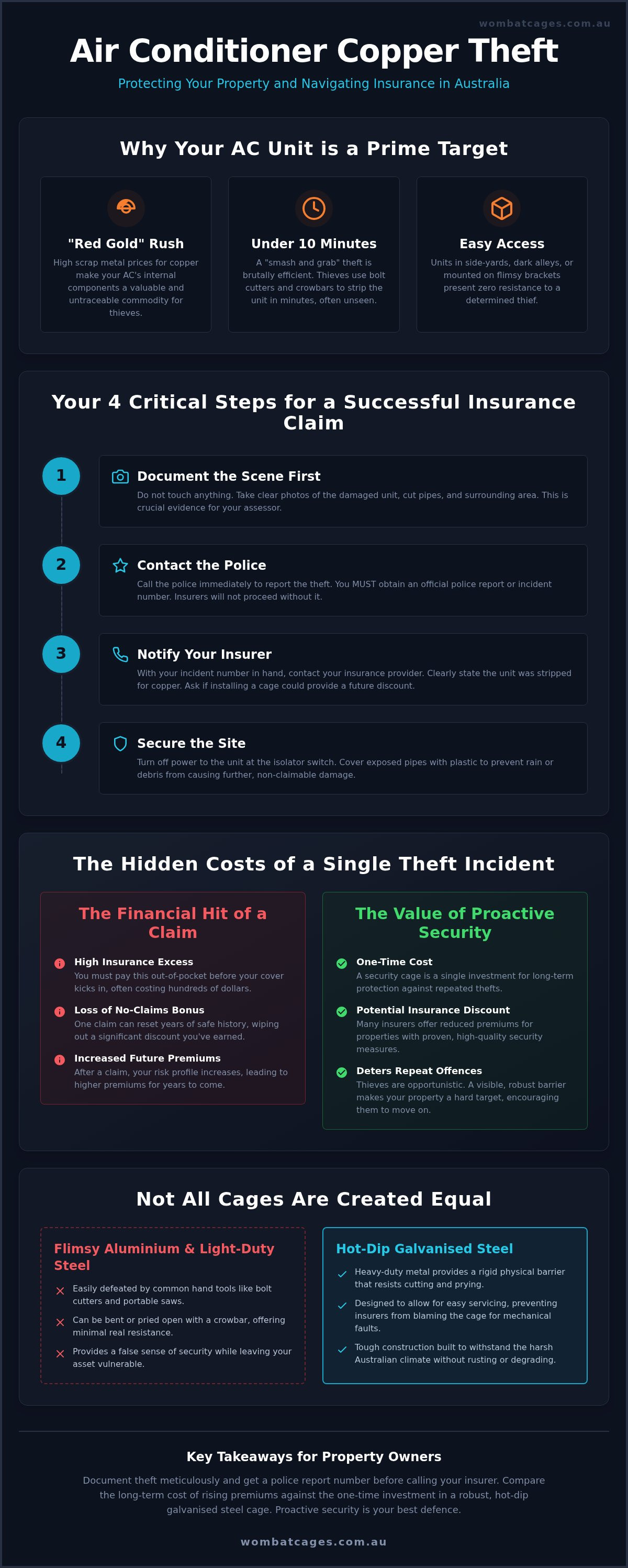
Copper theft isn't just a nuisance; it's a calculated criminal enterprise. High scrap metal prices in the Australian market have turned outdoor air conditioning units into easy targets for opportunistic thieves. This problem is part of a global issue of metal theft that costs property owners millions of dollars every year. Thieves aren't looking for the whole unit. They want the "red gold" hidden inside. Copper remains a high-value commodity because it's easy to melt down and difficult to trace once it reaches a scrap yard.
Most property owners don't realise how fast these crimes occur. A "smash and grab" theft usually takes less than ten minutes. Thieves don't use finesse. They use bolt cutters and crowbars to rip open the casing and snip the internal lines. This vulnerability is why many savvy owners look for an air conditioner cage insurance discount to justify the cost of proper security. Without a physical barrier, your expensive cooling system is essentially an unsecured cash box sitting on your exterior wall.
Vulnerability often stems from standard installation practices. Many units are mounted on flimsy plastic brackets or sit in unsecured side-yards. These setups provide zero resistance to a motivated thief. While some criminals might steal a whole unit to resell, most prefer stripping. Stripping is quieter, faster, and allows them to carry the most valuable parts away in a backpack without drawing attention.
The Anatomy of a Theft: What Thieves Actually Take
Thieves focus on the copper tubing and the internal condenser coils. These components contain the highest concentration of metal. During the process, they almost always destroy the compressor unit. A smashed compressor is a death sentence for your AC system; it's rarely cost-effective to repair. You also have to deal with the environmental fallout. Cutting the lines causes high-pressure refrigerant gas to vent into the atmosphere. This creates a hazardous mess and adds significant costs to the eventual replacement of the system.
Why Your Property Is at Risk
Thieves prioritise visibility and accessibility. If a unit is visible from the street, it's already on their radar. Units located in dark side-alleys are also high-risk. These spots provide the cover thieves need to work undisturbed for several minutes. You should also be aware of the "repeat target" phenomenon. Once a unit is stolen, thieves often return to the same property a few months later. They know the insurance company has likely paid for a brand-new unit, which means fresh copper is waiting for them. Securing your assets now can prevent these recurring losses and might even qualify you for an air conditioner cage insurance discount depending on your provider's policies.
Navigating the Air Conditioner Theft Insurance Claim Process
Discovery of a stripped unit is stressful. Your first instinct might be to clean up the mess or call a repairer immediately. Stop. Touching the equipment before documenting the scene can jeopardise your claim. Take clear, high-resolution photos of the unit from multiple angles. Focus on the cut copper lines and any damage to the exterior casing. This evidence is vital when dealing with HVAC theft claims where the assessor needs to see proof of forced entry or malicious damage.
Call the police before you call your insurer. You need an official incident number. Most Australian insurance providers won't even open a file without one. Tell the operator this is a theft of property from the exterior of your building. Once you have that number, notify your insurance company. Be direct. Explain that the unit has been stripped for copper. Ask your consultant if your current policy supports an air conditioner cage insurance discount for future protection. It's a pragmatic question to ask while you have their attention.
Secure the site once the documentation is complete. Cover the exposed pipes with heavy plastic and tape. This prevents rain or debris from entering the system and causing further internal corrosion. If the system is still partially functional, turn it off at the isolator switch. Running a compromised unit can lead to a total compressor burnout. This might be excluded from your claim if the insurer deems the damage was preventable.
What to Include in Your Technician Report
Your HVAC technician's report is the backbone of your claim. The assessor needs a clear root cause analysis. It must state that the damage was caused by external theft rather than mechanical wear and tear. Ensure the quote is itemised. It should separate the cost of the copper tubing, refrigerant gas, and labour. Close-up photos of the serial plates and model numbers are essential. These prove the age and value of the unit being replaced. A well-documented report from a professional makes the assessor's job easier and speeds up your payout.
Filing the Paperwork: Common Pitfalls to Avoid
Compliance is a common sticking point. If your original unit wasn't installed according to Australian building codes, your insurer might reject the claim. Ensure your technician confirms the original installation was compliant. Speed is also critical. Delaying your report by more than 48 hours can raise red flags. If you're in a managed complex, check your strata bylaws. Usually, the unit is the homeowner's responsibility, but the external mounting and piping might fall under Body Corporate insurance. Clarify this early to avoid being bounced between providers. To prevent this headache from happening again, consider installing heavy-duty security cages to safeguard your new investment and ask about an air conditioner cage insurance discount when you submit your final paperwork.
The True Cost of a Claim: Excesses and Premiums
Filing an insurance claim often feels like a win. It isn't. You need to look at the immediate out-of-pocket costs and the long-term financial fallout. Most Australian policies carry an excess ranging from A$500 to A$2,000. If a thief strips your copper and the repair bill hits A$1,800, you're only "saving" A$800. This small gain disappears quickly when you factor in the loss of your no-claims bonus. You've essentially paid a premium for years to protect yourself, only to lose that discount over a single opportunistic crime.
Insurers operate on risk profiles. A stolen unit tells them your property is vulnerable. This often triggers a premium hike at your next renewal. You might find your annual bill increasing by 15% simply because you're now classified as a high-risk client. Over three to five years, these increases far outweigh the value of the original claim payout. It's a cycle of rising costs that's hard to break. This is why asking about an air conditioner cage insurance discount is a smart move for your bottom line. It shows the insurer you're proactive about risk mitigation.
Don't forget the administrative burden. Managing a claim takes time. You'll spend hours on the phone with call centres, waiting for police to arrive, and coordinating with assessors. For many property owners, the value of this lost time is higher than the repair cost itself. It's a massive distraction that yields very little reward.
Calculating the Break-Even Point
You must compare the cost of a new unit against the total cost of the claim over several years. A single payout can reset your insurance status for a decade. If you have multiple incidents, you face the risk of non-renewal. This means the insurer refuses to cover you at all. You can read a detailed breakdown of these financial traps in our guide on The Real Cost of Replacing Stolen AC Copper. Investing in physical protection usually costs less than a single insurance excess and the subsequent premium spikes.
Business Downtime and Tenant Issues
The hidden costs of theft go beyond hardware. If you manage a commercial property, a hot office leads to immediate productivity loss. Staff can't work in 35-degree heat. For residential landlords, the situation is worse. Tenants often demand rent compensation or emergency repairs under Australian tenancy laws. You may end up paying for portable AC hire while waiting for an assessor to visit the site. These portable units are expensive to run and rarely cool a whole room. The damage to your reputation as a proactive landlord is also hard to quantify. A property that looks like a target attracts the wrong kind of attention. Securing the site with a galvanised steel cage sends a clear message: this property is defended.
Risk Mitigation: Does a Cage Lead to an Insurance Discount?
Cameras record the theft. They don't stop it. An opportunistic thief wearing a hoodie or a mask doesn't care about your CCTV. They care about how quickly they can get the copper and leave. Physical barriers change this equation. A heavy-duty enclosure forces a thief to use loud power tools and spend significant time on site. Most will simply move on to an easier target. This is the core of risk mitigation. It's about making your property the most difficult option in the street.
Insurers look for evidence of "reasonable care." This is a common clause in Australian property policies. It requires you to take sensible steps to prevent loss. Leaving a high-value condenser unit exposed in a dark alley might not meet this standard. Installing a cage provides documented proof of your efforts to secure the asset. While not every provider advertises it, many assessors view this as a primary reason to grant an air conditioner cage insurance discount. You're actively reducing the likelihood of a claim, which makes you a more attractive client for the insurer.
Hot-dip galvanised steel is the industry standard for a reason. It offers superior resistance to bolt cutters and manual saws. Unlike flimsy aluminium or plastic covers, a steel mesh frame remains rigid under pressure. It doesn't just protect against theft. It defends against vandalism and accidental damage from vehicles or gardening equipment. This multifaceted protection further lowers your risk profile.
Key Features of an Effective Security Enclosure
A good cage needs more than just four walls. It requires a rigid steel mesh that's tight enough to prevent hand access to the internal copper lines. Thieves often try to reach through gaps to snip tubing without removing the whole unit. Proper bolting is also essential. We bolt our enclosures directly into the brickwork and the concrete pad. This makes it impossible for a thief to simply cart the entire assembly away. Maintenance is another critical factor. A well-designed cage allows for full airflow and easy technician access. This ensures your unit runs efficiently and stays within its warranty guidelines.
Long-Term ROI of Physical Security
Think of a security cage as a one-off insurance premium that never expires. You pay for the protection once and it defends your unit for its entire lifespan. Compare this to the recurring risk of theft and the inevitable premium hikes we discussed earlier. The peace of mind for property managers is significant. You no longer have to worry about emergency repairs or angry tenants on a hot weekend. For a deeper look at your options, read our Split System Security Cage Guide. It's the best way to understand which model fits your specific installation. To secure your property today, contact Wombat Cages for a professional installation quote.
Securing Your Assets with Wombat Cages
Wombat Cages builds heavy-duty protection for the toughest Australian conditions. We don't deal in "good enough." We deal in permanent security. Our enclosures provide a rigid barrier that stops thieves before they touch your copper. This proactive approach is exactly what providers look for when considering an air conditioner cage insurance discount. It moves your property from "easy target" to "hardened asset." You stop being a statistic and start being a protected owner.
We offer a Single Split System Security Cage for residential units and Multi-Bay Security Cages for large commercial banks. Every cage is designed for maximum durability. We don't just supply the hardware; we provide professional installation services to ensure every bolt is secure. A cage is only as strong as its mounting points. We make sure yours won't budge under pressure. Our national service scope means you get the same industrial-grade protection regardless of your location.
Why Galvanised Steel is the Only Choice
Many competitors use lightweight aluminium. It's easy to ship but easier to cut. A pair of standard tin snips can get through aluminium in seconds. Wombat Cages uses hot-dip galvanised steel. It's heavy. It's hard. It's built to last decades. This material offers superior corrosion resistance; essential for coastal properties and harsh inland environments. The structural integrity is unmatched. It resists manual saws and bolt cutters with ease. There's also a psychological factor. The industrial look of galvanised steel signals total protection. Thieves see the weight and the bolts. They know it's not worth the effort. They move on.
Get a Quote and Protect Your Unit Today
Getting started is straightforward. You need to measure the height, width, and depth of your outdoor condenser. Include any clearance needed for piping or wall brackets. A perfect fit ensures there are no gaps for a crowbar to gain leverage. Once you have your dimensions, our professional national team handles the rest. We provide a seamless installation process that respects your property and secures your unit for the long term. Don't wait for the next heatwave or the next theft incident. Secure your investment now. Contact Wombat Cages for a secure quote and take the first step toward securing an air conditioner cage insurance discount for your property. It's a one-off investment in total peace of mind.
Stop the Cycle of AC Theft and Insurance Claims
Relying on insurance payouts to fix a stolen air conditioner is a reactive strategy that costs you more over time. Every claim resets your no-claims bonus and signals to your insurer that your property is a high-risk asset. By installing a physical barrier, you satisfy the "reasonable care" requirements of your policy and secure your hardware for the long term. This proactive approach is the most reliable path toward an air conditioner cage insurance discount while avoiding the headache of emergency repairs and tenant disputes.
Wombat Cages provides the industrial-grade protection you need. Our units are built from hot-dip galvanised steel for ultimate durability and are designed for maximum airflow; ensuring your system runs at peak efficiency. With professional installation available nationally, we make it easy to secure your outdoor condenser against the rising threat of copper theft. Don't wait for a thief to find your unit first. Take control of your asset protection and ensure your property remains cool and secure through every Australian summer.
Protect your investment with a Wombat Cage - Get a Quote Today
Frequently Asked Questions
Does home insurance cover air conditioner theft in Australia?
Most Australian home and contents policies cover fixed air conditioning units as permanent fixtures. If a thief strips the copper or steals the entire condenser, it's typically a covered event under the theft or malicious damage section of your policy. You must check your Product Disclosure Statement to ensure there are no specific exclusions for external metal theft. Always confirm your sum insured is high enough to cover current replacement costs in 2026.
What is the average cost of an air conditioner insurance claim report?
Technicians usually charge a standard call-out fee plus labour to produce an itemised insurance report. In Australia, this typically ranges from A$180 to A$300 depending on the complexity of the damage. This report is essential because it confirms the root cause of the failure was criminal activity rather than mechanical wear. Some insurers may reimburse this fee if your claim is successful, but you'll usually need to pay the tradie upfront.
Will my insurance premium go up if I claim for a stolen AC unit?
Yes, your premium will likely increase after a theft claim. Insurers view a successful theft as a sign that your property is a higher risk for future incidents. You'll also lose your no-claims bonus, which can reset your discount status for several years. Over time, the cumulative cost of these higher premiums often exceeds the initial payout. This financial reality makes an air conditioner cage insurance discount a vital consideration for long-term property management.
How do I prove to my insurance company that my AC was stolen?
Proof requires a combination of official documentation and visual evidence. You must provide a police report number to establish that a crime occurred. Supplement this with high-resolution photos of the damaged unit, specifically showing the severed copper tubing and forced casing. A technician's report confirming that the damage is consistent with theft is the final piece of evidence. Keep all receipts for the original unit to prove its age and value to the assessor.
Can I install an anti-theft air conditioner cage myself?
You can install a cage yourself if you have the right tools, but professional installation is recommended for maximum security. A cage is only effective if it's bolted correctly into the brickwork and concrete pad. If the fixings are shallow or weak, a thief can simply pry the entire enclosure off the wall. Our team ensures the cage is a permanent fixture that doesn't vibrate or rattle; protecting your unit without affecting its mechanical performance.
Do insurance companies offer discounts for installing security cages?
Many Australian insurers offer a reduction in premiums for properties with qualifying security measures. While not every provider explicitly lists an air conditioner cage insurance discount, it often falls under broader security system or theft prevention categories. By installing a hot-dip galvanised steel cage, you're taking reasonable steps to mitigate risk. This proactive stance makes you a lower-risk client, which gives you leverage when negotiating your annual renewal or switching providers.
What happens if my AC unit is damaged but not actually stolen?
Partial damage is usually covered under the vandalism or malicious damage sections of your policy. Thieves often damage the compressor or casing while trying to extract copper, even if they're interrupted before finishing the job. In these cases, the unit is often a total loss because the cost of repairing a smashed compressor exceeds the price of a new system. Document the damage exactly as you would for a full theft to ensure a smooth claim.
Is copper theft covered under commercial property insurance?
Copper theft is generally covered under commercial property insurance, but the terms can be stricter than residential policies. Some commercial insurers include specific sub-limits for metal theft or require a higher excess for external equipment. It's common for insurers to mandate physical security measures, like steel enclosures, before they'll offer full coverage for outdoor units. Always verify if your policy requires specific security standards to be met for a claim to be valid.


