
An outdoor air conditioner isn't just a convenience. It's a high-value asset sitting vulnerable on your property. In the harsh Australian climate, your unit faces a constant assault from corrosive salt spray, torrential rain, and baking UV rays. It's also a prime target for opportunistic theft or mindless vandalism. Installing a weatherproof air conditioner cage is the only way to lock down your investment. You probably worry that a cage will restrict airflow or void your manufacturer's warranty. You aren't alone in that concern.
We agree that a poorly designed enclosure is worse than no enclosure at all. A cage that traps heat will kill your system efficiency and lead to an early grave for the compressor. This guide shows you how to shield your HVAC unit from the elements and intruders without sacrificing a single watt of cooling power. Discover how to choose a durable, rust-resistant solution that meets the latest AS 1668.2:2024 standards. We will look at why hot-dip galvanised steel is the industry benchmark for long-term protection and peace of mind.
Key Takeaways
- Identify the specific climate threats like salt-air corrosion and heavy rain that lead to premature system failure.
- Discover why a weatherproof air conditioner cage must use an open mesh design to maintain airflow and prevent expensive mechanical breakdowns.
- Learn why industrial-grade hot-dip galvanised steel is the superior choice for resisting rust and structural damage.
- Master the installation requirements for securing enclosures directly to walls and ground to prevent theft and vandalism.
- Ensure your setup remains compliant with the latest Australian Standards while providing total peace of mind for your asset.
Why Your HVAC Needs a Weatherproof Air Conditioner Cage
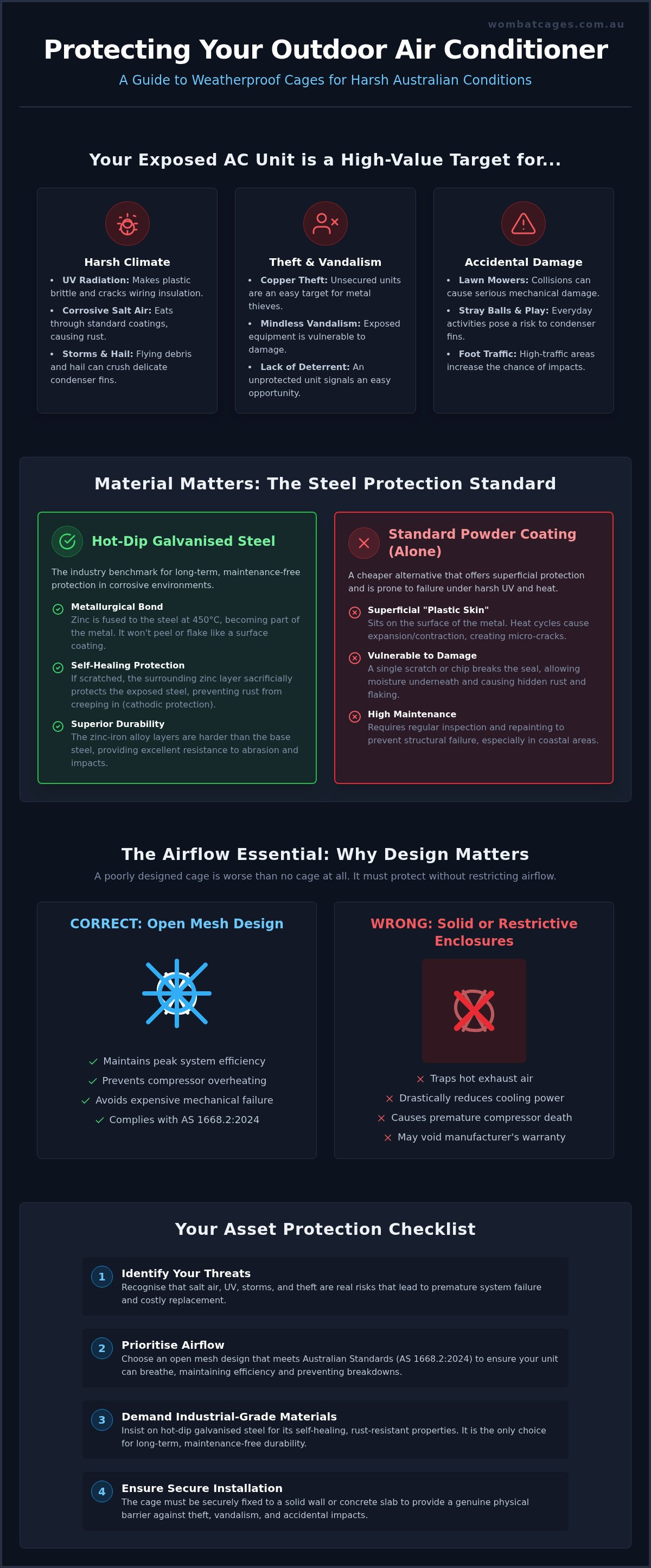
Your outdoor condenser unit is the hardest working part of your cooling system. It's also the most exposed. In Australia, we deal with some of the most aggressive environmental conditions on the planet. Intense UV radiation, high humidity, and salt-laden air don't just cause aesthetic wear. They cause mechanical failure. A standard AC bracket is designed for one job: holding the unit up. It offers zero protection against the elements or intruders. Investing in a weatherproof air conditioner cage turns a vulnerable asset into a secure one. It acts as a physical barrier that keeps your system running at peak performance.
The Australian Climate Challenge
The sun is a slow killer for HVAC systems. Constant exposure to UV radiation causes plastic fan blades to become brittle and wiring insulation to crack. Once the internal components are exposed, moisture moves in. For those living near the coast, salt-air corrosion is an even bigger threat. It eats through standard coatings in months, not years. This is why we use industrial-grade hot-dip galvanisation to ensure the cage itself survives the same conditions that destroy the AC unit.
Weather damage isn't always slow. Cyclonic winds and summer storms turn garden debris into high-speed projectiles. A heavy-duty steel cage acts as a first line of defence. It stops flying branches or hail from crushing the delicate fins of your condenser. Many property owners assume their insurance will cover these events. Often, insurers classify environmental degradation as "gradual wear and tear." This leaves you with a massive bill for a full replacement that could have been avoided.
Transitioning from Vulnerable to Protected
Protection isn't just about the weather. It's about security. A visible, robust barrier is a powerful deterrent against theft and vandalism. Copper theft is a real risk for unsecured units. A bolted steel enclosure makes your property a hard target. It tells opportunistic thieves that your equipment isn't worth the effort.
You also need to consider everyday accidents. Lawn mowers, stray footballs, and heavy foot traffic can all cause serious damage to an exposed unit. Installing a weatherproof air conditioner cage provides total peace of mind. It defines a "no-go zone" around your equipment. This is a critical step in protecting AC unit from accidental damage. By fixing a rigid frame directly to the ground or wall, you create a permanent safety zone. It's about common-sense prevention that saves you thousands in the long run.
Material Science: Hot-Dip Galvanisation vs. Standard Coatings
Not all metal enclosures are built to survive the Australian sun. When you invest in a weatherproof air conditioner cage, the material choice determines whether it lasts two years or twenty. Steel is the backbone of industrial protection because of its immense structural integrity. It's heavier and more rigid than aluminium, making it harder to bend or bypass. However, raw steel has one major enemy: oxidation. To fight this, we rely on the chemistry of hot-dip galvanisation.
The process is straightforward but effective. We submerge the entire steel frame into a vat of molten zinc at temperatures around 450 degrees Celsius. This creates a metallurgical bond between the two metals. It isn't just a thin coat of paint sitting on the surface. The zinc becomes part of the steel. This provides a level of permanence that standard coatings can't match. It's about building something that doesn't just look tough but actually is tough.
Why We Prioritise Hot-Dip Galvanised Steel
Zinc is a reactive metal that works as a sacrificial layer. If your cage gets dented or scratched by a lawnmower or flying debris, the surrounding zinc protects the exposed steel through a process called cathodic protection. It effectively heals the wound. This prevents moisture from creeping under the surface and causing structural rot. You won't have to deal with "white rust" or the constant need for repainting. It's a maintenance-free solution designed for the long haul.
- Structural Weight: Steel provides the mass needed to remain rigid during cyclonic winds.
- Corrosion Resistance: The zinc-iron alloy layers are harder than the base steel itself.
- Permanent Bond: The coating won't flake, peel, or delaminate under high UV stress.
The Problem with Powder Coating Alone
Many competitors rely on powder coating because it's cheaper and offers a variety of colours. But powder coating is essentially a plastic skin. Over time, the heat of the Australian summer causes the metal to expand and contract. This creates micro-cracks you can't see with the naked eye. Once humidity gets inside those cracks, the metal starts to bubble. By the time you see the rust, the damage is done. Hot-dip galvanisation is the ultimate barrier against oxidation.
If you're serious about protecting your HVAC unit, don't settle for flimsy alternatives. A heavy-duty galvanised enclosure ensures your system stays safe from both the weather and intruders. It's the industry standard for a reason.
The Airflow Essential: Why Mesh Beats Solid Enclosures
Airflow isn't a luxury for your HVAC system. It's a mechanical requirement. Your outdoor condenser unit operates on the principle of heat exchange. It pulls air through the coils to dump the heat collected from inside your home. If that air path is blocked, the heat has nowhere to go. Many property owners choose solid timber or plastic covers for aesthetic reasons. This is a mistake. A weatherproof air conditioner cage must prioritise ventilation to ensure the system doesn't choke.
The biggest risk of restrictive enclosures is "short-cycling." This happens when the unit draws its own hot exhaust air back into the intake. The compressor has to work twice as hard to achieve the same cooling effect. This doesn't just spike your energy bills. It leads to rapid mechanical wear. An open mesh design solves this problem. It provides the necessary physical barrier while allowing for maximum air movement. It's the only way to maintain the manufacturer's performance specifications.
Preventing Compressor Overheating
Restricted airflow creates an "oven effect" around your condenser. During a typical Australian summer, ambient temperatures are already high. Trapping heat inside a solid box can push internal temperatures well beyond safe operating limits. This is a common reason for voided warranties. HVAC manufacturers require specific clearances for a reason. Our mesh cages are designed to meet these requirements. They allow heat to dissipate naturally into the atmosphere. You get the protection you need without the risk of an expensive compressor burnout. Efficient airflow means lower running costs and a longer lifespan for your equipment.
Technical Access and Servicing
Practicality matters during the life of your AC unit. Technicians need to perform regular maintenance and inspections. A solid enclosure often has to be completely dismantled just to check a refrigerant line or electrical conduit. This adds time and cost to every service call. Mesh enclosures provide immediate visual access. A technician can inspect the coils and connections without touching a single bolt. It's a smarter way to manage your assets.
When you choose a cage, ensure there is enough clearance for refrigerant lines and wiring. A rigid, purpose-built frame provides the security of air conditioner vandal guards while keeping the unit accessible. It's about finding the balance between total security and operational efficiency. Don't sacrifice your system's health for a solid cover that looks good but performs poorly.
Installation Standards for Weatherproof Security
A weatherproof air conditioner cage is only as effective as its mounting points. Simply placing a cover over your unit won't cut it. To achieve true security and long-term stability, bolting the frame directly to the wall or ground is non-negotiable. This creates a rigid structure that won't shift during high-wind events or severe storms. In many parts of Australia, wind loads can be extreme. A loose enclosure becomes a liability. It can rattle, cause damage to the unit, or even become a projectile in a cyclone.
Precision positioning is also essential for weatherproofing. We ensure the cage is installed to avoid water pooling around the base. Ground-level moisture is a common cause of premature wear. By maintaining a slight clearance and using anti-tamper fixings, we protect the unit from both the elements and human interference. These specialised fixings are designed to resist standard tools. They ensure that once the cage is fixed, it stays fixed.
Wall-Mounted vs. Ground-Fixed Cages
The choice between wall and ground mounting depends on your property’s substrate. Concrete pads offer maximum rigidity for ground-fixed units. For units mounted higher up, we anchor directly into the brickwork or structural wall. A secure fit is vital for more than just safety. It prevents vibration noise during the unit’s operation. If a cage isn't perfectly flush and tight, the natural hum of the compressor will cause an annoying metallic rattle. Professional installation ensures a silent, stable fit that lasts for decades.
Deterring Theft While Braving the Elements
There is a direct synergy between weatherproofing and vandal-proofing. A cage that can withstand a storm is also a nightmare for a thief. "Loose" or flimsy cages are easy targets. They can be pried open or lifted away with minimal effort. By using heavy-duty galvanised steel and permanent anchors, you eliminate the "easy win" for opportunistic criminals. This is a core component of preventing air conditioner theft. You aren't just shielding the unit from rain; you're making it a hard target for anyone with bad intentions.
Ready to secure your HVAC system with a permanent solution? You can order a professional cage installation today to ensure your unit is protected by the best in the business.
The Wombat Cages Standard: Built for the Long Haul
Wombat Cages doesn't build for aesthetics. We build for endurance. Our weatherproof air conditioner cage is a piece of industrial-grade infrastructure designed to outlast the equipment it protects. We use heavy-duty steel that is hot-dip galvanised to withstand the most aggressive Australian environments. Whether you're managing a single split system at a residential property or a multi-bay commercial bank of condensers, our configurations are purpose-built for the task. We don't believe in one-size-fits-all solutions that compromise on security or system health.
Our commitment to airflow-friendly design is non-negotiable. Every cage features an open mesh pattern that ensures your condenser never chokes on its own exhaust. This maintains system efficiency while providing a level of physical protection that flimsy aluminium or plastic covers simply can't offer. We also prioritise technician access. Our designs ensure that regular servicing remains straightforward. A technician can inspect, test, and maintain the unit without the need for complex disassembly. We offer professional installation services nationally, ensuring every property owner has access to the same high standard of asset protection.
Engineered for Australian Conditions
We take a no-nonsense approach to durability. In the Australian climate, "flashy" products fail quickly. We choose function over flash every time. Our cages transition your property from a state of vulnerability to total peace of mind. By choosing a specialist in HVAC security enclosures, you're investing in a product that understands the specific risks of corrosion, theft, and accidental damage. We don't just provide a box. We provide a dependable guardian for your high-value cooling assets.
Next Steps for Your Property
Securing your unit starts with accurate measurements. You need to account for the unit itself plus the required clearance for refrigerant lines and electrical conduits. We provide clear guidance on how to measure your system for a custom-fit security cage. Once you have your dimensions, arranging a professional installation is a simple process. Our team handles the heavy lifting, ensuring the cage is bolted securely to the substrate for maximum rigidity. A Wombat Cage is a one-time investment for the life of your AC unit. It's the most practical way to defend your investment against the elements and intruders alike.
Secure Your HVAC for the Long Term
Protecting your outdoor unit isn't just about stopping thieves. It's about outlasting the aggressive Australian elements. You've seen why material science matters. Hot-dip galvanised steel provides the maximum corrosion resistance needed for our coastal air and intense humidity. Choosing an industrial-grade mesh ensures your system maintains optimal airflow throughout the hottest summer days. This prevents the overheating and short-cycling that eventually kills cheaper, solid enclosures or timber covers.
Don't leave your investment to chance. A weatherproof air conditioner cage is a permanent shield for your property's most expensive appliance. We offer a national installation service to ensure every cage is bolted with the rigidity required to withstand storm winds and vandalism. It's a one-time fix for decades of peace of mind. You don't have to worry about rust, theft, or voided warranties when the engineering is right. Take the first step toward total asset protection today.
Secure your HVAC investment with a heavy-duty Wombat Cage today. It's the smartest move you'll make for your property's climate control.
Frequently Asked Questions
Will a weatherproof cage cause my air conditioner to overheat?
No, your unit won't overheat if you use a weatherproof air conditioner cage with an open mesh design. These enclosures are engineered to maintain the manufacturer's required airflow. Mesh prevents the "oven effect" created by solid covers. Your condenser needs to dump heat effectively to stay efficient. A well-ventilated cage ensures the compressor operates within safe temperature limits while staying protected from the elements.
What is the difference between galvanised steel and aluminium cages?
Steel offers superior structural integrity and weight compared to aluminium. We use hot-dip galvanised steel because the zinc forms a permanent chemical bond with the metal. This makes it harder for intruders to bend or cut. Aluminium is lighter and more prone to structural fatigue over time. For high-wind areas and maximum security, the mass and rigidity of a heavy-duty steel frame are the only logical choices.
Can a technician still service my AC unit if it is inside a cage?
Yes, technicians can easily service your unit. The open mesh allows for full visual inspection of the coils and connections without removing the enclosure. Our designs provide enough clearance for refrigerant lines and electrical conduits. If major mechanical work is required, the modular panels can be accessed by a professional. This ensures your maintenance schedule isn't interrupted by your security measures. It's a practical solution for long-term HVAC health.
Are these cages rust-proof in coastal Australian areas?
These cages are specifically built to resist salt-air corrosion in coastal regions. Hot-dip galvanisation is more durable than standard powder coating because it doesn't flake or bubble when exposed to high humidity. The zinc layer acts as a sacrificial barrier that protects the steel underneath. This industrial-grade treatment is the benchmark for outdoor infrastructure in Australia. It ensures your weatherproof air conditioner cage remains rust-free for the life of the unit.
How is the cage secured to the ground or wall?
We bolt the frames directly to the ground or wall using heavy-duty anti-tamper fixings. This creates a rigid, permanent structure that cannot be easily lifted or pried away. Securing the cage to a concrete pad or solid brickwork is essential for both theft prevention and storm safety. A loose enclosure is a liability in high winds. Professional installation ensures the anchors are set correctly to provide maximum stability and peace of mind.
Does a security cage affect the noise levels of the outdoor unit?
A correctly installed cage shouldn't increase the noise levels of your outdoor unit. We ensure every frame is bolted flush to the substrate to prevent metallic rattles or vibrations. Noise issues usually arise from flimsy, lightweight covers that aren't secured properly. By using heavy-gauge steel and rigid mounting points, the cage remains silent even when the compressor is running at full capacity during a heatwave. It's a quiet, dependable guardian.
Can I install a weatherproof cage myself or do I need a professional?
While some property owners are handy with a drill, we recommend professional installation for maximum security. A professional ensures the cage is perfectly level and anchored correctly to avoid water pooling or vibration noise. They also use specialised anti-tamper fixings that are difficult to install without the right tools. Professional installation guarantees that your enclosure meets national standards and provides the highest level of protection against both weather and vandalism.
What happens if I need to replace my AC unit in the future?
If you need to replace your condenser in the future, the cage can often be reused. Most modern units follow standard sizing conventions. As long as your new unit fits within the internal dimensions and meets airflow clearances, there's no need for a new enclosure. The modular nature of our steel frames means panels can be adjusted or removed by a technician to facilitate the swap. It's a long-term investment in your property's infrastructure.


