
A thief can strip the copper from your outdoor unit in under five minutes for a measly $40. You're left with a $5,000 replacement bill and a sweltering building. It's a gut-wrenching discovery that happens to property owners across Australia every single day. Thieves want an easy win. Don't give them one. Installing a heavy-duty air conditioner vandal guard changes the equation entirely by making your unit a high-effort, low-reward target.
This guide shows you how to shield your outdoor HVAC equipment from copper theft and property damage with a solution built for the long haul. You'll learn how to secure your investment without choking your unit's airflow or voiding your manufacturer's warranty. We'll break down why hot-dip galvanised steel is the industry standard for durability. We also explain how a properly designed cage keeps your split system running at peak efficiency while keeping vandals at bay. It's about moving from vulnerability to total protection with common-sense security that actually works.
Key Takeaways
- Identify why an air conditioner vandal guard is a non-negotiable asset for properties in high-risk areas.
- Understand why hot-dip galvanised steel is the industry standard for durability and weather resistance.
- Protect your condenser without restricting airflow or voiding your manufacturer's warranty.
- Learn the importance of professional anchoring and anti-tamper fixings for long-term security.
- Compare the structural density of steel against aluminium to understand why steel is the superior choice for security.
What is an Air Conditioner Vandal Guard and Why is it Essential?
Outdoor condensers are sitting ducks. They sit in alleys, car parks, and side-passages. They're full of high-value copper. An air conditioner vandal guard is a heavy-duty steel enclosure designed specifically to shield these condensers from external threats. It isn't just a fence. It's a structural barrier built for one purpose: keeping your assets safe. This type of security is no longer a luxury for Australian property owners. It's a fundamental part of building maintenance.
Thieves target these units for their copper coils and pipework. They also face risks from graffiti and accidental physical impact from vehicles or equipment. A vandal guard acts as a physical deterrent that significantly increases the time and effort required for a theft to occur. Most criminals want a quick win. If they see a rigid steel cage, they usually move on. They look for an easier target elsewhere.
Copper theft is rising across both residential and commercial sectors. As scrap metal prices fluctuate, the frequency of these brazen attacks increases. Security isn't just an option anymore. It's a necessity for protecting your bottom line. Investing in a robust cage is a pragmatic decision that prevents a massive financial hit later.
The Real Cost of HVAC Vandalism
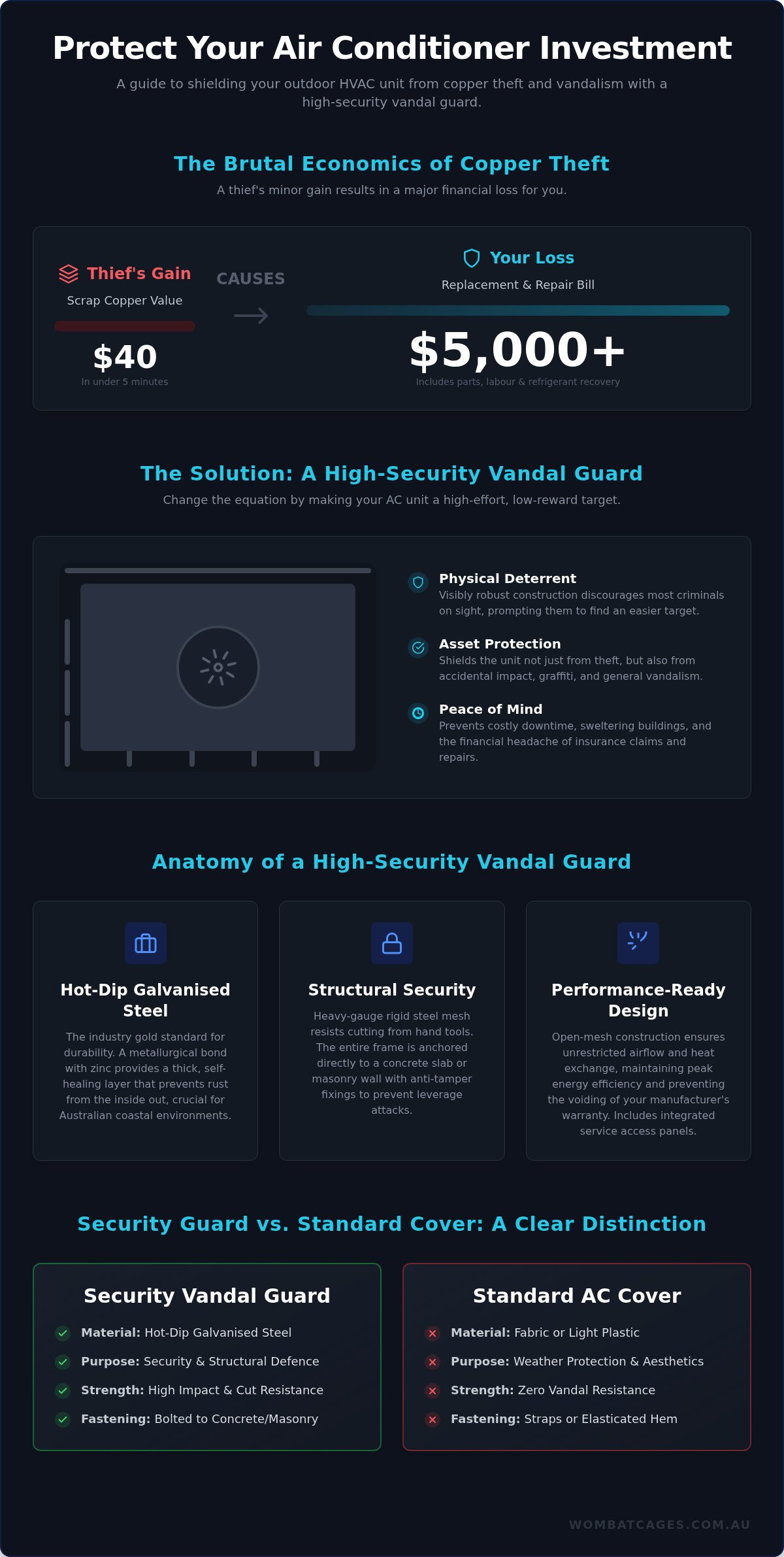
The math is brutal. A thief might walk away with $30 to $40 worth of scrap copper. To get it, they'll cause $4,000 to $5,000 in damage. They don't use precision tools. They use bolt cutters and saws. When they rip out the lines, they often cause massive refrigerant leaks. This secondary damage can kill the entire system. It turns a simple repair into a full replacement project.
Fixing a unit isn't just about the parts. You're paying for specialist labour and refrigerant recovery. Multiple insurance claims for AC damage also lead to higher premiums. In some cases, insurers may even refuse to cover units that aren't properly secured. It's a financial headache that a single installation can prevent. Peace of mind comes from knowing the unit is physically defended against these risks.
Vandal Guards vs. Standard AC Covers
Don't confuse a security cage with a standard cover. Fabric or light plastic covers are built for weather protection. They keep out leaves and dust. They offer zero resistance to a determined vandal. You can cut through them with a pocket knife. They're designed for aesthetics, not for defence. They won't stop a thief with a pair of pliers.
A structural air conditioner vandal guard is different. These are built from hot-dip galvanised steel. They're designed for permanent, high-security protection. They bolt directly into the concrete slab or the masonry wall. While an aesthetic cover hides the unit, a vandal guard defends it. One is for looks; the other is for structural survival in tough environments.
Key Features of a High-Security AC Condenser Cage
A high-security air conditioner vandal guard needs to be more than just a metal box. It requires a specific balance of structural strength and functional design. Every component must serve a dual purpose: stopping thieves and protecting the health of the unit. To be effective, the cage must be bolted directly to the concrete ground or masonry walls. If it's not anchored with industrial-grade fixings, it's just a nuisance, not a barrier. The open-mesh design ensures your unit's energy efficiency is never compromised by facilitating unrestricted heat exchange and preventing heat soak.
Rigid steel mesh is essential for both protection and visibility. It allows technicians to inspect the unit without removing the entire structure. This saves time during routine maintenance. It also ensures that any debris or blockages are visible from a distance. When you choose a security solution, look for these specific features:
- Full structural anchoring: Direct bolting to the slab or wall to prevent leverage attacks.
- Rigid steel mesh: Heavy-gauge wire that resists cutting from standard hand tools.
- Integrated access points: Dedicated panels for service and maintenance without compromising the frame.
If you're managing multiple units, investing in professional-grade cages is the most cost-effective way to secure your assets for the long term.
Hot-Dip Galvanised Steel: The Durability Factor
Hot-dip galvanised steel is the industry gold standard for a reason. The process involves dipping the entire steel frame into a bath of molten zinc. This creates a metallurgical bond that standard powder coating can't match. In coastal Australian environments, salt air is a silent killer for metalwork. Galvanisation provides a thick, protective layer that prevents rust from the inside out.
One of the most practical benefits is the "self-healing" property of the zinc coating. If the guard is scratched during an attempted break-in, the surrounding zinc migrates to cover the exposed steel. This prevents corrosion from taking hold. Standard mild steel will start to rust the moment the paint is chipped. Galvanised steel stays intact for decades, even in harsh conditions.
Airflow and Efficiency Requirements
Solid enclosures are a death sentence for HVAC systems. They trap hot air, forcing the compressor to work harder and eventually fail. A high-quality air conditioner vandal guard must prioritise ventilation. The mesh aperture size is critical. It needs to be small enough to block hands and tools, but large enough to allow the fan to pull in sufficient air. You can learn more about this by reading our guide on Ensuring Airflow: Why Open Mesh Design Matters. Balancing security with airflow ensures your electricity bills don't skyrocket while your unit stays protected.
Assessing Your Risk: When Do You Need a Vandal Guard?
Not every outdoor unit faces the same level of threat. Risk assessment starts with geography. You need to look at your condenser through the eyes of a thief or a vandal. Is it visible from the street? Is it hidden in a dark side-passage? Proximity to public footpaths or laneways increases the chance of opportunistic damage or graffiti. Conversely, secluded areas provide the cover of darkness that organised thieves crave. If your unit is "out of sight, out of mind" for you, it's a prime workplace for someone with a hacksaw.
Organised copper theft isn't random. Criminals scout for high-value targets where they can maximise their haul in a single night. Multi-unit installations at commercial sites are particularly vulnerable. A single air conditioner vandal guard might protect one home, but for a business, a coordinated security plan is required to prevent a total operational shutdown. If your condenser is easily accessible, it's essentially an unlocked safe sitting on your property.
Don't assume that because your neighbourhood feels safe, your equipment is secure. Copper prices drive theft, not local crime rates. A heavy-duty steel enclosure changes the math for a criminal. It turns a five-minute job into a loud, difficult, and time-consuming ordeal. Most thieves won't take the risk. They'll simply move on to a property that hasn't taken the same precautions.
Commercial and Industrial Applications
Schools, community centres, and retail blocks are prime targets. These buildings often have multiple condensers located in accessible ground-floor areas. Thieves can hit ten units in an hour if they aren't secured. This causes tens of thousands of dollars in damage and forces businesses to close during heatwaves. Banks and medical clinics also face high risks due to the critical nature of their climate control systems.
For these sites, multi unit AC security cages provide a consolidated defence. They protect the entire bank of equipment under one rigid steel structure. This is far more effective than trying to secure each unit individually with flimsy, powder-coated alternatives that lack structural integrity. Hot-dip galvanised steel ensures these commercial assets remain defended against both theft and the harsh Australian elements for years.
Residential Security Concerns
Homeowners often overlook the vulnerability of their split systems. Rental properties and holiday homes are especially high-risk. These units often sit idle for weeks, giving thieves plenty of time to operate without being disturbed. A vandal guard provides a permanent security presence even when you aren't there to monitor the property.
Protection isn't just about crime. It's about preventing accidental damage too. Pets can chew on lines. Children can poke sticks into the fan blades. Garden equipment like lawnmowers and whipper-snippers can easily puncture a condenser coil. You can find more strategies for preventing air conditioner theft and damage by evaluating your unit's physical environment. Don't wait for a repair bill to start thinking about security.
Comparing Guard Materials: Steel vs. Aluminium
Choosing the right material for your air conditioner vandal guard is the difference between a real barrier and a mere suggestion. While aluminium is lightweight and easy to handle, it's often too soft to resist determined vandalism. It lacks the structural density required to stop a focused attack. Steel is the heavyweight champion in this arena. It provides a formidable physical presence that aluminium simply cannot match. If a thief approaches a unit with a pair of bolt cutters, they'll find that aluminium gives way with minimal effort. Steel requires industrial-grade power tools and significant time, two things most criminals don't have.
The cost-effectiveness of steel becomes clear over the 10-20 year lifespan of a typical HVAC unit. Aluminium cages may be cheaper upfront, but they're prone to bending and prying. Once an aluminium frame is compromised, the entire unit is exposed. A steel cage maintains its structural integrity through multiple attempted breaches. It's a one-time investment in asset protection that outlasts the equipment it defends. For maximum security, you should order a heavy-duty steel security cage that is built to endure.
The Strength of Steel Mesh
The gauge of the steel is the most critical factor. We use heavy-duty mesh that is thick enough to resist bending or prying by hand. This rigid design prevents vandals from using crowbars to create gaps in the enclosure. The mesh aperture is also specifically sized to prevent large objects, like branches or metal rods, from being poked into the fan blades. This protects the delicate internal components from both intentional sabotage and accidental debris.
There's also a powerful psychological deterrent at play. A heavy steel structure looks difficult to breach. When a thief sees a bolted-down steel cage, they understand the effort required to get inside. Most will decide the risk isn't worth the reward. Aluminium often looks like a flimsy screen, which can actually encourage an opportunistic thief to try their luck. Steel sends a clear message: this property is protected.
Weather Resistance in the Australian Sun
The Australian sun is brutal on building materials. UV rays quickly degrade standard powder coatings on aluminium or mild steel. Once the coating fails, the metal underneath is vulnerable. Powder coating often peels or flakes off in large chunks when exposed to extreme heat and sun. Hot-dip galvanisation is different. It's a permanent metallurgical bond that won't peel, crack, or fade. It offers superior thermal stability, staying structurally sound even during a 45-degree heatwave.
For coastal properties, salt-air corrosion is a constant threat. Aluminium can suffer from "white rust" or pitting, which weakens the metal over time. Hot-dip galvanised steel is specifically designed to thrive in these harsh conditions. The zinc coating acts as a sacrificial layer, protecting the core steel from the corrosive effects of the ocean air. This ensures your security barrier remains strong and rust-proof for decades, regardless of the environment.
Professional Installation: Ensuring Your Guard Actually Works
An air conditioner vandal guard is a serious piece of kit, but its performance depends entirely on how it's fixed to your property. If you just sit a cage over your unit without proper anchoring, you're giving thieves a head start. They'll simply tip it over or carry it away. Professional installation ensures the structure becomes part of the building itself. DIY attempts on uneven ground often lead to gaps that can be easily exploited with a pry bar. You need a flush, rigid fit to ensure there are no weak points for a vandal to leverage.
Security is only as strong as the weakest link. In most cases, that link is the fixing method. Using standard screws or lightweight brackets is a waste of time. A determined thief with a basic tool kit will have them out in seconds. We prioritise structural integrity by using heavy-duty materials and permanent mounting techniques. This turns your HVAC unit into a hard target that requires too much effort to breach. It's about making the cost of theft higher than the potential reward.
Anchoring and Fixing Methods
Securing the frame requires industrial-grade fixings. We bolt directly into the brickwork or the concrete slab using masonry anchors. This creates a rigid connection that resists extreme leverage and physical impact. For units located on plinths or uneven surfaces, ground-mounted frames provide the necessary stability to keep the cage level and secure. This prevents the cage from vibrating or rattling during high winds or unit operation.
The use of anti-tamper fixings is non-negotiable. Standard hex bolts or Phillips head screws are too common. We use specialised security fasteners that require unique tools to remove. This prevents unauthorised people from simply unscrewing the cage and walking off with your condenser. It's a small detail that makes a massive difference in high-risk areas. You can read more about why air conditioner cage installation should be handled by experts to avoid these common security pitfalls.
Maintaining Technician Access
Security shouldn't make maintenance a nightmare. A common mistake is installing a cage too close to the condenser. Your HVAC mechanic needs enough clearance to remove the unit's cover and access the electrical components. If they can't get their tools in, they'll have to charge you extra for the time spent dismantling the guard. We recommend ensuring there is sufficient space on all sides for regular servicing.
For complex installs, we use removable panels or hinged access points. These features allow full entry to the unit for repairs while maintaining total security when locked. It's a pragmatic balance. The cage defends the unit from vandals but stays out of the way of the professionals who keep your system running. A well-designed cage should never impede the cooling performance of the unit. Proper spacing ensures the fan can still move air effectively, preventing the compressor from overheating and failing prematurely.
Secure Your HVAC Assets for the Long Term
Protecting your outdoor unit is about making theft a high-effort, low-reward task. We've seen how hot-dip galvanised steel outperforms aluminium in both durability and physical security. A properly anchored air conditioner vandal guard doesn't just block thieves. It protects against accidental damage while maintaining the critical airflow your split system needs to run efficiently. Choosing structural strength over flimsy aesthetic covers is a pragmatic decision that saves you from massive repair bills.
Don't wait for a $5,000 replacement cost to take action. Our cages are built with a rigid mesh design for zero airflow restriction. They feature hot-dip galvanised steel for ultimate rust protection in coastal environments. We offer professional installation available nationwide to ensure your unit is bolted down and truly secure. It's time to move from vulnerability to total protection with a solution built to last in the harsh Australian sun.
Protect your HVAC assets with a heavy-duty Wombat Cage today and get the peace of mind you deserve.
Frequently Asked Questions
What is the best way to prevent copper theft from my air conditioner?
Installing a physical barrier like a heavy-duty air conditioner vandal guard is the most effective deterrent available. While security cameras and lighting provide evidence after a crime, they don't stop a thief from cutting copper lines in seconds. A rigid steel cage creates a loud, time-consuming obstacle that most criminals want to avoid. Thieves look for quick wins. They will usually move on to an unprotected unit when they see a bolted-down steel enclosure.
Will an AC vandal guard void my manufacturer warranty?
No, a properly designed guard won't void your warranty as long as it doesn't interfere with the unit's mechanical operation. Manufacturers require specific clearances for airflow and maintenance access to keep the system running within its design limits. As long as the cage follows these spacing guidelines and doesn't require drilling into the AC unit itself, your warranty remains intact. It's a protective measure that prevents the physical damage that warranties don't cover.
Does a security cage restrict airflow and make my AC less efficient?
A cage with an open-mesh design ensures zero airflow restriction. Solid covers or tight screens can cause heat soak, which forces the compressor to work harder and reduces efficiency. Our rigid steel mesh provides maximum ventilation while maintaining high security. This allows the fan to pull in and exhaust air exactly as the manufacturer intended. It keeps your energy bills stable and ensures your unit continues to run at peak performance.
Can a vandal guard be installed on an existing air conditioning unit?
Yes, vandal guards are specifically designed for retrofit installation on existing outdoor condensers. The frame is built to sit over the unit and bolt directly into the concrete slab or masonry wall. This means you don't need to disconnect any pipes or electrical wiring to secure your equipment. It's a straightforward process that provides immediate protection for units that are already in service, regardless of whether they are ground-mounted or fixed to a wall.
What material is best for an outdoor AC security cage in Australia?
Hot-dip galvanised steel is the superior choice for the Australian climate. Unlike aluminium, which is often too soft to resist prying, steel provides the structural density needed for real security. The galvanisation process creates a permanent metallurgical bond that prevents rust, even in salt-heavy coastal areas. It won't peel or flake under intense UV rays like standard powder-coated finishes. This ensures decades of reliable service and a formidable psychological deterrent for vandals.
How do I ensure my AC technician can still service the unit once it is caged?
Proper planning during installation is the key to maintaining technician access. The cage should be sized to allow enough clearance for the removal of the unit's service panels. For complex installations, we use removable panels or hinged sections that can be unlocked by the mechanic. This ensures they can perform regular maintenance or repairs without having to dismantle the entire security structure. It's a pragmatic balance between total security and essential maintenance access.
Are these cages rust-proof for coastal properties?
Yes, our cages are hot-dip galvanised to provide ultimate rust protection. This process involves dipping the steel into molten zinc, which coats every surface, including the inside of the tubes. This is essential for coastal properties where salt air causes rapid corrosion on inferior metals. The zinc acts as a sacrificial layer that stops rust from reaching the core steel. It maintains the cage's structural integrity for years, even in the harshest seaside environments.
How much does an air conditioner vandal guard usually cost to install?
The cost of installation depends on several factors, including the size of the unit and the mounting surface. Bolting a cage into a flat concrete slab is faster than securing one to a brick wall or an uneven plinth. You should also consider whether you need a single split system cage or a multi-bay setup for commercial properties. While we don't provide fixed pricing here, professional installation ensures the cage is anchored correctly for maximum security and longevity.


