
If you're justifying expense of AC cage to property owner, the challenge is weighing a visible upfront expense against disruption that may never happen. Build the case around the actual equipment, its location and the risks at the property, not worst-case stories.
An outdoor AC unit has a replacement value and a role in keeping a property comfortable or operational. Its exposure depends on where it sits: a concealed, accessible unit may face different risks from one in a busy, monitored area.
This article explains how to assess the equipment, site exposure, cage scope and installation. A hot-dip galvanised steel cage with open mesh creates a physical barrier while supporting airflow and access for servicing. The configuration can suit one unit or several, giving owners, budget holders and committees a clear basis for a site-specific decision.
Key Takeaways
- Build a property-specific case by recording the unit’s location, visibility and exposure to accidental damage or interference.
- When justifying expense of AC cage to property owner, compare the proposed scope with the equipment’s role and the disruption if it’s damaged or unavailable.
- Distinguish what a cage can help deter from the risks that remain after installation.
- Compare having no barrier, installing a cage and the risks that remain to make the decision easier to assess.
- Match a single-unit or multi-bay cage to the equipment layout, then set out the installation scope clearly for approval.
Why an AC cage expense can make sense for a property
The expense of prevention is easy to see in a budget. The risk of theft or damage can feel hypothetical, particularly if the unit has never been targeted. A practical case starts with the property’s actual exposure and the consequences of disruption.
An AC cage is a physical barrier fitted around an outdoor condenser or compressor. It makes direct access more difficult and helps shield the equipment from interference or accidental impact. It can reduce exposure, but it cannot guarantee that theft or damage will not occur. When justifying expense of AC cage to property owner, consider the equipment, its location and the likely consequences if it is disrupted.
Which property risks should an owner weigh?
Assess the risks separately rather than treating them as one general security concern:
- Copper theft: Metal theft can involve valuable materials from equipment and infrastructure. The valuable metals in AC units are part of this broader issue, but the risk at a particular property depends on its circumstances.
- Vandalism: Consider whether a unit is exposed to deliberate interference, including when fewer people are on site.
- Accidental impact: Check nearby vehicle movements, storage areas and routine work that could bring equipment into contact with people or objects.
Then look at access and visibility. Is the unit concealed, easy to reach or in a monitored area? What might follow if it stopped operating, such as discomfort for occupants, interruption to business or extra work arranging a replacement? Use site observations, maintenance notes and relevant incident history where available. If there is no reliable history, say so rather than inventing a risk rate.
Who needs to approve the expense?
Identify who controls the decision. It may be the property owner, a budget holder, a property manager or a committee. Give them a clear scope: which outdoor units are included, where they are located and what the proposed barrier is intended to address.
Frame the request around protecting equipment and supporting operational continuity, not promised savings. A cage can make direct access more difficult, but it does not guarantee prevention or remove every risk. Be clear about what falls outside the proposal, such as damage to other parts of the property or disruption from unrelated equipment faults.
A sound approval case identifies the exposed unit, explains its role, describes the relevant risks and sets out the barrier proposed for that location. This gives decision-makers a grounded basis for weighing the expense against the property’s needs.
What an AC cage protects, and what it cannot guarantee
A cage surrounds an outdoor condenser or compressor and helps obstruct direct access to exposed equipment. This physical layer can make interference more difficult, but it is not a promise that theft, vandalism or accidental damage cannot happen. That distinction matters when justifying expense of AC cage to property owner: approval should be based on realistic risk reduction, not a guarantee.
How does a cage support protection without blocking normal operation?
Open mesh allows airflow around the outdoor unit and gives technicians access for inspection and servicing. This balance is important. A barrier that blocks airflow or prevents routine access could interfere with normal operation or maintenance, so the design and fit need to suit the unit and its position.
The protection is physical and specific. A cage can make it harder to reach the condenser or compressor, but it does not protect every part of an air-conditioning system or address unrelated faults. The police-recommended deterrent for AC theft is framed as a deterrent, not an assurance that an incident is impossible.
Why do fit and installation affect the value?
The cage needs to match the equipment layout. A single split system may suit a one-unit configuration, while several adjacent units may call for a multi-bay arrangement. A poor fit can leave gaps or make servicing awkward. A well-planned scope accounts for the unit’s position and technician access.
Material and fixing matter outdoors. Wombat Cages uses hot-dip galvanised steel, with professional installation that secures the frame to walls and ground. These details make the barrier part of the site rather than a loose cover placed around equipment. The hot-dip galvanised condenser cage guide explains the material choice in more detail.
For approval, describe what the proposed cage covers, how it will be configured and where it will be fixed. Avoid claims about guaranteed prevention, resistance ratings or lifespan unless they are supported by specific information. If a cage suits the site, explore AC cage supply and installation.
How to compare an AC cage expense with doing nothing
A useful comparison does not assume a theft or accident will happen. Set the proposed cage scope alongside the equipment’s role, its exposure and the consequences of disruption. When justifying expense of AC cage to property owner, separate recorded facts from possible future losses. Use a tailored quote for the proposed cage and installation rather than generic cost estimates.
What should the comparison include?
Record each unit’s location, accessibility and function. Note what could be affected if it became unavailable, such as occupant comfort or day-to-day operations. Then define the proposed configuration, installation work and access needed for technicians to inspect and service the equipment.
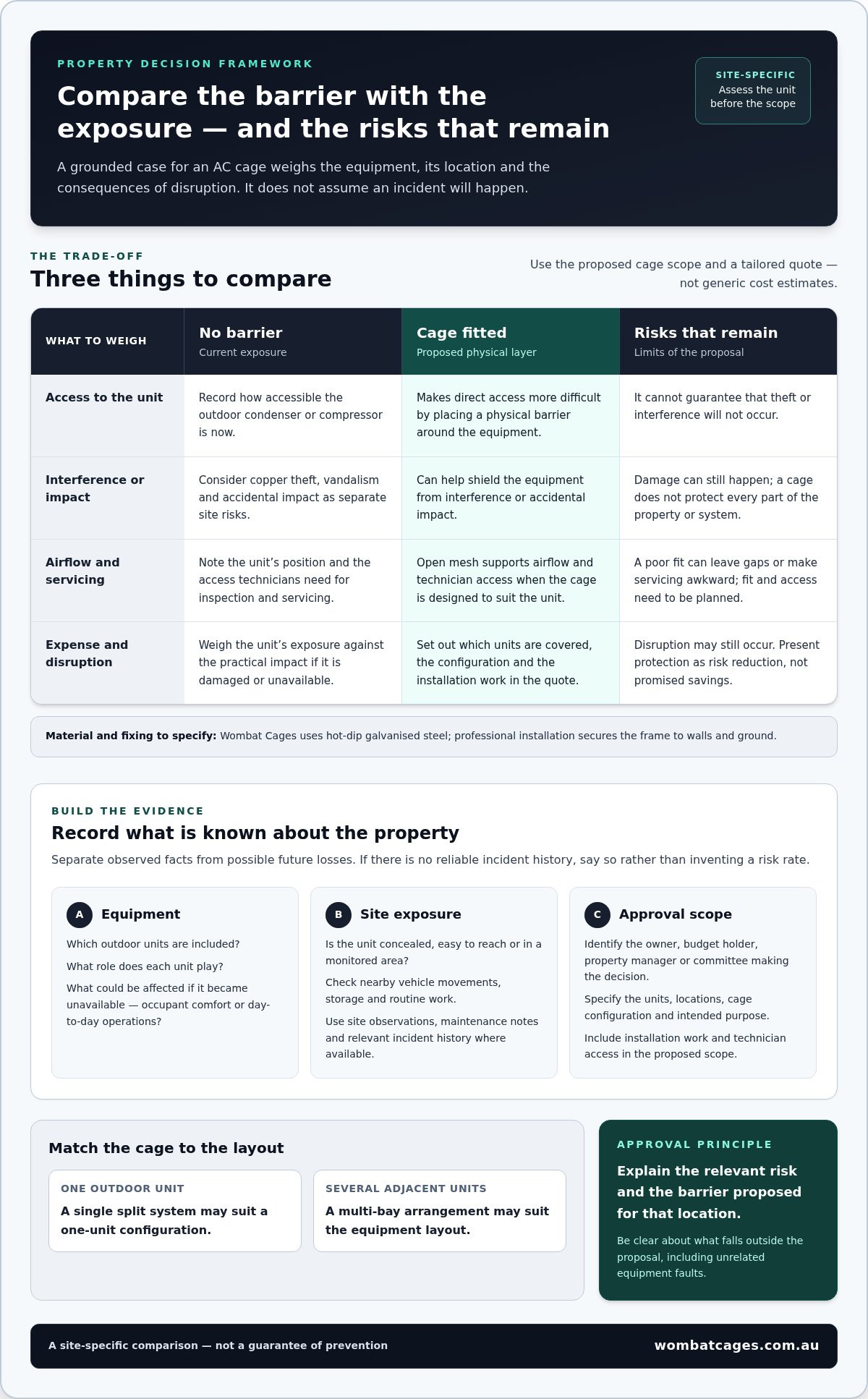
This comparison makes the trade-offs clear:
| Option | What to weigh | What remains |
|---|---|---|
| No barrier | No cage is installed around the unit. Consider its current exposure and the practical impact if it is damaged, interfered with or unavailable. | The equipment remains exposed to site-specific risks. Do not treat a possible incident as a certain loss. |
| Cage installed | Compare the tailored quote and installation scope with the unit’s role, location and servicing needs. | A cage adds a physical barrier, but does not guarantee that theft or damage will not occur. |
| Risks after installation | Check that the configuration covers the intended unit or units and allows technician access. | Other damage, equipment faults and risks beyond the cage’s coverage may still affect the property. |
Use maintenance records, site observations and relevant incident history where available. Show confirmed expenses as known figures, and label future replacement or disruption costs as possibilities unless reliable property records support them. Insurance cover, excesses and claim conditions depend on the policy and insurer. The AC theft insurance claims guide offers more context. Do not assume a cage will change a premium or claim outcome.
When might the expense be harder to justify?
A unit in a less accessible or more visible location, or one with limited operational importance, may present a different case from equipment that is easy to reach and central to the property’s use. Those factors do not settle the decision on their own. Weigh the site conditions against the proposed scope.
If exposure is modest, a broad installation covering several units may be difficult to support. If the concern centres on one accessible unit, a single-unit configuration may be the more relevant comparison. A cage reduces exposure to some forms of interference, but does not remove every risk or equipment failure. Make that limitation clear in the proposal.
How to build a clear case for AC cage approval
A strong approval request makes the decision easy to follow. Document the site conditions, identify the equipment covered, explain the proposed barrier and installation, then state what risks remain. This gives an owner a practical basis for justifying expense of AC cage to property owner without presenting a possible loss as a certainty.
What evidence makes the proposal easier to assess?
Build the case from details that can be checked. Take clear photographs of each outdoor unit and its surroundings. Note access points, visibility and nearby activity that could affect exposure. Record relevant theft, damage or service disruption from property records where available, without suggesting past incidents predict what will happen next.
Describe the unit’s function too. Explain what depends on it and what practical disruption could follow if it became unavailable. Separate observations and documented history from assumptions about future incidents or costs.
How should the owner present the request?
Use a short four-step structure:
- Document exposure: Record the unit’s location, access points, site visibility and relevant incident history.
- Define scope: State the number of units, the proposed cage configuration and the locations included.
- Assess impact: Explain the equipment’s role and the practical effect of downtime, labelling uncertain losses as possibilities.
- Request approval: Attach a project-specific written quote that sets out the cage supply and installation requirements.
Include technician access in the scope from the outset. For multiple units, explain how the arrangement fits the equipment layout. The multi-unit AC security cage buying guide can help owners consider a multi-bay setup.
Quotable summary: “Because the outdoor unit is accessible at this location and supports essential property operations, the proposed cage is a proportionate physical barrier, not a guarantee against every form of damage or disruption.”
Adjust that wording to match the evidence. If the unit is less exposed or has a limited operational role, say so and scale the recommendation accordingly. Identify what the cage covers and what it does not, without promising savings or insurance outcomes.
For a site-specific scope, review AC cage supply and installation options.
Choose an AC cage scope that fits the property
A useful approval case ends with a defined job, not a vague request to “secure the air conditioners”. Match the cage configuration to the number and position of the outdoor units and the practical needs of the site. This makes justifying expense of AC cage to property owner more straightforward: the proposed protection has a clear purpose and boundary.
What should the proposed scope specify?
Start with the equipment layout. State how many condensers or compressors need a cage, whether they are grouped together or positioned separately, and where each unit sits. Include the wall and ground surfaces available for fixing so the installation scope reflects the site.
Then account for servicing. Open mesh supports airflow and leaves access for technicians, so the layout should allow routine inspection and maintenance. A single split system may suit a one-unit cage, while several adjacent units may call for a multi-bay configuration. Choose the fit based on the equipment arrangement, not a one-size-fits-all assumption.
What is the next step for the property owner?
Gather clear site photographs and a short note describing unit positions, access around them and the installation surfaces. Include the number of units and any servicing access requirements. These details help define the work and give the budget holder a concrete scope to assess.
Wombat Cages supplies and professionally installs custom-configured hot-dip galvanised steel cages for outdoor AC condensers and compressors. The frames are secured to walls and ground, while open mesh supports airflow and technician access. Configurations suit a single unit or multiple units on the property.
With the site details in hand, request a tailored supply-and-install quote from Wombat Cages. Present it alongside the reason for protection, the equipment and locations covered, and the limits of what a cage can address. This gives the owner or committee a clear proposal to review without broad cost assumptions or promises of guaranteed prevention.
- Equipment: Number of outdoor units and their positions.
- Configuration: Single-unit or multi-bay cage to suit the layout.
- Installation: Relevant wall and ground fixing surfaces.
- Operation: Airflow and technician access for servicing.
Keep the scope proportionate to the property. A defined installation plan turns a general security concern into a practical decision about the equipment, site and proposed barrier.
Make the next step a site-specific decision
A sound case for an AC cage starts with the property, not scare tactics. Weigh the unit’s accessibility and operational role, document relevant exposure, then compare a clearly defined cage scope with the disruption a damaged or unavailable unit could cause. Separate known facts from possible future losses, and be clear that a cage is a physical barrier, not a guarantee against theft or damage.
For justifying expense of AC cage to property owner, the strongest proposal identifies the equipment and locations covered, matches the configuration to the site, and accounts for installation and technician access.
Wombat Cages supplies and professionally installs hot-dip galvanised steel cages for outdoor AC equipment. Open mesh supports airflow and servicing access, while installation secures the cage to walls and ground. Request a tailored AC cage quote to define a practical scope for your property and present a clear proposal to the relevant owner or budget holder.
With the site details in hand, you can make a measured decision that protects the equipment without overstating what a cage can do.
Frequently Asked Questions
Is an AC cage worth the expense for a property owner?
It can be worthwhile when the unit’s location, accessibility and role make a physical barrier a sensible risk control. Consider how exposed the outdoor equipment is and what disruption could follow if it were damaged or unavailable. Then compare that exposure with a project-specific cage and installation scope. A cage can make direct access more difficult, but it cannot guarantee that theft or damage will not occur.
How can I justify an AC security cage to a landlord or body corporate?
Present evidence from the property, not a scare-based argument. Note the unit’s location, access points, function and any relevant recorded incidents. Explain which units the proposed cage covers, how it will be configured and what installation involves. A clear case for justifying expense of AC cage to property owner distinguishes documented facts from possible future losses and states that the cage reduces exposure rather than guaranteeing prevention.
Can an AC cage prevent copper theft or vandalism?
An AC cage can help deter interference by placing a physical barrier around an outdoor condenser or compressor. It may make direct access to the equipment more difficult, which is relevant to risks such as copper theft and vandalism. It is not theft-proof and cannot prevent every form of damage. Treat it as one practical layer of protection, matched to the unit and its site, rather than a complete security solution.
Will an AC cage affect airflow or servicing?
A suitable open-mesh cage supports airflow around the outdoor unit while leaving access for technicians. Include both points in the proposed layout, especially where the equipment sits close to a wall or another obstruction. A cage is not a substitute for routine servicing. Its fit and positioning need to account for the unit’s operation and technician access.
Does an AC cage reduce property insurance premiums?
Do not assume that installing a cage will reduce premiums or change a claim outcome. Insurance terms and requirements depend on the policy and insurer. If insurance is part of the approval discussion, refer to the relevant policy wording or seek guidance from the insurer, keeping that separate from the cage’s physical purpose. The case for a cage should rest on the property’s exposure, equipment role and proposed protection.
What information should I include when requesting an AC cage quote?
Include the number and position of the outdoor units, clear site photographs, access around the equipment and the surfaces where the cage may be fixed. Note any servicing access needs and whether the units are grouped together or separate. This helps define a suitable configuration and installation scope. Wombat Cages supplies and professionally installs hot-dip galvanised steel cages for outdoor AC equipment.
Is a single-unit cage or a multi-bay cage right for my property?
Choose the configuration that matches the equipment layout. A single-unit cage may suit one split-system condenser, while a multi-bay cage can suit multiple units positioned together. The proposed scope should identify which units are included and allow for airflow and technician access. Wombat Cages configures cages for one outdoor unit or multiple units, with professional installation securing the frames to walls and ground.


