
What could a stolen or damaged outdoor HVAC unit cost your business beyond replacing the equipment? The business case for HVAC security investment starts with that wider exposure: repair or replacement, lost operating time, and disruption to staff, tenants or customers. These costs can be difficult to quantify, particularly when protection must also preserve airflow and access for servicing.
It’s reasonable to want evidence before committing budget and to make sure a security cage won’t create a maintenance problem of its own. A purpose-built cage provides a physical barrier against theft, vandalism and accidental damage. Open mesh allows airflow and technician access, while a securely fixed frame helps protect outdoor condensers and compressors.
This guide shows how to build a defensible case using your organisation’s asset values, incident history, downtime and response costs, rather than generic assumptions. It also explains how to compare that exposure with the whole-of-life cost of protection, scope a single-unit or multi-bay cage, and move towards a practical, site-ready solution with Wombat Cages’ installation service.
Key Takeaways
- Build the business case for HVAC security investment around your organisation’s records, separating documented costs from estimates and unknowns.
- List exposed outdoor condensers and compressors, what each unit serves, and site conditions that could affect its exposure.
- Compare the proposed protection scope with evidenced repair, replacement, response and business interruption costs.
- Structure an approval-ready proposal around the risk, supporting evidence, options, assumptions and a clear next step.
- Turn approval into a site-specific scope, with single-unit or multi-bay cage configurations and secure fixing planned for the location.
Why make a business case for HVAC security investment?
A business case for HVAC security investment gives decision-makers a way to compare the exposure of outdoor equipment, the consequences of loss or damage, and the cost and scope of protection. It turns a general concern into a reasoned decision based on the property’s assets, operating needs and available records.
Start with what each unit does. An outdoor condenser or compressor may support comfort and day-to-day operations across a tenancy, workplace or other facility. Theft, vandalism or accidental damage can lead to direct costs, such as repair or replacement. There may also be indirect effects: interrupted operations, inconvenience for occupants, staff time spent coordinating a response and management effort. Include these where they’re relevant and supported by your organisation’s evidence.
The purpose isn’t to promise incident-free operation or a guaranteed financial return. It’s to make the risks, assumptions and proposed control clear enough for an informed decision. A purpose-built security cage can form part of that control. Its design should protect the outdoor unit while allowing airflow and practical access for servicing.
What belongs in an HVAC security investment case?
Describe each exposed unit, what it serves and the role it plays at the property. Record credible, site-specific exposure, such as accessible placement or a documented history of damage. Separate known facts from estimates. Then specify the protection proposed and the operating requirements it must preserve, including airflow and technician access. If the HVAC equipment connects to a Building Automation System (BAS), note that context too. This case focuses on physical protection of outdoor equipment.
Which properties and decision-makers need the case?
Commercial property owners, facilities managers and asset decision-makers may all need to understand the risk and proposed scope. Finance stakeholders need transparent inputs: which costs are documented, which are estimates, and what remains uncertain. A single outdoor unit may call for a focused assessment. A site with several condensers may need an asset-by-asset review and a coordinated multi-bay protection scope.
Keep the case practical. A concise inventory, evidence of exposure, likely operational consequences and clear protection requirements give stakeholders a common basis for discussion. They can then weigh the proposal against other property priorities without overstating the risk or treating unverified costs as fact.
Measure HVAC asset exposure and the operational impact of loss
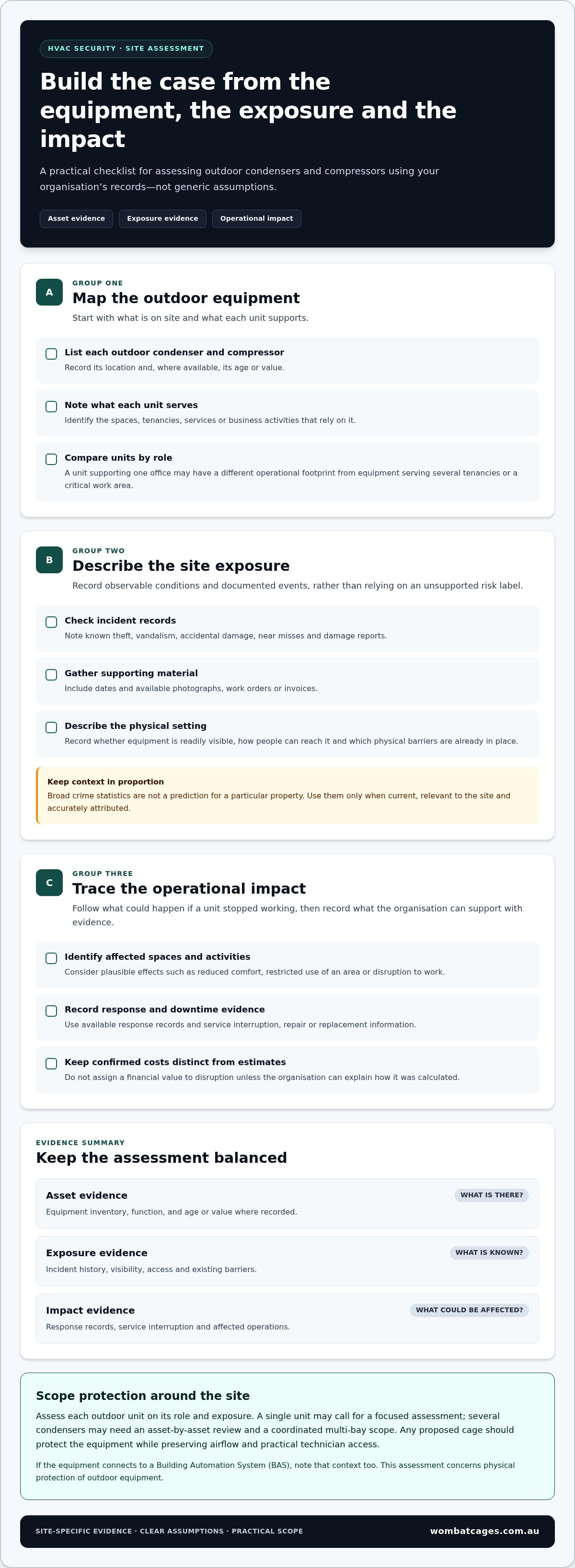
Build the assessment around the equipment at the property, not a general impression of risk. List each outdoor condenser and compressor, where it sits, what it serves and which spaces or activities rely on it. A unit supporting one office has a different operational footprint from equipment serving several tenancies or a critical work area.
HVAC security exposure is the risk to an outdoor asset combined with the operational consequences if that asset is lost or damaged. This keeps the assessment balanced. A visible unit isn’t proof that an incident will occur, but its function and replacement history may make its exposure worth examining.
Document theft, vandalism and accidental-damage risks
For each site, record known incidents, near misses and damage reports. Include dates and available photographs, work orders or invoices. Note whether equipment is readily visible, how people can reach it, and what physical barriers are already in place. Describe the conditions rather than labelling a location “high risk” without supporting evidence.
Australian crime statistics can provide context only when the data is current, relevant to the site and accurately attributed. Broad figures shouldn’t be presented as a prediction for a particular property. If an organisation operates critical infrastructure, it can also review whether the Critical Infrastructure Risk Management Program Rules apply to its risk-management obligations. Don’t assume the rules apply to every property or HVAC asset.
Connect equipment loss to operational impact
Trace what could happen if a unit stopped working. Identify the spaces, services or business activities it supports, then document plausible effects such as reduced comfort, restricted use of an area or disruption to work. Record response steps and any available downtime, repair or replacement evidence. Keep confirmed costs separate from estimates. Don’t assign a financial value to disruption unless the organisation can explain how it calculated it.
- Asset evidence: equipment inventory, function, age or value where recorded.
- Exposure evidence: incident history, visibility, access and existing barriers.
- Impact evidence: response records, service interruption and affected operations.
For sites with several outdoor units, compare each unit’s role and exposure rather than treating every condenser as identical. The commercial AC security cage buying guide covers further considerations for multi-unit protection.
Once the evidence is organised, Wombat Cages’ HVAC security cage options can help translate a single-unit or multi-bay requirement into a practical scope.
Compare the cost of protection with the cost of HVAC disruption
A useful comparison doesn’t assume that theft or damage will happen. Set out the current position, then weigh a proposed cage scope against the costs the organisation could face if an outdoor unit were lost or damaged. Use your site’s asset and disruption evidence, not generic industry estimates.
The value of HVAC security investment depends on both the equipment’s exposure and the operational consequence of its loss. A unit with a limited role may present a different case from equipment that supports a heavily used area. Neither scenario justifies claiming that estimated avoided losses are guaranteed savings or that protection will pay for itself within a set period.
Build a transparent cost-and-impact comparison
Keep project inputs separate from possible incident costs. Record the proposed cage and installation scope as a one-time project input, using the project-specific figure available to your organisation. Then list documented repair or replacement costs, response effort and evidenced interruption separately. If you include future inspections or upkeep, show them as separate assumptions, not established costs unless records support them.
Use a simple format to make the comparison easy to review:
- Current baseline: exposed units, existing controls and known incident or damage records.
- Potential impact: supported repair, replacement, response and interruption inputs.
- Proposed protection: cage configuration, installation scope and any stated ongoing assumptions.
Use invoices, asset registers and operational records wherever possible. If decision-makers need low, central and high scenarios, show how each assumption changes the result. Don’t add a range just to make the proposal look precise.
Assess protection without compromising equipment use
Cost isn’t the only test. The proposed barrier must suit the unit and the way it’s maintained. Wombat Cages’ outdoor condenser and compressor cages are made from hot-dip galvanised steel. Their open mesh allows airflow and technician access for servicing. Installation involves bolting frames to walls and ground surfaces, with the fixing approach suited to site conditions.
Include these functional requirements in the scope. A cage that obstructs airflow or makes servicing impractical would undermine the purpose of protecting the asset. For more on material and outdoor-use considerations, see the galvanised condenser cage guide.
The comparison should help stakeholders judge the proposal, not manufacture certainty. Show the evidence, identify estimates and state what remains unknown. This gives finance and property teams a defensible basis to approve, revise or defer the project.
Build an approval-ready HVAC security investment proposal
A strong proposal makes the decision easy to follow. State the risk, show the evidence, compare the options, define the proposed scope, list assumptions and finish with a recommended next action. This gives owners, facilities teams and finance stakeholders a shared view of what’s known and what still needs project-specific assessment.
Label every figure. Mark it as documented when it comes from a record, estimated when it relies on an explained assumption, or to be assessed when the project scope will determine it. Name who supplied or owns each input. This makes the business case for HVAC security investment more credible than a forecast built on untraceable figures.
What evidence makes the recommendation credible?
Attach the material behind the recommendation, such as the outdoor equipment list, site photographs, incident and damage records, invoices, and relevant maintenance documents. Add a brief note beside each figure explaining its source and any limitations. For insurance-related record-keeping context, see the air conditioner theft insurance claims guide. Don’t present a cage as a route to lower premiums or a guaranteed claim outcome.
Then define the options in practical terms: retain current arrangements, protect selected units, or scope protection across multiple units. For each option, state what equipment is covered and what remains outside the proposal. Keep operational requirements explicit. A purpose-built cage uses open mesh to allow airflow and technician access for servicing, so the physical control can work alongside the equipment’s intended use.
How to answer common investment objections
If the concern is budget, connect the proposed scope to the organisation’s documented exposure and operating priorities. Don’t claim that estimated avoided losses will cover the project. If the concern is maintenance or performance, explain how open mesh supports airflow and service access, then show how the proposed layout allows access to each unit. A cage is one physical control within a broader property risk approach, not a substitute for other appropriate measures.
Close with a decision-ready recommendation. State whether the next step is to scope a single split-system cage or a multi-bay configuration, identify any site details still needed, and assign responsibility for moving the proposal forward. Keep assumptions visible so they can be updated as the project scope is refined.
To turn an approved proposal into a site-specific cage and installation scope, discuss your HVAC cage installation project.
Turn the HVAC security case into a scoped protection project
Once the investment is approved, turn the decision into a clear site scope. Record which outdoor condensers or compressors are included, how they’re arranged, and what access technicians need for servicing. Note relevant site conditions, including nearby walls and ground surfaces, so the protection and fixing approach can be planned around the actual layout.
Match the cage configuration to the HVAC layout
A single split-system condenser may suit an individual security cage. Where several units sit side by side, a multi-bay configuration may provide a practical way to protect them within one planned scope. The right configuration depends on the equipment arrangement and site requirements, not simply the number of units. For single-unit considerations, read the split system security cage guide.
Wombat Cages makes outdoor HVAC cages from hot-dip galvanised steel. Open mesh helps preserve airflow and gives technicians access for servicing. These details matter to the business case for HVAC security investment: the barrier needs to protect the equipment while allowing it to operate and be maintained as intended.
Move from approval to installation
Bring the project information together before scoping the work:
- Equipment: identify the units included and the functions they serve.
- Layout: note unit positions and spacing, and whether a single-unit or multi-bay configuration fits.
- Access: capture technician servicing needs and any clearance considerations.
- Fixing: record the relevant wall and ground surfaces, with the final approach suited to site conditions.
Wombat Cages’ installation service secures cage frames to walls and ground surfaces. A defined scope connects the approved protection decision to the equipment layout, operational access and installation requirements, while allowing for differences between sites.
With the units, layout and access needs documented, the next step is to scope a suitable cage project. Discuss an HVAC security cage project with Wombat Cages.
Turn your assessment into practical protection
A defensible business case for HVAC security investment uses your organisation’s asset records, incident evidence and operational impacts. It separates documented costs from estimates, then weighs the proposed protection against the equipment’s role and the disruption its loss could cause.
The next step is a site-specific scope. Wombat Cages makes purpose-built hot-dip galvanised steel cages for outdoor condensers and compressors. Open mesh supports airflow and technician access for servicing, while single-unit and multi-bay configurations suit different equipment layouts. Professional installation secures frames to walls and ground surfaces, with the fixing approach planned for site conditions.
With the case and site requirements clear, you can move from assessment to a practical protection project without promising a guaranteed outcome. Discuss an HVAC security cage for your property and take the next step towards protecting your outdoor equipment.
Frequently Asked Questions
What is a business case for HVAC security investment?
A business case for HVAC security investment compares outdoor HVAC equipment’s exposure with the potential consequences of loss or damage and the scope of proposed protection. It helps property owners, facilities teams and finance stakeholders make a reasoned decision using site-specific evidence. Include the units and functions at risk, incident records where available, operational impacts, project scope and clear assumptions. The case should support a decision, not promise an incident-free outcome.
How do you calculate the return on an HVAC security cage?
There’s no reliable way to promise a return without evidence about your site and assumptions about future incidents. Compare the project-specific cage and installation costs with documented repair or replacement costs, response effort and business interruption from past events. If you model possible avoided losses, label them as estimates and explain the basis. Treat the result as a scenario for decision-making, not guaranteed savings or a set payback period.
Can an HVAC security cage affect airflow or servicing?
A suitably scoped cage is designed to protect outdoor equipment while allowing it to operate and be serviced. Wombat Cages uses open mesh, which supports airflow and gives technicians access to condensers and compressors. Include the unit layout, airflow needs and servicing access in the project scope. The cage protects outdoor equipment; it isn’t a mechanical repair or a protective enclosure for indoor units.
What costs should an HVAC security investment proposal include?
Include the project-specific cage and installation scope, then list relevant repair or replacement costs, response effort and documented business interruption separately. Identify any assumed ongoing inspection or upkeep requirements rather than presenting them as confirmed costs without records. Use asset registers, invoices and operational data where available. Mark each figure as documented, estimated or subject to project-specific assessment, and avoid generic averages that don’t reflect your property.
Will installing an HVAC security cage reduce insurance premiums?
Installing a cage doesn’t guarantee a premium reduction or a particular insurance outcome. Premiums and cover depend on the terms and circumstances of the policy, so don’t count a possible discount as a confirmed saving in the investment case. You can document the cage as a physical security measure and retain relevant project records. Keep any insurance-related assumptions separate from evidenced costs and operational impacts.
How do I justify HVAC security when there has been no theft?
A lack of past theft doesn’t show that outdoor equipment has no exposure. Build the case from observable site conditions, such as unit visibility and access, the role of each condenser or compressor, and the operational effect if it were damaged. Record known incidents or near misses if they exist, but don’t present risk as certain. A balanced proposal explains both the evidence and its limits.
What should a business case for multi-unit HVAC security include?
List each outdoor unit, what it serves, its position and any relevant exposure or maintenance requirements. Explain which units are included in the proposed scope and how a multi-bay cage suits their layout. Record airflow and technician access needs, along with project-specific installation assumptions. Compare documented costs and operational impacts without treating every unit as equally critical or assuming protection guarantees a financial return.


