
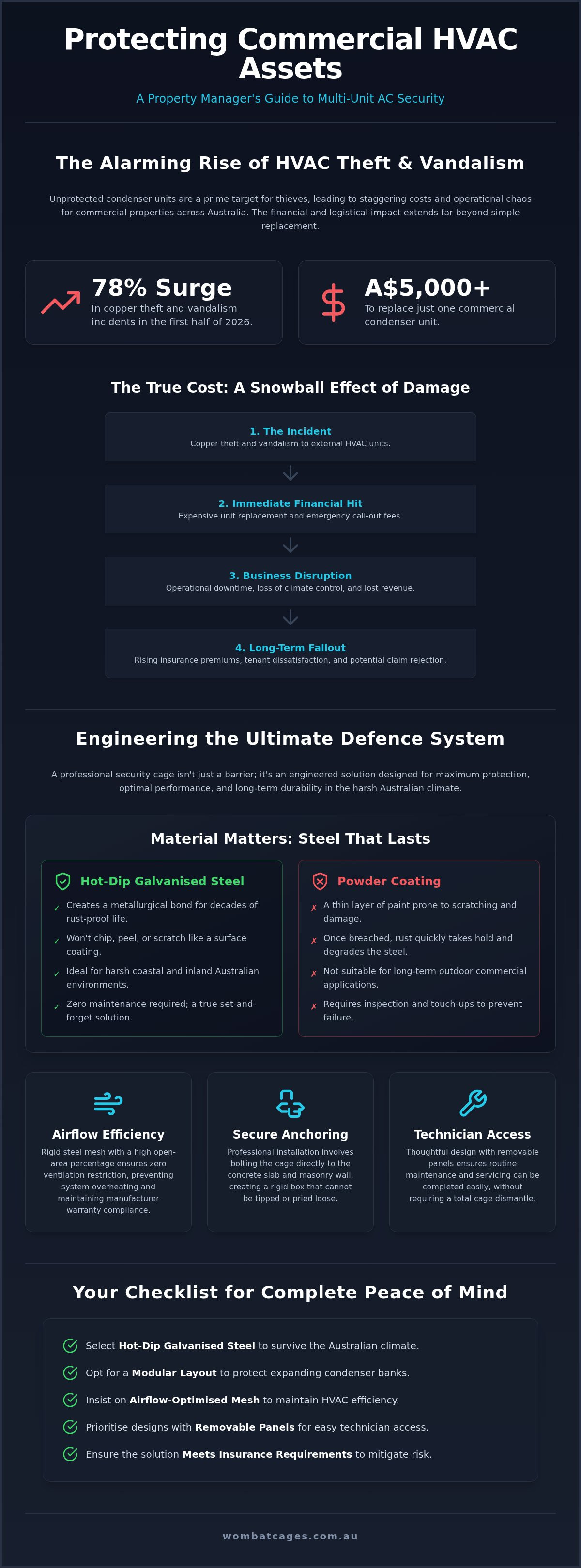
Copper theft and vandalism incidents surged by 78% in the first half of 2026. For commercial property owners across Australia, a bank of unprotected condenser units is a neon sign for thieves looking for a quick payout. Installing a multi unit AC security cage is no longer optional for high-risk sites. Replacing just one unit can cost upwards of A$5,000. When you manage a multi-tenant building, those replacement costs multiply fast. You've likely felt the frustration of rising insurance premiums or the daily stress of checking your equipment for damage. It's a massive liability that keeps property managers awake at night.
This guide shows you how a heavy-duty steel solution provides the permanent, rust-proof protection your site requires. We'll explain how to secure your assets with airflow-optimised mesh that stops thieves without killing your HVAC efficiency. You'll learn about mesh gauges, secure mounting techniques, and how to ensure your setup meets strict insurance requirements. We're covering everything you need to know to move from total vulnerability to complete peace of mind with a professional, multi-bay installation.
Key Takeaways
- Select hot-dip galvanised steel to ensure your security investment survives the harsh Australian climate without rusting or degrading.
- Customise your layout with a modular multi unit AC security cage to protect expanding condenser banks while maintaining professional aesthetics.
- Optimise airflow with rigid steel mesh designs that prevent system overheating and maintain original HVAC efficiency ratings.
- Prioritise technician access by choosing enclosures with removable panels, ensuring routine maintenance doesn't require a total cage dismantle.
- Meet insurance requirements and stop copper theft before it leads to a total building shutdown and expensive emergency repairs.
The Vulnerability of Multi-Unit HVAC Systems
Commercial Heating, ventilation, and air conditioning systems represent a massive capital investment. When these units are grouped together in a condenser bank, they become a high-value target for opportunistic thieves. A single multi unit AC security cage serves as a critical frontline defence. Without it, your equipment is exposed to anyone with a pair of bolt cutters. It's a vulnerability that can shut down an entire commercial operation in minutes.
Why Thieves Target Multi-Unit Condenser Banks
Thieves look for the path of least resistance. A row of five or ten units offers a high concentration of copper in one accessible spot. They don't need to break into the building. They just strip the lines and move on. Scrap copper prices in the Australian market remain high. This makes your condenser bank a lucrative shop for criminals. It's fast money for them, but a logistical nightmare for you. It's about efficiency for the thief; they get more metal with less effort. One night of work for a vandal can result in tens of thousands of dollars in damage to your property.
The True Cost of HVAC Vandalism
Damage often goes beyond stolen copper. Vandalism to delicate aluminium fins or internal compressors can render a unit useless. In 2026, a new air conditioning unit can cost a property owner A$4,000 to A$5,000 or more to replace. This figure doesn't include the cost of emergency call-out fees or lost business revenue. When climate control fails in a multi-tenant building, tenant dissatisfaction rises immediately. Business downtime leads to lost profits and broken lease agreements. One act of vandalism creates a snowball effect that hits your bottom line from multiple angles. It's not just a repair job. It's a threat to your building's operational viability.
Leaving high-value external equipment unprotected has serious insurance implications. Many Australian insurers now view a multi unit AC security cage as a standard requirement for commercial risk mitigation. If you don't take reasonable steps to secure your assets, your premiums will climb. In some cases, insurers may even reject claims for theft if the equipment was left completely vulnerable. Commercial risk is about scale. A residential unit theft is a nuisance. A commercial bank theft is a catastrophic operational failure. You aren't just protecting metal. You're protecting your business continuity and your professional reputation. Physical security is the only permanent solution to this rising threat.
Engineering the Ideal Multi-Unit AC Security Cage
A multi unit AC security cage must be more than a visual deterrent. It needs to be a physical fortress. Engineering these structures requires a balance between indestructible strength and mechanical necessity. If you over-engineer for security, you risk suffocating the condensers. If you under-engineer for materials, the Australian salt air will eat the cage within years. You need a solution that stands firm against both bolt cutters and corrosion. It is about building for the long term.
Hot-Dip Galvanised Steel vs. Powder Coating
Material selection is the first line of defence. Hot-dip galvanised steel is the only professional choice for commercial assets. During the process, the steel is submerged in molten zinc. This creates a metallurgical bond that won't chip or peel. Powder coating is often just a thin layer of paint. In high-traffic commercial zones, it scratches easily. Once the metal is exposed, rust takes hold. Galvanised steel offers decades of protection in inland areas and superior resistance in harsh coastal environments. It is a set and forget material that requires zero maintenance. It stays rigid and functional while other materials fail.
Mesh Design and Airflow Efficiency
Protecting the unit is pointless if the cage causes the system to fail. This is the airflow paradox. High-efficiency condensers require massive amounts of intake air to maintain pressure. Professional designs use rigid steel mesh with a high open-area percentage. This ensures zero ventilation restriction. Restricting airflow creates hot spots around the coils. These hot spots force the compressor to work harder. This leads to premature mechanical failure and higher energy bills. Proper engineering is also vital for manufacturer warranty compliance. Most HVAC brands will void a warranty if the enclosure restricts air movement. You need a design that provides security without compromising performance.
Structural integrity depends on how the cage is fixed. A professional multi unit AC security cage must be bolted directly to the concrete slab and the masonry wall. This dual-point anchoring prevents thieves from simply tipping the cage over or prying it from the ground. It creates a rigid box that cannot be bypassed without heavy industrial equipment. This level of physical security is consistent with guidelines found in resources like Homeland Security and the Indoor Environment, which highlights the need for securing critical infrastructure from external tampering. It is about creating a formidable physical barrier.
For property owners looking for maximum resilience, choosing the right specifications is non-negotiable. You can explore custom-configured multi-bay options to find a fit for your specific site requirements. Every weld and every bolt matters when you are defending thousands of dollars in equipment. Don't settle for flimsy alternatives that won't stand up to a determined attack.
Configuration Options for Large Condenser Banks
Commercial properties rarely rely on a single condenser. Banks of three, five, or ten units are common. Securing these assets requires a strategic approach to layout. A multi unit AC security cage can be configured as a continuous enclosure or a series of interconnected bays. This choice impacts both your budget and the physical footprint on-site. It is about finding the most efficient way to wall off your equipment from outside interference. Proper planning ensures no weak points are left for a thief to exploit.
Side-by-Side Multi-Bay Security Cages
Shared internal frames are the backbone of a multi-bay setup. By using a single continuous structure, you reduce the amount of raw material needed. This makes multi-unit enclosures more cost-efficient than buying individual cages for every unit. It also creates a cleaner, more professional look for the property. Visual uniformity matters for commercial curb appeal. Beyond aesthetics, shared frames increase the overall rigidity of the installation. A larger, heavier structure is significantly harder to tamper with or remove. It provides a united front against theft. Simple. Effective. Built to last.
Protecting Mixed-Size Units
Condenser banks often consist of different models. You might have a small unit sitting next to a massive commercial condenser. A standard split system security cage works well for isolated units, but large banks need custom-sized bays. Cages must be built with varied heights and depths within a single run. This ensures every unit has the correct clearance for intake and exhaust air. Consistent clearance is non-negotiable for system health. Industry experts emphasize that preventing HVAC theft requires a secure foundation and a cage that doesn't compromise the machine's operation. We design for the specific dimensions of your equipment bank.
Protecting the pipe run is the final piece of the puzzle. Thieves often target the exposed copper lines running between the unit and the building wall. A professional multi unit AC security cage should extend to cover these lines or include integrated line-set protection. Modular extensions allow you to add more bays as your infrastructure grows. If you add two more units next year, the cage system expands with you. It is a scalable security solution. This flexibility ensures your investment remains relevant as your building's cooling needs change. Protect the units. Defend the pipes. Secure the asset.
Critical Considerations: Installation and Maintenance Access
A multi unit AC security cage is a permanent fixture. It must not become a barrier to the people hired to fix your equipment. If a technician has to spend two hours dismantling a cage just to reach a valve, you pay for that time in labour costs. Efficiency on the tools translates to direct savings for the property owner. Professional design anticipates the needs of the mechanic while keeping the thief out. It is a balance of accessibility and resistance.
Designing for Technician Access
Standard clearance requirements for HVAC mechanics in Australia usually demand at least 600mm of working space around service panels. We design for this "knuckle room" to ensure tools can be used effectively. Hinged doors provide rapid entry for routine filter checks or pressure tests. For major component replacements, such as swapping out a compressor, removable bolt-on panels are the superior choice. These panels allow the technician to strip the cage back to its frame for total access. You must also ensure the electrical isolator switches remain visible and reachable. Safety compliance is just as important as security. Don't let your security solution become an OHS liability.
The Professional Installation Process
Rigidity starts at the base. A professional installation follows a strict sequence to ensure the structure remains a formidable barrier for decades. It isn't just about the cage; it's about how that cage interacts with the building. We follow a methodical approach:
- Assess the substrate: We prefer heavy-duty concrete pads for maximum anchor strength. If a pad isn't available, we secure frames to structural brickwork using high-load chemical anchors.
- Align the multi-bay frame: Every bay must be perfectly level. Proper alignment prevents vibration noise and ensures the mesh panels don't rattle against the condenser units during high-load operation.
- Fix with security fasteners: Standard hex bolts are a weakness. We use specialised tamper-resistant anchors that require specific industrial tools for extraction. This stops opportunistic thieves with basic toolkits.
Proper setup ensures the cage doesn't sag or shift over time. A sagging cage can block airflow or make it impossible to reattach service panels after a repair. This is where professional trade experience makes the difference. It's about doing the job once and doing it right. If you want to ensure your equipment is defended by a "Dependable Guardian" that still allows for easy servicing, you need a specialist approach.
Ready to protect your infrastructure? Contact us today to book our cage installation services and get your commercial units secured by experts.
Why Wombat Cages is the Choice for HVAC Security
Wombat Cages operates as the dependable guardian for your commercial assets. We don't waste time with abstract marketing jargon. We focus on physical strength and structural integrity. Every multi unit AC security cage we manufacture is a response to a specific threat. We understand that a building's climate control is its lifeline. If that line is cut, the building stops. Our designs are pragmatic and purpose-built for the Australian trades environment.
The No-Nonsense Wombat Advantage
Our no-nonsense approach means we prioritise utility over flair. We use hot-dip galvanised steel because it is the only material that survives decades of exposure to salt and sun. You speak directly to specialists who know the difference between a simple residential fix and a complex commercial installation. While we maintain a local business ethos, we offer national reach for property managers with portfolios across the country. Our cages are built to be permanent fixtures. They are rigid, uncomplicated, and effective. We build for the long term.
Next Steps for Your Property
Moving from vulnerability to total protection is a straightforward process. First, measure your condenser bank. You need the maximum height, width, and depth of the entire group. Don't forget to account for the space required for the pipe runs. Once you have these dimensions, contact our team for a site assessment. We evaluate the substrate to ensure the installation remains fixed under pressure. This professional oversight prevents common mistakes like blocking airflow or ignoring maintenance access. It is about doing the job once and doing it right.
A secure property is a profitable property. By installing a robust barrier, you eliminate the risk of copper theft and the resulting business downtime. It is a common-sense investment in asset protection. Our commitment is to provide a solution that is as honest and hardworking as the tradespeople who install it. Secure your assets today with a multi-bay security cage. We provide the peace of mind that comes from physical strength.
Secure Your Commercial Assets for the Long Term
Protecting a bank of condensers requires more than just a basic fence. It demands a barrier that stops thieves without killing your HVAC efficiency. You now understand why hot-dip galvanised steel is the only professional choice for the Australian climate. It provides a metallurgical bond that resists rust for over 20 years. Investing in a multi unit AC security cage is the most effective way to stabilise your insurance premiums and prevent catastrophic business downtime.
Wombat Cages offers heavy-gauge steel mesh designs that serve as a formidable deterrent. We provide nationwide installation support to ensure your cages are bolted down right the first time. Our focus remains on utility, durability, and total asset protection. You can stop worrying about copper theft and focus on running your business. It's time to move from vulnerability to total peace of mind.
Ready to defend your property? Request a Commercial Quote for Multi-Bay Cages and get the protection your building deserves. Secure your site today.
Frequently Asked Questions
Will a multi unit AC security cage void my HVAC manufacturer warranty?
A multi unit AC security cage won't void your manufacturer warranty as long as it maintains the required ventilation clearance. Most brands specify an open mesh design to prevent heat buildup and mechanical strain. Our cages use high-flow steel mesh to ensure the compressor operates within factory temperature limits. Always check your specific unit's manual for clearance minimums before starting an installation.
How much clearance is needed between the AC unit and the cage walls?
You typically need at least 600mm of clearance between the condenser and the cage walls for technician access. This space allows for proper coil cleaning and electrical servicing without obstruction. Some high-capacity commercial units may require more room for intake air to prevent overheating. We configure every enclosure to respect these mechanical boundaries while keeping the footprint as tight as possible.
Can a security cage prevent all types of copper theft?
No security measure is 100% impenetrable, but a heavy-duty steel cage stops the vast majority of opportunistic copper theft. Thieves look for the easiest target with the least resistance. Cutting through rigid, galvanised steel mesh requires industrial tools and significant time. Most vandals move on to an unprotected site rather than risking detection. It's about making theft too difficult to be profitable.
Are these cages resistant to rust in coastal Australian environments?
Our cages are highly resistant to rust in coastal Australian environments due to the hot-dip galvanisation process. This treatment creates a metallurgical bond between the zinc and the steel. It won't peel or flake like standard paint or powder coating. This protection is essential for properties near the ocean where salt spray destroys unprotected metal within months. It is a permanent solution for harsh climates.
How do technicians access the units for regular maintenance?
Technicians access the units through integrated hinged doors or removable panels designed specifically for maintenance. These panels allow for full entry to service valves and electrical boards without dismantling the entire structure. We prioritise "knuckle room" in our designs so mechanics can work efficiently. This ensures your security solution doesn't lead to higher labour costs during routine servicing or emergency repairs.
Can I add more bays to a multi-unit cage later on?
You can add more bays to your multi unit AC security cage as your HVAC infrastructure grows. Our modular systems are designed to be scalable for commercial properties. New sections can be bolted onto the existing frame to protect additional condensers. This flexibility makes it a smart long-term investment for buildings that plan to expand their cooling capacity or add new tenants in the future.
What is the difference between a custom cage and a flat-pack option?
A custom cage is engineered for the specific dimensions and obstacles of your site, while flat-pack options come in standard sizes. Custom solutions handle uneven ground, wall obstructions, and varying unit heights better than pre-made kits. For large commercial banks, custom configurations ensure every unit has proper airflow and security. Flat-packs are often lighter and less rigid than our heavy-duty commercial frames.
Is professional installation required for commercial security cages?
Professional installation is highly recommended for commercial cages to ensure maximum structural rigidity and security. Securing the frame to concrete slabs or masonry requires specialised heavy-duty anchors and trade experience. An incorrectly installed cage can vibrate, block airflow, or be easily pried off the ground. Our team ensures the installation meets insurance requirements and provides a permanent barrier against tampering and vandalism.


