
A rooftop full of exposed HVAC units isn't just essential infrastructure. It's an open invitation for copper thieves. For property managers, a single night of activity on a loading dock can lead to thousands of dollars in repairs and lost trade. You need shopping centre condenser protection that works under pressure. You've likely seen flimsy cages that rust out. Some even cause compressors to overheat by blocking the air. It's a frustrating balance between security and performance.
We're here to show you that you don't have to choose. You can safeguard your large-scale condenser banks while keeping your HVAC system at peak efficiency. This article covers the essentials of modular steel security. We'll look at ensuring technician access and meeting strict airflow requirements to optimise performance. We'll also explore how permanent, rust-proof enclosures help reduce insurance premiums. It's about turning a vulnerable asset into a hardened fortress that stands up to the elements and the opportunists.
Key Takeaways
- Learn why shopping centre condenser protection is essential for stopping organised copper theft and loading dock vandalism.
- Discover how modular multi-bay security cages allow you to secure long rows of HVAC units with custom configurations.
- Understand why hot-dip galvanised steel mesh is the only viable choice for Australian conditions; it offers maximum durability without restricting airflow.
- See how removable or hinged panels ensure technicians maintain full access for servicing while keeping the units bolted down.
- Learn how a permanent security layer can lead to lower insurance premiums through better asset protection.
Protecting Shopping Centre HVAC: The High Stakes of Asset Security
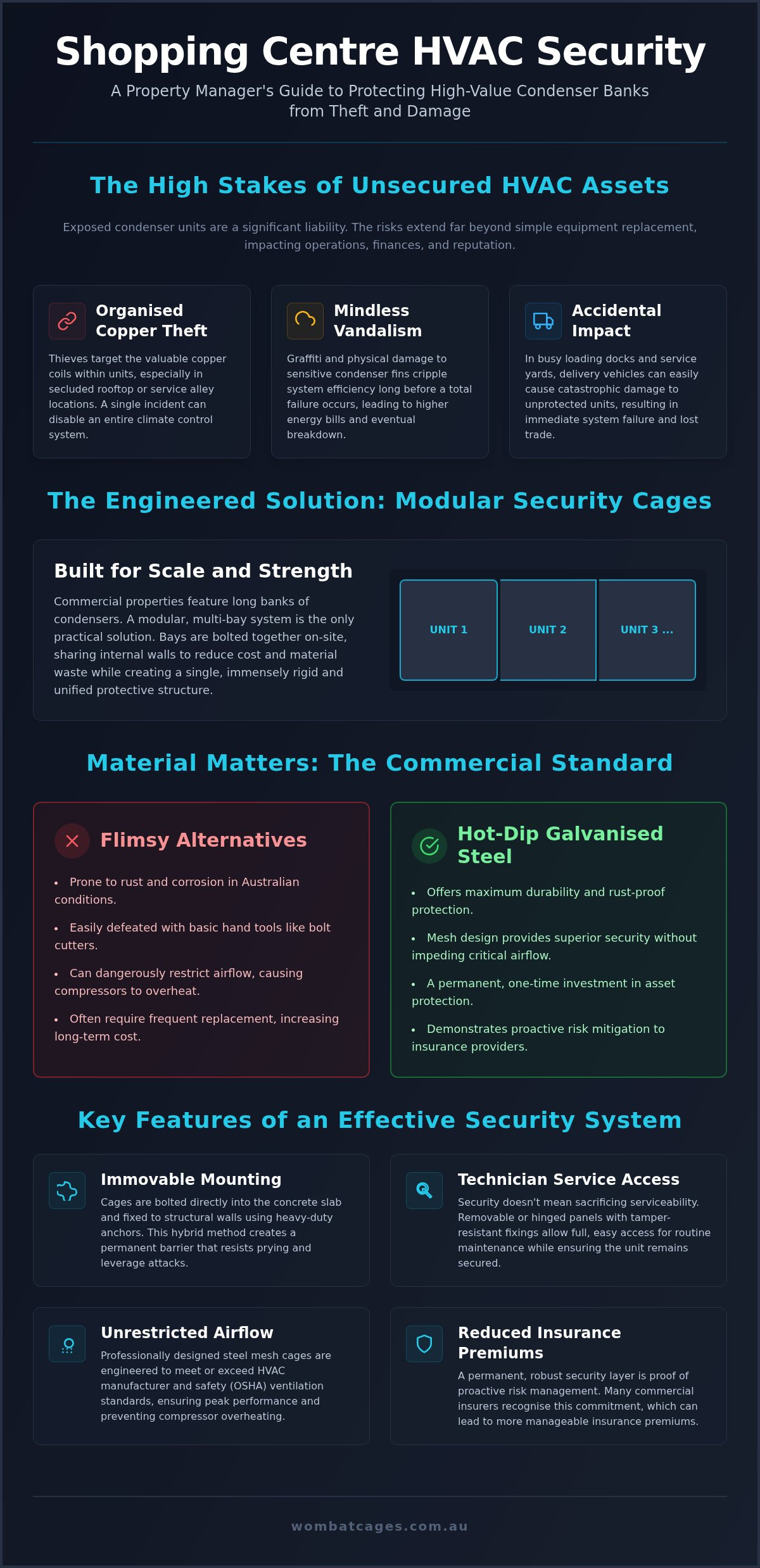
Effective shopping centre condenser protection isn't an optional extra. It's a critical infrastructure layer. These systems secure high-value Heating, ventilation, and air conditioning (HVAC) assets against multiple threats. Property managers face three main risks. Organised copper theft is the most damaging. Mindless vandalism causes constant headaches. Accidental impact from delivery trucks in busy loading docks can lead to instant system failure. Each of these threats can take a unit offline in minutes.
The financial ripple effect goes well beyond the cost of replacement parts. When climate control fails, retailers lose trade immediately. Shoppers don't stay in a hot centre. Food spoilage becomes a risk for supermarket tenants. Beyond the immediate loss of trade, there's the matter of insurance. Most commercial insurers now look for evidence of proactive asset protection. Proper shopping centre condenser protection satisfies these requirements; it demonstrates a commitment to risk mitigation that can help keep premiums manageable.
Why Shopping Centres Are Prime Targets
Thieves target shopping centres because the rewards are high. Roof-mounted banks look safe, but they're often secluded from street view. This gives criminals the cover they need to work undisturbed after hours. Service alleys and loading docks are even more vulnerable. A thief can strip a unit of its copper in minutes without a heavy-duty barrier. Shopping centre HVAC systems are high-risk assets because they concentrate massive amounts of valuable copper in accessible, often unmonitored locations.
The Hidden Costs of Unsecured Equipment
Emergency repairs are expensive. Compare a one-time investment in a multi unit AC security cage to the price of a full system replacement. The choice is clear. Reputational damage is another factor. A shopping centre that loses air conditioning during an Australian summer heatwave faces more than just repair bills. Tenancy agreements often have strict climate control clauses; failing to meet them can lead to legal disputes. Vandalism in public areas adds another layer of risk. Graffiti and physical damage to condenser fins can cripple efficiency long before a total failure occurs. Securing these units ensures the centre remains a comfortable, functional environment for everyone.
Designing an Effective Bank of Condensers Security Cage
Shopping centres don't just have one or two units. They have rows. Effective shopping centre condenser protection requires a modular approach. We call these multi-bay systems. They're built for scale. They're designed to wrap around long HVAC banks without leaving gaps. Every unit in the row gets the same level of security. It's a systematic way to defend a massive investment. You can't just throw a generic guard over a commercial unit and expect it to hold. It needs to be purpose-built.
Multi-Bay Configurations for Large Footprints
Large retail sites often cluster their units in long rows on rooftops or in service yards. A single, massive enclosure is impractical. It's too heavy to move. It's hard to install. Instead, we use modular bays that bolt together on-site. You can add as many as you need. This design uses shared internal walls between bays. It reduces material waste. It keeps costs lower for the property owner. It also creates a unified structure that is far more rigid than individual cages. If you have isolated satellite units on other parts of the roof, check our split system security cage guide for those specific requirements.
Mounting and Fixing Standards
Security is only as good as the mounting. A cage that can be pried off is useless. We bolt directly into the concrete slab using heavy-duty anchors. We also fix to the structural wall where possible. This hybrid method prevents thieves from using a crowbar for leverage. It creates a permanent, immovable barrier. The goal is to make the cage part of the building itself. It should be a deterrent before a thief even touches their tools. If they see a solid, bolted-down frame, they usually move on to an easier target.
We use tamper-resistant fixings for every panel. You can't just unscrew these with a standard toolkit. This is about physical strength. It's about resilience. While we focus on security, we never ignore safety or performance. Our designs align with professional OSHA ventilation standards to ensure the system remains safe for technicians and effective for the building's climate needs. Flimsy wire mesh doesn't cut it. You need a rigid steel frame that stands up to an angle grinder or a sledgehammer. For larger retail footprints, a professional multi-bay security cage is the only way to ensure total asset protection.
Comparing Materials: Why Galvanised Steel Is the Commercial Standard
Material choice is the foundation of any security strategy. For shopping centre condenser protection, hot-dip galvanised steel is the only viable option. It's built for the rigours of the Australian climate. Whether your units sit on a salt-sprayed coastal roof or in a dusty service yard, steel provides the necessary resistance. Rooftop units face extreme UV radiation and intense heat. Flimsy materials warp or degrade under these conditions. Steel remains rigid. It doesn't buckle under pressure. Unlike solid covers, heavy-gauge steel mesh offers a perfect balance. It provides high visibility for maintenance checks while maintaining the structural integrity needed to deter thieves. It's about strength-to-weight performance. This mesh is difficult to cut with manual tools. Power tools will make enough noise to alert site security.
Adhering to ASHRAE standards requires careful consideration of how materials affect the unit's thermal environment. Steel mesh ensures that heat rejection isn't hindered. This protects the compressor from premature failure. Steel doesn't flinch. It's built to last.
Steel vs. Aluminium vs. Plastic
Many property owners consider aluminium for its light weight. This is a mistake. Aluminium is a soft metal. A pair of bolt cutters or a cordless saw will move through it like butter. Thieves targeting copper often see aluminium cages as a secondary prize. They'll steal the cage for scrap too. Plastic covers are even worse. They are purely aesthetic. They offer zero security value and often restrict airflow, leading to efficiency drops. Steel is the only material that offers true peace of mind.
| Feature | Hot-Dip Galvanised Steel | Aluminium | Plastic |
|---|---|---|---|
| Durability | Maximum | Moderate | Low |
| Vandal Resistance | High | Low | None |
| Airflow | Excellent (Mesh) | Moderate | Poor |
| Lifespan | 20+ Years | 5-10 Years | 1-3 Years |
The Hot-Dip Galvanising Process
Hot-dip galvanising isn't just a coating. It's a chemical bond. The steel is submerged in molten zinc. This creates a layer that is tougher than the base metal itself. It has a unique self-healing property. If the cage gets scratched by a delivery trolley or a technician’s ladder, the surrounding zinc sacrifices itself to protect the exposed steel. This prevents rust from spreading. Powder coating can't do this. Once powder coating chips, the cage begins to rot from the inside out. In a busy loading dock, equipment takes a beating. A galvanised cage can handle a knock from a pallet jack without losing its protective layer. Hot-dip galvanisation is the undisputed gold standard for outdoor HVAC security in high-traffic commercial zones.
Airflow, Compliance, and Technician Access Standards
Technicians often view security cages as a hurdle. It's a fair point. If a cage turns a simple service call into a three-hour ordeal, it has failed. Effective shopping centre condenser protection must balance heavy-duty security with immediate maintenance access. You shouldn't have to choose. A cage that restricts airflow will kill a compressor long before a thief does. High head pressure leads to increased energy consumption and premature component failure. Following manufacturer guidelines for clearance is essential for keeping warranties intact. It ensures the system operates within its designed parameters.
Ensuring Maximum Airflow Efficiency
Airflow is the lifeblood of a condenser. We use an open mesh design to ensure maximum "free area" for air movement. This prevents static pressure drops that choke the system. Solid-sided covers are a risk. They trap heat and cause the unit to recirculate its own exhaust. This drastically shortens the lifespan of the condenser. To maintain peak HVAC performance, follow these minimum clearance standards:
- Intake Clearance: Maintain at least 150 to 300mm between the mesh and the unit coils.
- Service Access: Allow 500 to 600mm on the control panel side for tool clearance.
- Discharge Area: Ensure the top of the cage is completely open or uses high-flow mesh to prevent air recirculation.
Adhering to these gaps ensures the unit breathes properly. It prevents the "short-cycling" that leads to expensive emergency repairs during a heatwave. It also ensures you remain compliant with the specifications set by the equipment manufacturer.
Maintenance Access and Security
Security shouldn't frustrate the maintenance tradie. We design our enclosures with the technician in mind. Access points use heavy-duty padlocks protected by shrouded hasps. These shrouds make it nearly impossible for thieves to use bolt cutters on the lock. For routine checks, a simple hinged door provides entry to the electrical panels. However, major repairs like a compressor replacement require more space.
We use lift-off panels for these scenarios. A technician can remove an entire side of the cage in minutes. This provides total access to the unit's internal components. Once the job is done, the panel bolts back into place, restoring the security perimeter. It's a pragmatic approach to asset protection. If you need a solution that satisfies both your security team and your HVAC contractors, consider our professional cage installation services for your next site upgrade. This ensures your shopping centre condenser protection is installed to the highest industrial standards.
Implementing Multi-Bay Security Solutions with Wombat Cages
Securing a commercial HVAC bank is a serious undertaking. It requires more than just a few panels. Wombat Cages provides a complete shopping centre condenser protection system. We focus on heavy-duty, hot-dip galvanised steel. It's purpose-built for the Australian environment. We don't do flimsy. We don't do good enough. Our goal is total asset protection through structural strength. Every enclosure we build is a statement of permanence. It tells thieves that your site is not an easy target. It's about providing the quiet confidence that your infrastructure is safe.
The Wombat Cages Installation Process
A professional installation is the difference between a secure site and a target. Our process starts with a precise site measure. We account for every unit in the bank. We look at clearances, pipework, and technician access. Every multi-bay configuration is modular. This allows us to scale the protection to any footprint. Our teams operate nationally across Australia. We ensure every cage is level, rigid, and bolted down for maximum security. These cages stand up to the harshest Australian sun. They resist salt spray in coastal regions. It's a permanent solution for a permanent problem. We don't leave site until the job is done right. The frames are bolted directly to the slab or structural walls. This creates a rigid barrier that resists leverage. It's about building things that last.
Next Steps for Facility Managers
Don't wait for the next theft to happen. A proactive approach is always cheaper than emergency repairs. Conduct an audit of your current HVAC vulnerabilities. Look for exposed copper lines. Check for easy access points in service alleys. If your units are sitting open, they're at risk. We work with facility managers to design custom-configured multi-bay solutions. Whether you have three units or thirty, we can secure them. Our cages provide the Dependable Guardian your infrastructure needs. We understand the pressure of managing a major retail asset. You need solutions that work without constant supervision. Our cages are maintenance-free. Once they are installed, they do their job for decades. No rust. No sagging. No excuses. It's straightforward protection for complex sites.
Get a custom quote for your shopping centre condenser protection today. We provide the physical strength you need to keep your centre running. Peace of mind comes from knowing your assets are defended by heavy-duty steel. Contact our team to discuss your specific site requirements. We'll help you secure your HVAC bank and protect your bottom line.
Securing Your Centre’s Climate Control
Protecting your HVAC assets is about more than just a cage. It's about ensuring business continuity. We've explored how modular multi-bay systems offer the flexibility needed for large retail footprints. You now know that hot-dip galvanised steel provides the necessary resistance to the Australian sun and salt spray. High-flow mesh ensures your units breathe. Removable panels keep your technicians happy. It's a pragmatic solution to a complex problem.
Implementing professional shopping centre condenser protection is a long-term investment in risk mitigation. It stops the cycle of repeat theft and keeps your insurance provider satisfied. Wombat Cages provides the structural strength required for high-traffic environments. Our systems are built to last. They offer the permanence that flimsy alternatives lack.
Don't wait for a heatwave and a stripped unit to take action. Secure your commercial HVAC assets with Wombat Cages. Our solutions feature hot-dip galvanised steel for 20+ year durability. These custom-configured multi-bay systems are trusted by facility managers across Australia. Take the first step toward total asset security today.
Frequently Asked Questions
How does a security cage affect the airflow of my HVAC system?
A correctly designed security cage has zero negative impact on your HVAC system's performance. We use an open mesh design that provides maximum free area for air movement. This prevents heat build-up and static pressure drops. Maintaining these airflow standards is a core part of effective shopping centre condenser protection. It keeps the compressor running within its intended temperature range and prevents efficiency loss.
Can a bank of condensers security cage be customised for different unit sizes?
Yes, we can configure our multi-bay systems to accommodate units of varying heights and depths within the same bank. The modular nature of our steel enclosures means we don't rely on a one-size-fits-all approach. We conduct a site measure to ensure the frame wraps tightly around your specific equipment. This eliminates gaps that thieves could exploit while maintaining a professional, uniform appearance across the site.
What is the best material for protecting outdoor AC units from copper theft?
Hot-dip galvanised steel is the industry standard for commercial asset protection. It offers superior hardness compared to aluminium and far better weather resistance than painted or powder-coated alternatives. The zinc coating provides a self-healing layer that prevents rust from spreading if the cage is scratched. This material is difficult to cut with manual tools, making it the most effective deterrent against organised copper theft.
Do these cages allow enough room for a technician to service the units?
Our cages are built with the technician's needs in mind. We include hinged access doors for routine maintenance and electrical checks. For major repairs, we use lift-off panels that allow a contractor to remove an entire side of the cage in minutes. This provides full access to the unit's internals without compromising the structural integrity of the main frame once the job is finished.
How are the cages secured to the ground or wall to prevent removal?
We bolt our frames directly into the concrete slab or structural walls using heavy-duty masonry anchors. This creates a rigid connection that prevents thieves from using crowbars to pry the cage away. We also use tamper-resistant fixings on all panels. These require specialised tools to remove, ensuring that your shopping centre condenser protection remains an immovable barrier that can't be simply unscrewed or lifted.
Are Wombat Cages suitable for coastal shopping centres with high salt spray?
Wombat Cages are specifically designed for harsh Australian coastal environments. The hot-dip galvanising process creates a thick, metallurgical bond between the zinc and the steel. This provides maximum protection against salt spray and high humidity. It's a far more durable finish than powder coating, which often bubbles and peels in seaside locations. Our cages will remain rust-free and structurally sound for decades.
What is the difference between a standard cage and a multi-bay security cage?
A standard cage is a standalone unit designed for a single split system. A multi-bay security cage is a modular system built for rows of condensers. Multi-bay designs use shared internal walls, which reduces material waste and keeps the footprint compact. This creates a continuous, rigid line of defence that is much harder to breach than a series of individual, unconnected cages.
Will installing a security cage void my air conditioner manufacturer warranty?
Installing a security cage won't void your manufacturer warranty as long as you maintain the required clearances. We design our enclosures to meet the specific ventilation and service space requirements set by HVAC manufacturers. By ensuring the unit doesn't overheat and remains accessible for servicing, our cages actually help protect your warranty. They prevent the accidental damage and theft that manufacturers don't cover.


