
A thief nets fifty dollars from your copper pipes, but you're left with a fifteen thousand dollar repair bill and a sweltering warehouse. It's a brutal value asymmetry. Metal theft incidents have surged by 40 per cent in recent reporting cycles across the country. This leaves Australian property owners facing massive insurance premiums and crippling business downtime. You likely already know that a CCTV camera only films the crime. It doesn't stop the blade. Effective condenser copper theft prevention requires a shift from passive observation to active, physical resistance.
You need a solution that protects your assets without choking your compressors. We've designed this guide to help you secure your HVAC units using proven physical barriers and strategic techniques built for the Australian heat. You'll learn how to implement a "set and forget" security system that keeps thieves out while maintaining manufacturer-mandated airflow. We'll examine hot-dip galvanised steel cages and rigid mounting methods that stay put. It's time to stop worrying about your external units and reclaim your peace of mind with a permanent, professional defence.
Key Takeaways
- Understand the massive financial gap between a thief's scrap profit and your five-figure HVAC repair bill.
- Identify why standard installations are soft targets and pinpoint the most vulnerable components of your outdoor unit.
- Implement effective condenser copper theft prevention by prioritising rigid physical barriers over passive electronic monitoring.
- Follow a practical security checklist to audit your unit placement and strengthen your property's perimeter defence.
- Learn how engineered steel mesh enclosures provide permanent protection while maintaining critical system airflow and technician access.
The Rising Risk of Condenser Copper Theft in Australia
Copper theft is the surgical, often violent removal of refrigerant lines and internal coils from an air conditioning unit. Thieves strip these components to sell for their raw scrap value. In the current Australian market, clean copper scrap fetches between $8.00 and $12.50 per kilogram. While the thief might only walk away with a small payment, the damage left behind is catastrophic. This trend is part of a wider surge in scrap metal and copper theft across the country. State utilities have reported that incidents involving metal tampering have jumped by 40 per cent recently. Property owners are finding that standard security measures are no longer enough.
Effective condenser copper theft prevention starts with understanding the value asymmetry of the crime. A criminal sees your external HVAC unit as a soft target. It sits outside. It is often in a dark alley or behind a commercial building. It is accessible and unmonitored. Within sixty seconds, a thief with a battery-powered grinder can render a five-figure asset useless. The impact is not just financial. It is a direct hit to your operational continuity.
Why Thieves Target Your HVAC System
Thieves prioritise speed and ease of resale. Most outdoor condensers are tucked away from street view. This provides the cover of darkness needed for a quick strike. A thief can strip the external line set and internal coil in under two minutes. They don't care about the R32 refrigerant venting into the atmosphere. They ignore the fire risk of cutting through lines. They only see the quick cash available at illicit scrap yards. Because copper is a global commodity, local crime rates track closely with international price hikes. When copper prices rise, your air conditioner becomes a more attractive target.
The Real Cost of a Security Breach
The financial fallout extends far beyond the price of a few metres of pipe. If a thief cuts your lines, you face several compounding costs. The bill arrives quickly. It is often much higher than expected.
- Total Unit Replacement: If the internal coils are ripped out, a new condenser often costs between $1,500 and $4,500 for residential units. Commercial systems can easily exceed $15,000.
- Specialist Labour: You must hire an ARCtick licensed technician to re-pipe and re-gas the system. This involves high hourly rates and expensive refrigerant replacement.
- Electrical and Mechanical Damage: Rapidly cutting lines can cause electrical shorts or allow moisture into the compressor. This often leads to total mechanical failure.
- Insurance Hikes: Claiming for theft often leads to higher premiums and a significant excess payment.
Business downtime is the final blow. A cooling failure in an Australian summer can force a retail store to close. It can cause inventory loss in a temperature-controlled warehouse. These hidden costs make a one-time investment in physical protection a common-sense business decision.
Identifying Vulnerabilities in Your Outdoor Unit
Standard HVAC installations prioritise ease of maintenance over security. They are not built to withstand a criminal with a battery-powered grinder or a simple crowbar. Most outdoor units sit on plastic brackets or loose rubber pads that offer zero structural resistance. A thief can easily shift or tilt the unit to reach the copper piping hidden behind the casing. These flimsy mounting points make the system a soft target. If your unit is not bolted down, it can be manipulated in seconds. Thieves use basic hand tools to bypass standard plastic covers, leaving your expensive assets completely exposed.
Visibility and lighting are critical factors in your property's defence profile. Units hidden in shadows or behind overgrown garden beds provide a safe, unmonitored workspace for intruders. Effective condenser copper theft prevention requires a clear line of sight from the street or nearby security cameras. Without this visibility, a thief has the time they need to dismantle your equipment without being noticed. This logic follows established Australian Institute of Criminology theft prevention strategies regarding target hardening. If a criminal feels they are being watched, they are less likely to strike.
Exposed Line Sets: The Weakest Link
Insulated copper lines are the most vulnerable part of any split system. They are the first thing a thief looks for because they represent the easiest loot. These lines carry high-pressure refrigerant that vents instantly when cut. A "quick snip" with bolt cutters causes immediate environmental damage and creates an expensive repair bill. Standard PVC trunking is purely aesthetic and snaps under the slightest pressure. Once the plastic is gone, the copper is ready to be stripped. This often leads to moisture entering the compressor, which destroys the entire unit.
Ground-Mounted vs Wall-Mounted Risks
Ground-mounted units are highly accessible. They allow a thief to work at waist height with maximum leverage. If these units are not bolted directly into a concrete slab, the entire condenser can be hauled away or tipped over to access the base. Wall-mounted units offer a different set of risks. While they require a ladder, they often sit on simple metal brackets that can be pried from the masonry. A thief can use a crowbar to tear the unit from the wall, causing it to fall. This impact usually results in total mechanical failure and voids any manufacturer warranty.
If your unit is currently sitting unprotected, upgrading to a single split system security cage is a practical way to fix these vulnerabilities and secure your equipment permanently.
Physical Barriers vs Electronic Security Deterrents
Many property managers rely on digital eyes to protect their assets. They install high-definition cameras and motion-sensor lights. While these tools provide a sense of oversight, they rarely achieve effective condenser copper theft prevention on their own. Electronic security is a reactive measure. It records the damage as it happens but does nothing to stop a blade from hitting the copper. By the time a security alert reaches your phone, the thief has already vented the refrigerant and vanished. You're left with clear footage of a masked intruder and a fifteen thousand dollar repair bill.
The Limitations of Passive Monitoring
CCTV footage is often a post-mortem tool rather than a deterrent. Modern thieves are well-aware of camera placements. They wear hoodies, masks, and gloves to obscure their identity. This renders the footage useless for police identification. Even with clear images, the path to prosecution is difficult. Despite strict Scrap Metal Industry Act regulations that ban cash payments and require photo ID, illicit trade continues in the shadows. Response times are another critical failure point. A professional can strip a unit in under two minutes. Police or private security guards simply cannot arrive fast enough to intervene. In industrial zones, loud alarms are frequently ignored by neighbours who assume it is a false trigger. Motion-sensor lights are similarly ineffective. In commercial areas where high ambient light or frequent movement is common, these lights are easily ignored by both the public and the criminals.
The Strength of Galvanised Steel Enclosures
Physical denial is the only definitive way to secure your equipment. A heavy-duty steel cage changes the equation for a criminal. It moves the target from "easy pickings" to "too much effort." If a thief cannot reach the copper line sets, they cannot steal them. Hot-dip galvanised steel enclosures provide the structural integrity needed to resist prying, cutting, and blunt force attacks. These cages are bolted directly to concrete slabs or masonry walls. This creates a rigid barrier that cannot be bypassed with simple hand tools. The psychological impact is immediate. A caged unit signals that the property is hardened. It forces the intruder to look for a softer target elsewhere. This is the core of active condenser copper theft prevention. You are making the crime physically impossible rather than just visible on a screen.
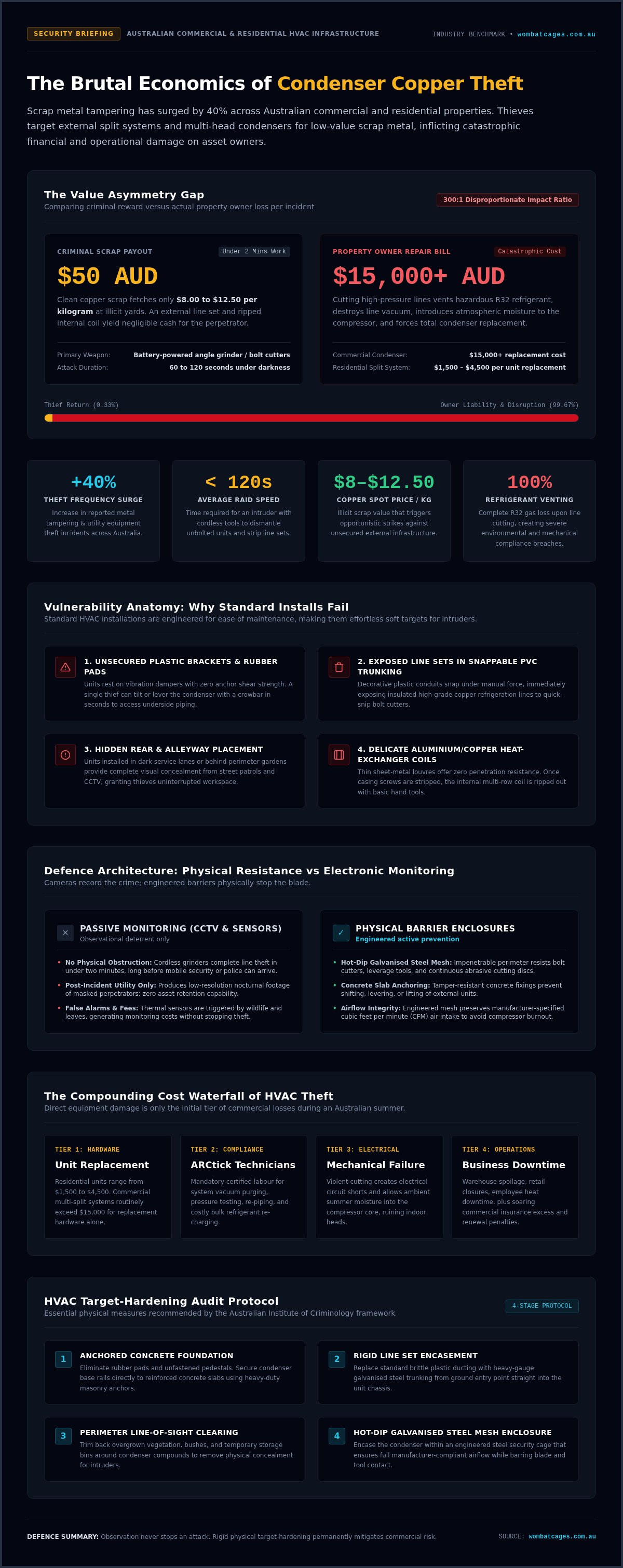
Condenser Copper Theft Prevention Checklist
Securing your HVAC assets requires a methodical approach. You cannot rely on a single lock or a lone camera. A robust condenser copper theft prevention strategy involves hardening every layer of your property. Start with a thorough audit of your unit's placement. While many owners try to hide condensers behind screens or plants for aesthetic reasons, this often provides the perfect cover for a thief to work undisturbed. A unit that is visible from a well-lit area but physically inaccessible is far safer than one tucked away in a dark corner.
Your perimeter is the first line of defence. Ensure that boundary fencing is intact and that gates are fitted with high-quality locks. Once an intruder is on-site, the goal is to make the unit itself impossible to strip. This means installing heavy-duty steel security cages that are bolted directly to both the masonry wall and the concrete ground slab. This dual-point mounting prevents the cage from being pried away or toppled. It is also vital to ensure the cage covers the line sets entirely, specifically where they enter the building. If a thief can see exposed copper between the cage and the wall, they will cut it there.
Schedule regular inspections with your maintenance team. Technicians should look for more than just mechanical performance. They need to check for signs of tampering, such as loosened bolts, cut mesh, or scratched paint on the trunking. Catching these early signs of "casing" can prevent a full-scale theft later. You can secure your site by choosing a single split system security cage designed for maximum rigidity and resistance.
Mechanical Security Best Practices
The hardware you use defines the strength of your barrier. Always use tamper-proof bolts and fixings. These require specialised tools for removal, which most opportunistic thieves do not carry. Ensure the structure is made from hot-dip galvanised steel. This treatment prevents rust from weakening the metal in the harsh Australian climate. If the steel corrodes, the structural integrity vanishes. Pay close attention to the mesh size. It must be tight enough to block hands and tools, yet open enough to maintain the airflow required by your manufacturer's warranty.
Environmental Deterrence
Physical barriers work best when the environment supports them. Trim back any bushes, trees, or hedges that create blind spots. You want a clear line of sight to the equipment. Consider laying loose gravel around the base of the unit. The sound of footsteps on gravel acts as a natural acoustic alarm that thieves hate. Finally, display clear warning signs. Stating that the unit is protected by physical security and active monitoring can be enough to make a criminal move to an easier target.
Engineered Protection: The Wombat Cages Advantage
Wombat Cages builds for the long haul. We use hot-dip galvanised steel because it is the only material that survives the Australian coast. Salt air and extreme UV radiation destroy standard powder-coated finishes and thin aluminium alternatives. Our cages remain rustproof inside and out. This structural integrity is vital for long-term condenser copper theft prevention. A rusty cage is a weak cage. We provide a barrier that stays rigid and dependable for the life of your building. It is a pragmatic solution designed for local conditions.
Commercial sites often face unique challenges with multiple outdoor units. We offer the flexibility of single and multi-bay configurations. These can be linked to protect entire banks of HVAC equipment. This modular approach ensures that every condenser, regardless of its size or location, is fully enclosed. We also prioritise operational efficiency. Every cage features dedicated access points. This allows your HVAC technician to perform routine maintenance or repairs without the need for complex disassembly. Security should never be a barrier to serviceability.
Maximum Airflow for System Health
Solid security screens or tight wooden slats are a death sentence for HVAC compressors. They trap heat and cause units to overheat. This leads to high-pressure lockouts and premature mechanical failure. Wombat Cages uses an open mesh design engineered for 360-degree ventilation. Your system breathes exactly as the manufacturer intended. The precision-engineered mesh aperture facilitates unrestricted air intake and exhaust, ensuring the fan motor operates within its designed static pressure limits. You get absolute physical protection without sacrificing the energy efficiency or the lifespan of your unit.
Professional Installation and Support
A security barrier is only as strong as its mounting points. DIY solutions often rely on shallow screws or flimsy brackets that can be pried loose with a crowbar. We prioritise cage installation services that bolt the structure directly into masonry walls and concrete slabs. This creates a rigid, unmoving fortress around your assets. For complex commercial sites, we provide custom configurations that account for intricate pipe runs and uneven surfaces. We ensure there are no gaps left for a thief to exploit. It is a professional-grade defence for a high-stakes problem. You can find more detail in our comprehensive guide to the split system security cage.
Protect your assets today with Wombat Cages.
Hardening Your Property Against Metal Theft
Leaving your outdoor HVAC units exposed is a risk that simply isn't worth taking. We've established that while cameras might film the act, only a rigid steel barrier stops the blade. A one-time investment in physical security prevents the multi-thousand dollar repair bills and business downtime that follow a copper strike. It's about shifting from vulnerability to total protection with a solution that's as hardworking as you are.
Choosing the right condenser copper theft prevention strategy means balancing security with system performance. Our custom-engineered hot-dip galvanised steel cages provide an industrial-strength shield while allowing for maximum airflow and easy technician access. We offer a professional national installation service to ensure your cages are bolted directly to walls and ground for ultimate rigidity. You can walk away knowing your assets are defended by a specialist. Get a Quote for Your Security Cage today. Secure your equipment and focus on running your business without the constant worry of theft.
Frequently Asked Questions
Will a security cage void my air conditioner manufacturer warranty?
A properly designed enclosure won't void your manufacturer warranty. Most brands, such as Daikin or Mitsubishi, require specific clearances to prevent overheating. Our cages use an open mesh design that maintains these airflow requirements. This prevents the compressor from straining or tripping on high pressure. You keep your warranty intact while securing your equipment. It's a common-sense approach to condenser copper theft prevention that prioritises system health.
How does a steel cage affect the airflow and efficiency of my AC unit?
Steel cages have a negligible effect on efficiency if they feature a high free-airflow ratio. Wombat Cages use a wide-aperture mesh that allows the fan motor to pull and exhaust air without resistance. Solid covers or tight slats can cause a 15 to 50 per cent drop in efficiency. Our engineered mesh avoids this trap. Your unit continues to run at its rated EER while remaining physically protected from intruders.
Can a technician still service my air conditioner if it is inside a cage?
Technicians can service your unit easily because the cages are designed with maintenance in mind. We include specific access panels or removable sections that allow a licensed trade to reach the electrical and refrigeration components. You don't need to dismantle the entire structure for a routine service. This design ensures your HVAC professional can work efficiently while the cage continues to defend the unit against opportunistic theft during off-hours.
Is hot-dip galvanised steel better than aluminium for theft prevention?
Hot-dip galvanised steel is far superior to aluminium for high-security applications. Aluminium is a soft metal that thieves can cut through quickly using basic hand tools or small battery-powered saws. Steel provides the structural hardness and weight needed to resist prying and blunt force. The hot-dip galvanising process also ensures the cage doesn't rust. This maintains the strength of the barrier in harsh Australian coastal environments for decades.
How much does it cost to replace stolen copper from an AC unit?
Replacing stolen copper is a major expense that far outweighs the scrap value of the metal. For a residential split system, you can expect to pay between $1,500 and $4,500 for parts and labour. Commercial repairs often range from $7,000 to over $15,000. These costs include new line sets, expensive refrigerant re-gassing, and the hourly rates of licensed ARCtick technicians. Prevention is always cheaper than a total system rebuild.
What is the best way to secure a multi-unit HVAC system on a commercial roof?
Multi-bay security cages are the most effective solution for commercial roof banks. These modular systems link together to wrap around multiple condensers in a single, rigid enclosure. We bolt the frames directly into the roof structure or concrete plinths to prevent prying. This creates a unified fortress that protects every unit in the bank. It's a professional way to secure high-value commercial assets that are otherwise easy targets for rooftop intruders.
Can thieves cut through a galvanised steel security cage easily?
Cutting through a heavy-duty steel cage is difficult and requires noisy power tools. Most thieves look for soft targets they can strip in under two minutes with silent hand tools. A galvanised steel barrier forces them to use grinders, which creates heat, sparks, and significant noise. This noise increases the risk of detection. Most criminals will simply move to an unprotected property rather than attempt to breach a hardened steel enclosure.
Do insurance companies offer discounts for installing AC security cages?
Many Australian insurance providers look favourably on target-hardening measures like security cages. While every policy is different, physical protection reduces the likelihood of a high-value claim. This can lead to lower premiums or a reduced excess in some cases. You should check with your specific insurer to see if they offer incentives for condenser copper theft prevention. Protecting your unit is a proactive step that demonstrates responsible asset management.


