
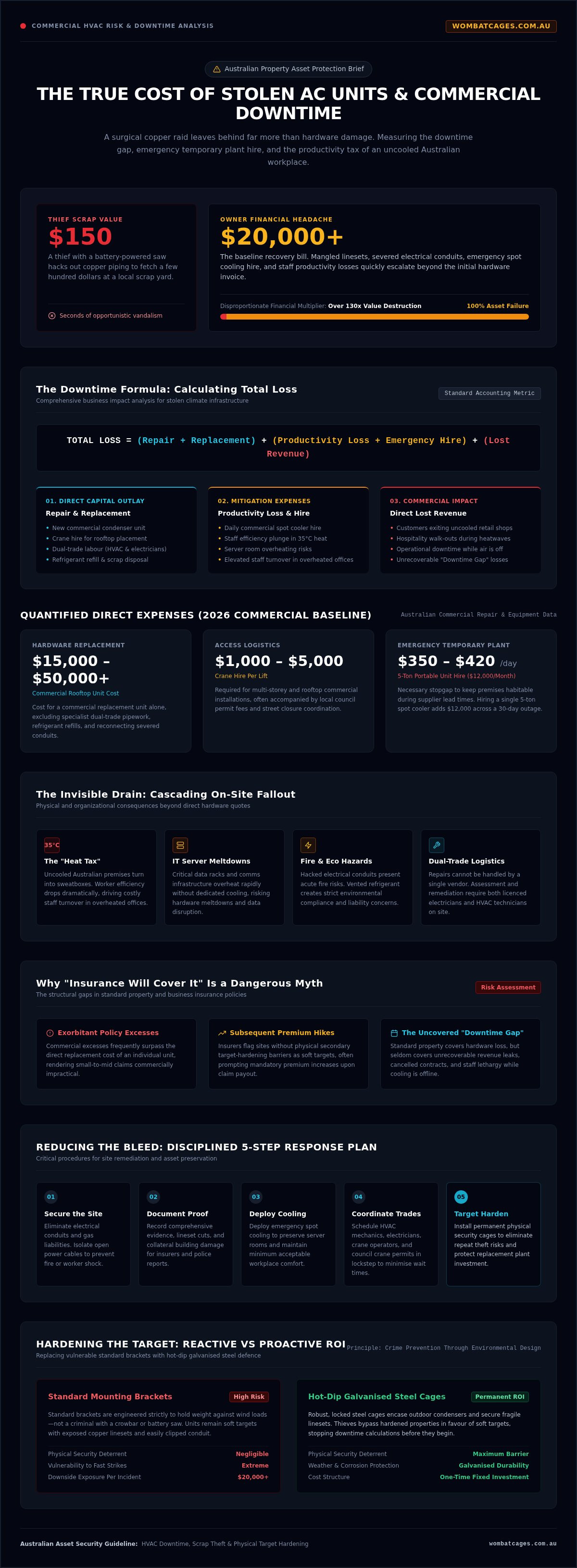
A thief hacks into your condenser for $150 worth of scrap copper and leaves you with a $20,000 headache. It's a brutal reality for Australian property owners. Most people focus on the hardware bill. They forget the cost of staff who can't work in 35-degree heat or the nightmare of organising cranes and council permits. When you're calculating downtime cost from stolen AC unit incidents, the invoice for a new unit is just the start. You're facing a massive productivity tax that drains your bank account every hour the air stays off.
It's frustrating to pay for someone else's crime. We're going to help you quantify the true financial impact of HVAC theft and implement a plan to stop the bleed. This guide breaks down the hidden expenses of business interruption, explains the complexities of modern refrigerant transitions, and provides a step-by-step response plan. You'll walk away with a concrete dollar figure for your risk and a permanent solution to ensure your assets stay exactly where they belong. It's about moving from vulnerability to total protection with common-sense prevention that lasts.
Key Takeaways
- Use a robust formula for calculating downtime cost from stolen AC unit incidents, factoring in staff productivity losses and missed revenue.
- Identify the hidden risks of HVAC failure, including potential server room hardware meltdowns and the high cost of staff turnover in overheated offices.
- Implement a disciplined five-step response plan to secure your site, document damage for insurance, and restore climate control quickly.
- Shift from reactive repairs to permanent protection by installing hot-dip galvanised steel security cages that deter thieves and ensure long-term resilience.
The True Price of a Midnight Raid: Beyond the Replacement Unit
A thief with a battery-powered saw doesn't care about your building's integrity. They want the copper salvaged from your condenser, which might only fetch a few hundred dollars at a scrap yard. This "surgical strike" is rarely clean. They rip out linesets, hack through electrical conduits, and leave your system in ruins. The direct cost of a new unit is a shock, but it's only the baseline. True financial impact starts the moment the air stops flowing and the temperature inside begins to climb.
When you're calculating downtime cost from stolen AC unit incidents, you're measuring the total loss from the second the theft happens until the building is fully operational again. This includes lost staff hours, emergency equipment hire, and complex repair bills. Standard mounting brackets offer no protection here. They're designed to hold a unit in place against the wind, not a determined criminal with a crowbar. Effective security requires target hardening principles that turn a vulnerable asset into a hardened target. Without a physical barrier, you're essentially leaving an open chequebook on the side of your building.
The Anatomy of an HVAC Theft
Thieves move fast and leave a massive mess behind. You'll find stripped copper piping and shredded insulation scattered across the site. This isn't just a simple plumbing fix. You'll face costly refrigerant refills and potential environmental liabilities if gas has vented into the atmosphere. Hacked electrical connections create immediate fire risks and safety hazards. You'll often need multiple trades on-site, including electricians and HVAC technicians, just to assess the damage before the actual repair work begins.
Why "Insurance Will Cover It" is a Dangerous Myth
Don't rely on your policy to save your bottom line. High excesses often outweigh the cost of a single unit replacement, making a claim financially pointless. If you do proceed with a claim, expect your premiums to hike. Insurance providers view properties without secondary security as soft targets. Most importantly, standard policies rarely cover the "Downtime Gap." This is the invisible drain on your revenue while staff are too hot to be productive or customers simply choose to shop elsewhere. By the time the payout arrives, the damage to your reputation and productivity is already done.
The Downtime Formula: Calculating Your Total Loss
Time is your enemy once a unit goes missing. Every hour the air is off, the financial multiplier grows. When you're calculating downtime cost from stolen AC unit incidents, you need a pragmatic view of your ledger. You aren't just looking for a single invoice. You're looking for the total bleed. A proper assessment involves conducting a business impact analysis to map out every ripple effect. Use this formula for a clear picture: Total Loss = (Repair + Replacement) + (Productivity Loss + Emergency Hire) + (Lost Revenue).
Step 1: Quantifying Direct Repair and Replacement
Direct costs are the visible wounds. In 2026, a commercial rooftop unit replacement typically ranges from $15,000 to over $50,000. This doesn't include the specialist labour required to fix the mess. You'll need HVAC technicians to pipe in the new system and electricians to repair severed conduits. If the thieves targeted a rooftop, crane hire adds another $1,000 to $5,000 per lift. Finally, you have to pay disposal fees to clear the mangled scrap they left behind. These expenses are immediate and non-negotiable.
Step 2: Calculating Productivity and Revenue Loss
The "Heat Tax" is often the most expensive part of the outage. In an Australian summer, an uncooled office quickly becomes a 35-degree sweatbox. Staff efficiency drops significantly as they struggle with the heat. In retail or hospitality, the impact is even sharper. Customers won't stay in a hot building. They'll take their business elsewhere. To survive the lead time for new equipment, you might hire emergency spot coolers. A 5-ton unit rents for $350 to $420 per day. Over a month, that's a $12,000 expense just to keep the building habitable.
Preventing this disaster is far cheaper than paying the bill. Investing in heavy-duty security cages ensures you never have to run these numbers in the first place. Hardening your site protects your revenue and your peace of mind. It's a one-time cost that eliminates a recurring risk.
The Invisible Drain: Hidden Costs of HVAC Vulnerability
The financial impact of a theft doesn't stop at the balance sheet. It seeps into your company culture and client perceptions. When you're calculating downtime cost from stolen AC unit events, you have to account for the "invisible drain" on your operations. A building that sits at 35 degrees for a week is a building in crisis. Your best staff won't tolerate a sweatbox for long; they'll look for an employer who prioritises a functional workspace. If your clients visit a sweltering office, your brand looks unreliable and poorly managed. It's a reputational hit that's hard to fix with a new compressor.
The Heat-Productivity Correlation
Heat is a known productivity killer. Industry research suggests that once the indoor temperature climbs above 25°C, staff efficiency drops by approximately 2% for every additional degree. In a 35-degree office, you're effectively losing 20% of your total output. Cognitive function declines as the body struggles to cool itself. This leads to more errors, slower reaction times, and general fatigue. You also have a legal duty of care under Australian WHS laws to provide a safe working environment. If a staff member suffers heat stress, the resulting legal and medical costs will dwarf any repair bill.
Inventory and Infrastructure Protection
Your IT equipment is just as vulnerable as your staff. Server rooms generate massive heat and require constant cooling to prevent hardware failure. Without AC, you risk catastrophic data loss and the high cost of emergency hardware replacement. For businesses like pharmacies, florists, or cafes, the stakes are even higher. Spoiled stock is a direct write-off that many business interruption insurance coverage policies may not fully cover during the restoration period. You can learn more about Protecting your AC from accidental and intentional damage to avoid these operational nightmares. Physical security is the only way to ensure your inventory stays cold and your servers stay online.
Reducing the Bleed: A 5-Step Response Plan
Speed is your only defence against mounting losses. If you spend days second-guessing the repair budget, you're effectively paying a daily tax in lost productivity. Every hour of indecision is an hour of lost revenue. You need a disciplined approach to contain the damage and get your building back online. A structured response ensures you don't miss critical steps that could lead to insurance rejections or a second theft event.
Immediate Actions After Theft
Call the police first. You need a formal report number to track local crime trends and satisfy your insurer's requirements. Next, isolate the power and gas. Thieves often leave live wires or severed linesets that pose a fire risk or safety hazard to staff. Take clear, high-resolution photos of the mangled equipment and the point of entry before anyone touches the site. This documentation is critical when following the property owner’s guide to AC insurance claims. Finally, contact your HVAC partner. In Australia, lead times for commercial units can stretch from 48 hours to 12 weeks. Getting on the schedule early is the difference between a minor blip and a seasonal disaster.
Securing the Site During Repairs
Don't leave your site vulnerable while you wait for parts. Thieves often return to the same location because they know the layout and have already tested your lack of security. They view a property without a cage as an easy "round two." If you are currently calculating downtime cost from stolen AC unit events, you'll see that a second theft is financially catastrophic. Prioritise stock availability over the lowest price. Paying a premium for a unit that is in stock today is far cheaper than waiting six weeks for a backorder while paying for emergency cooler hire.
Use temporary barriers to protect exposed piping during the transition. Most importantly, never install a replacement unit without a permanent security solution. A shiny new condenser is a magnet for the same crew that hit you the first time. You need a physical barrier that stops the cycle of theft and repair once and for all. It's about building resilience into your infrastructure so your business can focus on its core operations without looking over its shoulder.
Secure your new unit with a galvanised steel cage today to ensure you never have to repeat this process.
Hardening the Target: Why a Steel Cage is Your Best ROI
Prevention is always cheaper than a cure. When you finish calculating downtime cost from stolen AC unit incidents, the ROI of physical security becomes undeniable. A security cage costs a small fraction of a single replacement event. You aren't just buying steel; you're buying an insurance policy against business interruption. Most opportunistic thieves look for the easiest path. They want a quick win with minimal effort. When they see heavy-duty galvanised steel, they move to a softer target. It's about making your site the most difficult option in the street so thieves don't even bother trying.
Wombat Cages provide a rigid barrier that resists power tools and crowbars. We bolt these units directly to the ground and the wall. This makes removal nearly impossible without heavy machinery and a lot of noise. Unlike flimsy plastic or aluminium covers, our steel mesh is built for impact. We use an open mesh design that ensures zero airflow restriction. Your unit runs at peak efficiency even on the hottest days. You get total protection without sacrificing the mechanical performance of your HVAC system.
The Wombat Cages Advantage
Our products are purpose-built for the harsh Australian climate. We use hot-dip galvanised steel to ensure your cage survives the intense sun and coastal rain without rusting. This is a "set and forget" solution for long-term protection that outlasts the equipment it defends. We offer custom configurations to suit any setup, from a Single Split System Security Cage to massive Multi-Bay Security Cages for commercial banks. You can read more about why hot-dip galvanised steel is the superior choice for asset protection in local conditions.
Maintenance Access Without Compromise
Security shouldn't make your technician's life a nightmare. Our cages feature a technician-friendly design that allows for routine servicing and inspections without total disassembly. You get rigid security that doesn't void your manufacturer's warranty or block access to critical valves and electrical panels. It's a professional solution that balances high-level defence with practical utility. It ensures your system stays under warranty while remaining off-limits to vandals. Stop the risk of downtime today and secure your assets before the next heatwave hits.
Get a quote for a Wombat Cage and lock down your property's future today.
Secure Your Bottom Line with Permanent Protection
HVAC theft is a surgical strike that leaves your business bleeding cash. When you finish calculating downtime cost from stolen AC unit incidents, the numbers are often staggering. You aren't just paying for a new condenser. You're paying for lost staff hours, emergency hire fees, and a damaged reputation. A proactive response plan helps contain the immediate damage, but the only way to stop the cycle is by hardening your site against future raids.
Wombat Cages provides the ultimate defence with heavy-duty hot-dip galvanised steel. Our cages are built for harsh Australian conditions and offer a permanent solution that outlasts the equipment itself. With professional national installation and a design that ensures zero airflow restriction, it's the smartest investment you can make for your property. Don't wait for the next heatwave to discover your vulnerabilities. Secure your assets and prevent downtime with Wombat Cages. Take control of your site security today and keep your business running cool.
Frequently Asked Questions
How long does it typically take to replace a stolen AC unit?
Lead times vary from 48 hours for stock units to 12 weeks for custom commercial tonnage. It isn't just delivery. You have to coordinate electricians, HVAC techs, and potentially crane hire for rooftops. This delay is a primary factor when calculating downtime cost from stolen AC unit incidents. Every day of waiting adds to the total loss through emergency hire costs and lost staff productivity.
Will a security cage affect the airflow of my air conditioner?
No, a properly designed cage ensures zero airflow restriction. Wombat Cages use an open steel mesh design that allows the condenser to breathe and run at peak efficiency. This prevents the compressor from overheating or overworking, which protects your manufacturer's warranty. You get the benefit of rigid physical security without compromising the mechanical performance or energy efficiency of your cooling system.
Is copper theft from air conditioners common in Australia?
Copper theft is a significant issue across Australia, especially when global metal prices remain high. Thieves target outdoor units because they're often exposed and easy to strip for quick cash. While a thief might only get $40 to $150 for the salvaged copper, the property owner faces thousands in replacement costs. This risk makes physical deterrence essential for commercial and residential properties alike.
Can I install an AC security cage myself or do I need a professional?
Professional installation is recommended to ensure maximum security. Wombat Cages offer national installation services to ensure the frame is bolted correctly to the ground or wall. A cage is only as strong as its anchors. Professional installers use industrial-grade fixings that prevent thieves from simply prying the entire structure off the building with a crowbar or a vehicle.
Do insurance companies offer discounts for AC units protected by cages?
Many insurance providers look favourably on properties that implement target hardening measures. While specific discounts vary between policies, installing a steel cage reduces the likelihood of a claim. This helps you avoid high excesses and prevents premium hikes following a theft event. Some insurers may even require secondary security measures for properties located in areas with high rates of reported metal theft.
What is the average cost of business downtime per hour?
The hourly cost depends on your specific revenue and staff numbers. You calculate this by adding your hourly payroll for affected staff to your average hourly gross profit. If your team is only 50% productive due to the heat, you're losing half your wage bill every hour. This is a critical part of calculating downtime cost from stolen AC unit events that most owners overlook initially.
How do I know what size cage I need for my condenser?
You need to measure the height, width, and depth of your outdoor unit, including any clearance required for piping. Wombat Cages provides solutions for single split systems and large multi-bay commercial banks. It's best to allow a small buffer around the unit for maintenance access. Providing these dimensions during the quoting process ensures your cage fits perfectly and provides total protection without blocking service points.
Will a galvanised steel cage rust in coastal areas?
No, hot-dip galvanised steel is specifically built to withstand harsh Australian coastal conditions. The galvanisation process creates a thick, protective zinc coating that prevents corrosion even in salt-heavy environments. This makes it a far superior choice compared to painted or powder-coated alternatives. It's a "set and forget" solution designed for long-term durability and structural integrity in any outdoor setting across the country.


