
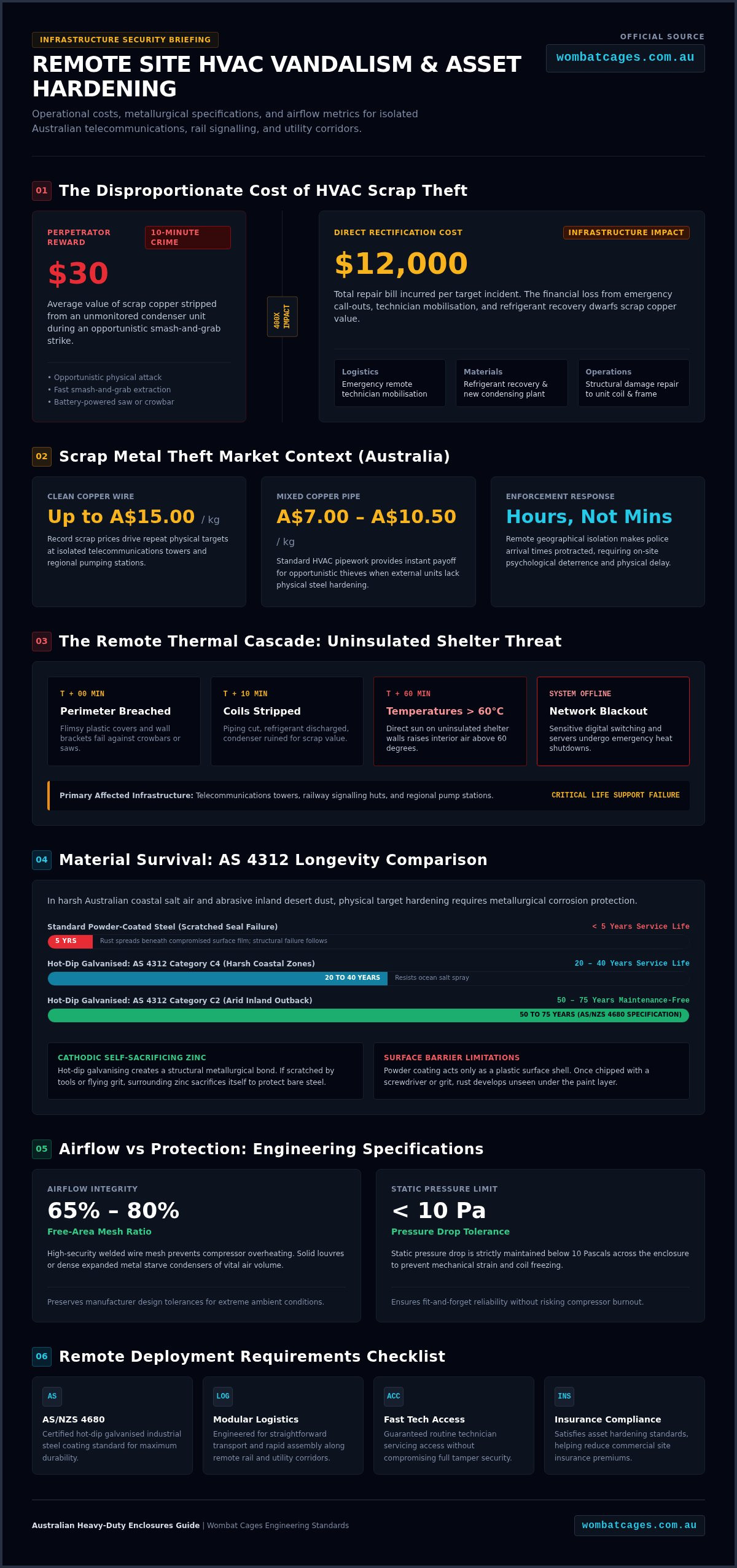
A thief strips your remote HVAC unit for 30 dollars worth of scrap copper. That 10-minute crime leaves you with a 12,000 dollar repair bill and a crashed network. It's a brutal reality for Australian infrastructure managers overseeing telecommunications or regional utility sites. You know that once an isolated asset is targeted, it stays on the radar for repeat hits. Replacing a condenser in the middle of a remote outback corridor or an isolated rail junction isn't just expensive. It's an operational disaster that triggers equipment failure when temperatures soar past 60 degrees inside equipment shelters.
This 2026 guide shows you how to stop the cycle with a heavy-duty remote site HVAC security cage from Wombat Cages. We'll explore why hot-dip galvanised steel is the only choice for the harsh Australian climate and how to maintain airflow without sacrificing security. You'll learn how to choose a fit and forget enclosure that reduces insurance premiums and guarantees technician access. We're covering everything from AS/NZS 4680 standards to modular designs that make remote logistics simple. This is about moving from vulnerability to total asset protection with common-sense engineering that outlasts the threat.
Key Takeaways
- Understand the total cost of HVAC vandalism. Emergency call-outs and refrigerant loss often dwarf the value of stolen copper.
- Discover why hot-dip galvanised steel is essential for long-term corrosion resistance in harsh Australian desert and coastal environments.
- Learn how to select a remote site HVAC security cage that balances uninhibited airflow with anti-tamper mesh to protect against heavy-duty tools.
- Ensure your security solution allows for fast technician access. This is critical for maintaining remote maintenance schedules without compromising protection.
- Identify the mounting requirements and logistics needed to secure isolated assets across national locations for full insurance compliance.
The Rising Risks of HVAC Vandalism at Remote Australian Sites
Thieves see an unmonitored air conditioner as an easy payday. Isolated sites like telecommunications towers, railway signalling huts, and regional pump stations lack constant surveillance. This makes them prime targets for opportunistic crime. A vandal might only walk away with 30 dollars worth of scrap copper, but they leave behind a trail of destruction that costs thousands to rectify. You aren't just dealing with a missing pipe. You're dealing with a total system failure that can cripple your operations in hours. Physical barriers do more than just stop a grinder. They serve as a powerful psychological deterrent. Most criminals look for the path of least resistance. If your asset looks like a fortress, they'll move on to a softer target.
Understanding the Copper Theft Epidemic
Scrap copper prices in Australia remain at historic highs. Clean copper wire can fetch up to A$15.00 per kg, while mixed copper pipe sits around A$7.00 to A$10.50 per kg. For a thief, a remote site HVAC security cage is the only thing standing between them and a quick buck. Standard plastic covers and flimsy wall brackets offer zero resistance to a crowbar or battery-powered saw. These "smash and grab" crimes are fast, destructive, and increasingly common in regional areas where police response times are measured in hours rather than minutes. Remote HVAC theft is a high-reward, low-risk activity for vandals who know exactly where the most valuable components are located.
Operational Impact of HVAC Failure
The real pain isn't the hardware cost. It's the fallout. In remote Australian infrastructure, cooling is life support for sensitive digital equipment. Without HVAC, ambient temperatures inside uninsulated metal shelters can exceed 60 degrees Celsius within 60 minutes of direct sun. This triggers emergency server shutdowns and massive network blackouts. Coordinating a repair at an isolated location is a logistical nightmare. You're paying for emergency technician mobilisation, refrigerant recovery, and new condensing plant. Installing a split system security cage prevents the structural damage that occurs during attempted break-ins. It protects the integrity of the unit's frame and coils. Using steel treated via a hot-dip galvanization process ensures this protection lasts for decades, even in corrosive desert dust or coastal salt air. This one-time investment stops a 30 dollar theft from turning into a 12,000 dollar disaster.
Material Matters: Why Hot-Dip Galvanised Steel is Non-Negotiable
Selecting the right material for a remote site HVAC security cage isn't about aesthetics. It's about chemical survival. In the Australian outback or along the coastline, salt and dust destroy unprotected metal. Hot-dip galvanisation creates a permanent metallurgical bond between the zinc and the steel. This isn't just a surface layer. It's a structural fusion that resists impact and abrasion. If a thief tries to pry the cage open, the coating won't just flake off. According to scrap metal theft research, physical target hardening is the most effective way to protect infrastructure. Choosing heavy-duty steel ensures the enclosure outlasts the threat.
Galvanised Steel vs. Powder-Coated Alternatives
Many managers choose powder-coated cages because they look better initially. This is a mistake for remote assets. Powder coating relies on an unbroken plastic seal. Once a thief scratches that seal with a screwdriver or a storm pelts it with grit, the underlying steel starts to rot. Rust spreads beneath the paint, leading to structural failure within five years. Hot-dip galvanised steel uses cathodic protection. If the surface is scratched, the surrounding zinc sacrifices itself to protect the exposed steel. Under AS 4312 Category C2 conditions found in arid inland areas, this coating can last 50 to 75 years without maintenance. In harsh C4 coastal zones, you still get 20 to 40 years of service. It's a "fit and forget" solution that justifies the investment.
Mesh Density and Airflow Requirements
Airflow is the lifeblood of your HVAC system. If you wrap a condenser in solid louvres or dense expanded metal, you'll kill the compressor. High-security welded wire mesh is the standard for a reason. It provides a free-area ratio of 65% to 80%. This keeps static pressure drops below 10 Pa, even when the mercury hits 45 degrees. You need to maintain the manufacturer's specified clearances, usually 300mm to 600mm for intakes and up to 1500mm for discharge. Using hot dip galvanised condenser cages ensures you meet these technical specs while keeping hands and bolt cutters away from the coils. If you're ready to secure your regional assets, you can view our range of industrial enclosures designed for national deployment.
Key Specifications for High-Security Remote Enclosures
A remote site HVAC security cage is only as strong as its weakest point. You need to look past the marketing fluff. Real protection comes from heavy-duty angle and box section frames. We recommend a minimum 3mm to 4mm wire mesh diameter. Anything thinner is just a fence, not a security barrier. It needs to resist manual cutting tools like hand-held bolt cutters. Mounting is just as critical. You can't just screw a cage into soft dirt. It must be bolted directly to concrete slabs or structural masonry walls. Use undercut concrete anchor bolts. For maximum security, use shear nuts. These have a hex head that snaps off once tightened. This leaves a smooth cone that a thief cannot grip with a wrench or pliers.
Technician access is where many generic cages fail. If a tech has to dismantle the entire structure for a routine service, they won't put it back correctly. Look for integrated service doors. These should have shrouded padlock hasps. A shroud prevents a thief from getting a pair of bolt cutters around the lock. It's a simple addition that stops a quick break-in. These features ensure the enclosure remains a permanent fixture rather than a temporary hurdle.
Sizing for Single and Multi-Bay Units
Clearance is vital for thermal expansion and vibration. You need at least 300mm of space between the coil and the mesh. This prevents heat recirculation. If you have a bank of condensers, a multi unit AC security cage is the most efficient choice. Modular designs allow you to protect multiple units under one rigid frame. This reduces the number of anchor points and keeps the site organised. Standardised sizing works for most split systems. However, oversized commercial plant equipment might need custom dimensions to meet atmospheric corrosivity standards for long-term durability in aggressive environments.
Security Features to Look For
Check the hinges. External hinges are a vulnerability. A thief can just pull the pin and lift the door off. Internal hinging systems or captive pins are non-negotiable for remote sites. The mesh density must balance airflow with physical resistance. 25x25mm or 50x50mm spacing is ideal. It keeps hands out while letting the unit breathe in 45-degree heat. The ideal mesh gauge for a remote site enclosure is 4mm welded steel wire, which provides high tensile strength against prying and cutting tools.
Logistics and Installation: Securing Isolated Assets
Installing a remote site HVAC security cage requires more than just a drill and some bolts. Remote locations present unique challenges. You're often dealing with uneven terrain, shifting soil, or aging masonry. A secure installation starts with the foundation. For ground-mounted units, a level concrete plinth is essential. It provides a stable surface for the cage to anchor into. Without a solid base, the cage can be pried upward or shifted, creating gaps for tools to enter. If the unit is wall-mounted, ensure the fixings penetrate structural material. Securing a heavy steel enclosure to thin cladding or weatherboards is useless during a determined attack.
Professional installation is often a prerequisite for insurance compliance. Many insurers look for physical risk mitigation when covering remote assets. A cage that is poorly mounted with standard hex-head bolts won't meet the standard. Thieves carry battery-powered impact drivers. They can disassemble a basic enclosure in seconds. Professional installers use anti-tamper hardware that requires specialised tools for removal. This ensures the cage remains a permanent fixture. Retrofitting is also a common requirement. Most industrial cages are designed to slip over existing units. This allows you to secure the asset without disconnecting refrigerant lines or electrical wiring.
Ground vs. Wall Mounting Logistics
Freestanding cages are the standard for large commercial condensers. They provide 360-degree protection and sit on a dedicated concrete slab. This is ideal for sites with plenty of footprint. However, rooftop or elevated units require a different approach. Wall-mounted frames save space and keep the unit away from ground-level debris. Regardless of the position, you must ensure your commercial air conditioner protection meets site-specific safety standards. This includes maintaining clearance for technician walkways and fire exit paths.
Maintenance Access and Servicing
Security should never come at the cost of serviceability. If a technician finds the cage too difficult to open, they might leave it unlocked or damage the mesh to get inside. Organise your cages with dedicated access hatches for coil cleaning and electrical isolators. Master-keyed padlock systems are the best practice for unstaffed remote locations. This allows your authorised contractors to access multiple sites with a single key. It eliminates the risk of technicians being locked out of critical equipment during a heatwave. Design your enclosure to allow for a minimum 300mm clearance on intake faces. This protects the HVAC warranty by preventing compressor motor overload. If you need a solution that balances high security with easy servicing, contact Wombat Cages for a national installation quote.
Wombat Cages: Purpose-Built Protection for National Remote Sites
Wombat Cages provides more than just a steel box. We provide a definitive end to the cycle of copper theft. Our engineering is pragmatic. It's built for utility. We don't care about flashiness. We care about structural integrity. Every remote site HVAC security cage we build is a testament to Australian durability. We use hot-dip galvanised steel because it's the only material that stands up to the outback. It creates a metallurgical bond that won't flake or peel. This is no-nonsense protection for national infrastructure. We secure your assets so you can focus on your operations. It's about protecting your bottom line. One installation stops a lifetime of recurring repair costs.
The Dependable Guardian for Your HVAC
Transitioning from vulnerability to total protection happens the moment our cage is bolted down. We act as the dependable guardian for your HVAC systems. Our approach is that of a seasoned tradesperson. We know the risks. We know how thieves operate. Our designs reflect that knowledge. We use rigid mesh to prevent prying. We use anti-tamper fixings to prevent disassembly. This gives you peace of mind. You won't have to worry about the next heatwave causing a network outage because of a 30-dollar theft. Our cages are not an afterthought. They are the first line of defence. We prioritise the hardness of the steel and the weight of the frame. This is about physical strength. It is about permanence. When you choose Wombat Cages, you are choosing a partner in asset protection.
Getting a Quote for Your Remote Site
Getting protected is straightforward. We offer custom configurations to suit any requirement. This includes the Single Split System Security Cage and Multi-Bay Security Cages for massive plant equipment. Our quoting process is streamlined for national infrastructure projects. We provide clear quotes with no hidden fees. We serve commercial clients across the entire country. This includes coastal industrial zones and inland resource corridors. Our national capability means consistency for your portfolio. You get the same high-standard protection at every site. No matter how isolated.
We handle the logistics of national deployment. Moving heavy steel frames across state lines is complex. We simplify it. Our cages are designed for efficient transport and rapid installation. This reduces the time technicians spend on site. It minimises the window of vulnerability for your equipment. We provide a complete solution from the first design consultation to the final bolt being tightened. You get a security barrier that is as hardworking as the infrastructure it protects. Contact Wombat Cages today for a professional security assessment and quote.
Defend Your Regional Assets for the Long Term
Leaving an isolated air conditioner unprotected is a gamble you don't need to take. A remote site HVAC security cage is a one-time investment that stops recurring theft costs. You've seen why hot-dip galvanised steel is the industry standard. It provides a 20-plus year lifespan in the toughest Australian conditions. Rigid steel mesh keeps vandals out while maintaining maximum airflow to protect your compressor. These designs are technician-friendly. They ensure routine servicing stays simple and your warranty remains intact.
Protection is about common-sense prevention. It's about choosing a solution that outlasts the threat. Don't wait for the next heatwave or a vandal's crowbar to compromise your network. You can transition from vulnerability to total security today. Secure your remote assets with a Wombat Cages quote. Our team is ready to help you lock down your infrastructure with national supply and professional installation. Take control of your site security and build something that lasts.
Frequently Asked Questions
Will a security cage void my HVAC manufacturer's warranty?
No, provided the installation maintains the manufacturer's specified clearances for airflow and service access. Most warranties are voided by compressor failure due to overheating. A properly designed remote site HVAC security cage uses high-flow mesh to ensure the unit breathes correctly. We recommend checking your specific unit manual for clearance requirements. This ensures the protection doesn't interfere with the mechanical performance or legal standing of your warranty.
How do I ensure my HVAC unit doesn't overheat inside a cage?
Airflow management is built into the core design of our enclosures. We use rigid steel mesh with a high open-area ratio to keep static pressure drops to a minimum. This allows the condenser fan to pull and push air without restriction. Maintaining a minimum clearance of 300mm on intake sides and 1500mm for discharge is vital. These specifications prevent thermal recirculation and keep the compressor running at optimal temperatures even in 45-degree heat.
Can a remote site HVAC security cage be retrofitted to an old unit?
Yes, our security cages are designed for easy retrofitting to existing infrastructure. The frame slips directly over the installed condenser without the need to disconnect refrigerant lines or electrical wiring. This makes it a cost-effective security upgrade for older regional sites that have become targets for copper theft. The installation process involves bolting the frame to a concrete slab or structural wall to create an immediate physical barrier.
What is the difference between galvanised steel and aluminium for security?
Steel is significantly harder and more resistant to prying than aluminium. While aluminium is lighter, it lacks the structural integrity required to stop a determined thief with a crowbar or battery-operated saw. Wombat Cages exclusively uses hot-dip galvanised steel because it provides superior impact resistance and long-term durability. Steel cages are heavier and more difficult to manipulate. This makes them the industry standard for high-risk remote locations across Australia.
Are these cages resistant to saltwater corrosion at coastal remote sites?
Hot-dip galvanisation is specifically chosen for its performance in aggressive environments. The metallurgical bond between the zinc and steel provides decades of protection against salt spray and coastal moisture. Under Australian standards for atmospheric corrosivity, this coating is rated for 20 to 40 years of service in high-corrosion zones. It is a far more resilient choice than powder-coated alternatives which can flake and rust when the surface is scratched.
How do technicians get inside the cage for emergency repairs?
Our cages feature integrated service access points designed for fast technician entry. These doors are secured with shrouded padlock hasps that protect the lock from bolt cutters. You can implement a master-keyed system for your national sites to ensure authorised contractors always have the correct key on hand. This design ensures that security never compromises the speed of emergency repairs or seasonal maintenance schedules at unstaffed locations.
Do insurance companies offer discounts for installing AC security cages?
Many insurers recognise physical risk mitigation as a key factor in lowering premiums for remote infrastructure. While specific discounts vary between providers, installing a heavy-duty enclosure demonstrates a proactive approach to asset protection. This can reduce the frequency of claims related to copper theft and vandalism. We recommend providing your insurer with the specifications of your steel cage to discuss potential adjustments to your commercial policy.
What is the typical lead time for national supply and installation?
Lead times depend on the scale of the project and the specific configurations required for your site. We offer national supply and professional installation services for commercial clients across Australia. Our streamlined quoting process ensures we can move quickly on national infrastructure upgrades. For accurate timelines on a Single Split System Security Cage or Multi-Bay Security Cages, it is best to contact us directly for a current assessment based on your location.


