
A cheap security cage is often just a delayed expense. For many strata schemes across Australia, the protection they bought last year is already bleeding rust streaks down the building facade. It's a common sight. You invest in a cage to stop "smash and grab" copper theft, only to find the barrier itself becomes a maintenance nightmare. When comparing a hot dip galvanised vs powder coated ac cage, the choice isn't just about colour; it's about structural survival in our harsh climate.
You need a solution that meets building by-laws and stays maintenance-free for decades. This guide explains why hot-dip galvanising is the superior choice for protecting your HVAC assets against thieves and the elements. We'll break down the chemistry of corrosion resistance, the reality of maintenance-free claims, and how to ensure your security upgrade gets the green light from the body corporate. Discover how to lock down your copper and your budget with the right steel. It's time to move from vulnerability to total protection with a barrier that's built to last.
Key Takeaways
- Identify why strata common areas are high-risk targets for copper thieves and how to effectively defend these exposed assets.
- Compare the long-term durability of a hot dip galvanised vs powder coated ac cage to find a maintenance-free solution that lasts for decades.
- Streamline the body corporate approval process by selecting security designs that balance heavy-duty protection with building aesthetic standards.
- Minimise liability and insurance risks by using professional installers who specialise in tamper-proof, heavy-gauge steel fixings.
Why Strata Buildings Are High-Risk Targets for HVAC Theft
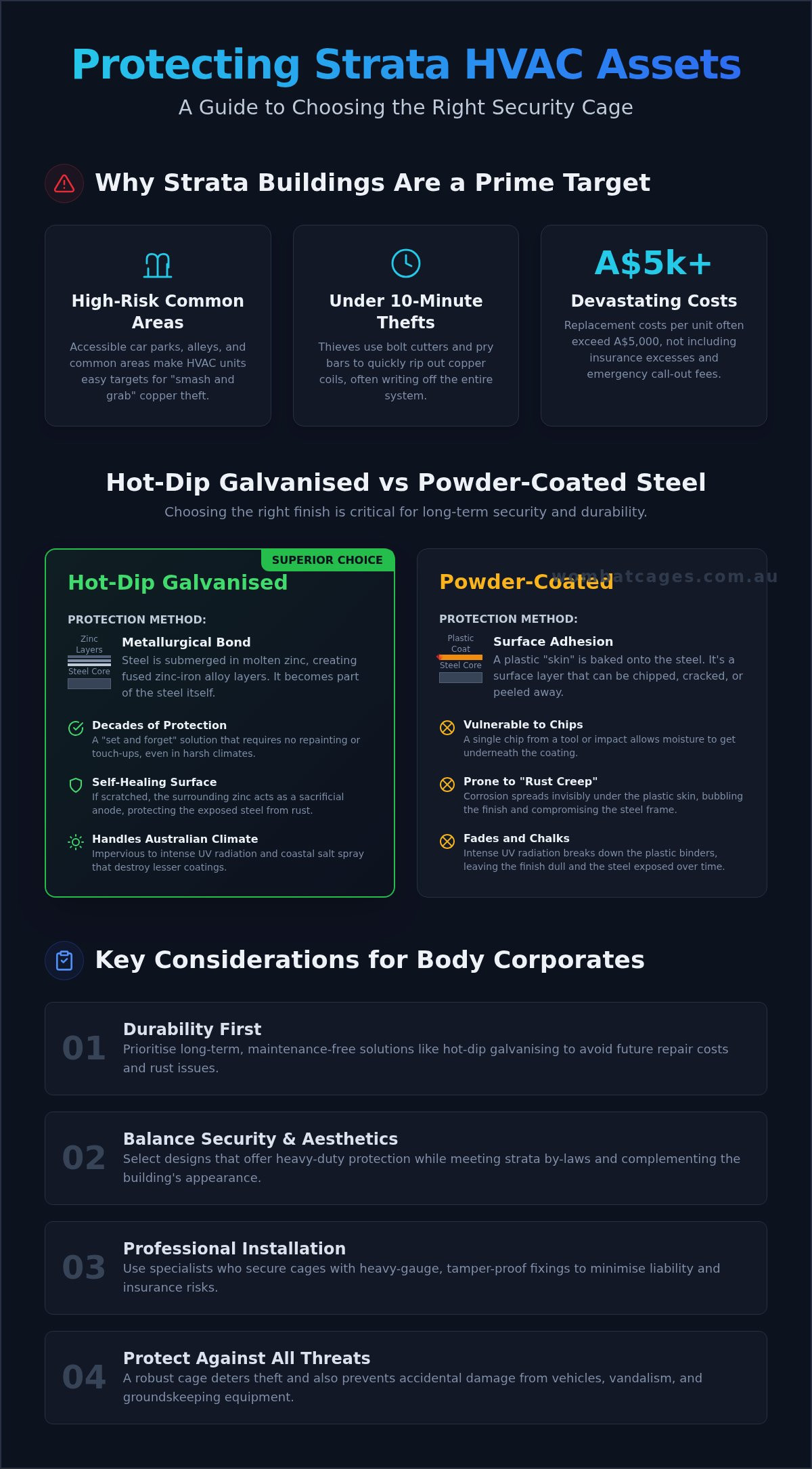
Strata complexes are a prime target for copper thieves. It's a simple calculation of risk versus reward. Most outdoor condensers sit in accessible common areas, alleys, or basement car parks. To a thief, a bank of ten air conditioners is a buffet. They aren't looking for the whole unit. They want the internal copper tubing. When debating a hot dip galvanised vs powder coated ac cage, the focus must be on the material's ability to resist physical tampering.
Choosing a hot dip galvanised vs powder coated ac cage is the first step in hardening your building against these professional scavengers. You need a barrier that doesn't just look tough but actually holds up under pressure. To understand why steel is the industry standard for protection, you can research what is hot-dip galvanizing? and its unique metallurgical bond with the metal. This bond makes the steel significantly harder to breach without heavy power tools.
A single theft event is devastating for any strata budget. Replacement costs often exceed A$5,000 per unit. When you factor in insurance excesses and emergency technician fees, the financial fallout is massive. Standard plastic covers and flimsy brackets offer zero resistance. They are designed for airflow, not for stopping a determined vandal with a pry bar. Even if the thief only takes a few dollars worth of copper, the damage to the condenser's delicate internal components is usually terminal.
The "Smash and Grab" Nature of Copper Theft
Speed is the thief's greatest asset. Most "smash and grab" jobs are finished in under ten minutes. Scavengers use bolt cutters to snip the refrigerant lines and pry bars to rip out the coils. This aggressive removal usually renders the entire HVAC system a write-off. The damage goes beyond the unit itself. Lot owners lose climate control immediately. The strata committee then faces weeks of navigating insurance claims and coordinating expensive repairs while residents suffer in the heat.
Vandalism Risks in High-Traffic Common Areas
Not all damage comes from thieves. High-traffic areas in mixed-use developments are prone to accidental strikes. Groundskeeping equipment like line trimmers or lawnmowers can easily damage delicate condenser fins. Vehicles in tight car parks are another constant threat. A multi unit AC security cage creates a permanent physical deterrent. It protects the asset from both intentional vandalism and the daily wear of a busy strata scheme. This level of protection ensures that the building's aesthetic remains intact while the mechanical hardware stays functional for its full service life.
Hot-Dip Galvanised vs Powder Coated: Choosing the Right Protection
The choice between a hot dip galvanised vs powder coated ac cage comes down to the difference between a coating and a bond. Hot-dip galvanising isn't just a layer on top of the metal. It is a metallurgical reaction. The steel is submerged in molten zinc, creating a series of zinc-iron alloy layers that fuse with the base metal. This process provides decades of protection in most environments. It is a permanent change to the steel's surface.
Powder coating relies on surface adhesion. It is essentially a plastic skin baked onto the metal. While it looks clean on day one, it is vulnerable. If a delivery trolley or a vandal's tool chips that skin, moisture enters. This leads to "rust creep." The corrosion spreads invisibly under the coating, bubbling the finish until the entire frame is compromised. For those following industry standards for powder coating galvanized steel, a duplex system can offer the best of both worlds, but for pure utility and security, galvanising is the superior choice.
Longevity in the Australian Climate
Coastal salt spray is the silent killer of strata assets. In many Australian cities, salt air travels kilometres inland. Powder coating fades and chalks under intense UV radiation. The plastic binders break down, leaving the steel exposed. Galvanised steel is different. It is a "set and forget" material for body corporates. It doesn't require repainting or touch-ups. It simply works, regardless of the sun or salt. This makes it the most cost-effective option over the life of the building.
Security Performance Under Mechanical Attack
Security isn't just about presence. It is about performance under duress. A hot dip galvanised vs powder coated ac cage performs differently when someone takes a pry bar to it. Zinc acts as a sacrificial anode. Even if a thief manages to scratch the surface, the surrounding zinc will sacrifice itself to protect the exposed steel core. This prevents the metal from weakening or rusting away at the point of impact. It ensures the cage remains a rigid barrier.
This mechanical resilience is why hot dip galvanised condenser cages are the industrial benchmark. They handle the "rough and tumble" of common areas without losing their structural integrity. If you want a barrier that defends your assets without becoming a maintenance liability, you can view our range of heavy-duty enclosures to see the difference in build quality. It's a pragmatic investment in long-term security.
Balancing Security with Strata By-Laws and Compliance
Strata committees prioritise uniformity. They want solutions that blend into the building's architecture. When debating a hot dip galvanised vs powder coated ac cage, the conversation often begins with aesthetics. Galvanised steel provides a neutral, industrial finish. It works with modern facades and older brickwork alike. It signals a serious approach to asset protection. It looks purpose-built. This helps committees move past the "eyesore" argument and focus on the practical benefits of securing the site.
Navigating Aesthetic and Structural Requirements
Proposals for common property alterations must be professional. You need to demonstrate that the cage footprint is precise. It must not obstruct fire exits or narrow walkways. This is critical for compliance with safety regulations. For complexes with multi-unit condenser banks, a unified cage system is the most efficient choice. It creates a clean, organised look across the entire bank. High-quality steel fabrication ensures the building maintains its professional image. It avoids the "patchwork" look of mismatched individual cages. A solid, uniform installation is much easier for a committee to approve than a series of DIY attempts.
HVAC Warranty and Airflow Considerations
Security shouldn't kill the machine. Solid or poorly designed covers are a major risk to mechanical health. They cause heat recirculation. This forces the compressor to work harder; this leads to premature failure. An open mesh design is the only way to meet strict manufacturer airflow specifications. It ensures the unit breathes properly in high summer. Proper ventilation is non-negotiable for maintaining energy efficiency and system longevity.
Gates or removable panels are equally important. Technicians need quarterly access for servicing and emergency repairs. If a cage makes servicing difficult, maintenance gets skipped. This leads to higher running costs and voided warranties. A well-designed steel enclosure balances total security with full mechanical access. It protects the copper without choking the fan. This pragmatic approach keeps both the body corporate and the mechanical contractors satisfied.
How to Organise Professional Installation for Your Scheme
A security cage is only as strong as its fixings. DIY or general handyman installations often skip the critical technical details. If a cage is loose or causes damage to common property, the liability rests with the body corporate. Insurers may refuse claims if the installation doesn't meet professional standards. When you compare the physical weight of a hot dip galvanised vs powder coated ac cage, the galvanised unit is often more substantial. This extra mass requires heavy-duty anchoring to remain secure for its full service life.
Before any drilling starts, a thorough site assessment is mandatory. Professional installers must locate existing copper lines and electrical conduits. Hitting a refrigerant line during installation creates the very disaster you are trying to prevent. Coordinating with your strata manager is also essential. They will notify residents of the scheduled work. Methodical installers work quickly to minimise noise and keep common area walkways clear. This approach ensures the security upgrade proceeds without resident complaints.
Securing the Perimeter: Wall vs Ground Mounting
Substrate matters. A heavy steel frame needs a wall that can take the load. Installers must evaluate if the brickwork or concrete is structural. For rooftop units, concrete pads are the standard. They provide a level, stable base for ground-mounting. This prevents the unit from vibrating or shifting over time. Tamper-resistant hardware is the final layer of defence. Thieves carry basic tools. They expect to unbolt a cage quickly. Using shear nuts or security bolts ensures the cage stays put even under mechanical attack. It turns a quick "smash and grab" into a difficult, noisy chore that thieves would rather avoid.
Working with Specialist Installers
Body corporates need peace of mind. A "supply and install" service removes the risk of mismatched parts or poor workmanship. Specialist fabricators understand the dimensions of modern HVAC units. They ensure the fit is tight enough to prevent prying but loose enough for optimal airflow. While the visual difference between a hot dip galvanised vs powder coated ac cage is obvious, the real distinction lies in the installation requirements for long-term security. Professional installation is also a key factor in securing air conditioner cage insurance discounts. It proves to the insurer that the asset is hardened against theft by experts. To ensure your building's assets are properly defended, you can request a site assessment for your strata scheme today.
Wombat Cages: Hardened Protection for Strata Assets
Wombat Cages operates with a single, clear objective. We manufacture and install hardened barriers for mechanical assets across Australia. We don't deal in general fabrication or aesthetic metalwork. Our focus is the protection of HVAC units from theft and vandalism. We specialise in hot-dip galvanised steel enclosures. This material choice is deliberate. It provides the structural integrity required for high-risk strata environments. Our designs prioritise three things: airflow, longevity, and security.
We offer versatile configurations for every building type. This includes a single split system security cage for individual units. For larger strata schemes, we provide multi-bay security cages. These banks of enclosures are purpose-built for complex condenser layouts. When you evaluate a hot dip galvanised vs powder coated ac cage, the superiority of the galvanised bond is clear. It provides a level of permanence that plastic-based coatings cannot match. It is a pragmatic investment in building security.
Built for the Long Haul
Our cages are engineered to outlast the air conditioning units they defend. The Australian climate is relentless. UV radiation and coastal salt spray quickly degrade standard finishes. Our "Dependable Guardian" approach ensures your assets remain secure for decades. We use heavy-gauge mesh that meets rigid Australian Standards for hot-dip galvanising. This provides a sacrificial layer of zinc that protects the steel core even if the surface is scratched. It is a no-nonsense solution for a harsh environment. You get total protection without the need for recurring maintenance or repainting.
Streamlining the Body Corporate Approval
Navigating the committee approval process can be a hurdle. We simplify this step for strata managers and lot owners. Wombat Cages provides clear technical specifications and professional quotes. These documents are ready for committee review. We help you present a business case that focuses on long-term cost savings. By preventing copper theft, you eliminate the massive expense of unit replacements and insurance excesses. It is a common-sense prevention strategy that protects the strata budget.
Our service is comprehensive. We provide national supply and professional cage installation services. Our installers are familiar with the specific requirements of strata property. They ensure that every cage is bolted securely to walls or concrete pads using tamper-resistant fixings. We coordinate closely with building management to ensure minimal disruption to residents. This professional approach is why we are the trusted partner for schemes across the country. Contact Wombat Cages for a tailored security solution for your strata scheme. It is the most efficient way to secure your building's assets.
Harden Your Strata Assets for the Long Term
Effective strata management relies on making decisions that last. Protecting your building's HVAC system from copper theft is a priority that shouldn't lead to a secondary maintenance crisis. When you weigh up a hot dip galvanised vs powder coated ac cage, you're choosing between permanent security and a recurring maintenance bill. Hot-dip galvanised steel provides a metallurgical bond that resists salt spray and UV damage where powder coating eventually fails. It's the only way to ensure your security barrier doesn't become a rust-streaked eyesore.
Wombat Cages provides specialist multi-bay designs engineered specifically for complex strata schemes. We offer Australia-wide installation support to ensure every unit is bolted down with professional-grade, tamper-proof fixings. Our pragmatic designs focus on utility. They keep your units breathing and your copper secure. You can stop the cycle of "smash and grab" theft with a single, durable investment. Take a proactive step toward total protection and long-term peace of mind for your lot owners.
Secure your building’s HVAC assets with a Wombat Cages quote
Frequently Asked Questions
Can we install security cages on common property without a by-law change?
Most strata schemes require committee approval for any addition to common property. This usually involves a formal request or a minor by-law amendment depending on your specific state's legislation. It's best to check with your strata manager before commencing work. Providing a professional quote with clear dimensions and material specs helps the committee understand that the installation is a permanent security upgrade rather than a temporary fix.
How do AC security cages affect the manufacturer’s warranty?
Security cages don't void manufacturer warranties if they allow for proper airflow. Most manufacturers require a minimum clearance for air intake and discharge to prevent the compressor from overheating. Our rigid steel mesh design ensures the unit breathes correctly while staying protected. If a cage restricts airflow, the unit works harder and fails early. This is where professional design is critical for maintaining your mechanical assets.
Is it possible for technicians to service the unit while it is inside a cage?
Technicians can easily service units through integrated access panels or gates. We design these enclosures so that a mechanic can perform regular maintenance or emergency repairs without unbolting the entire frame. This is a vital consideration for strata managers. If a cage is too difficult to open, maintenance gets skipped. Our cages balance total security with practical access to ensure your HVAC systems remain functional throughout their service life.
Will a galvanised steel cage rust if the building is near the ocean?
Hot-dip galvanised steel is specifically engineered to resist coastal corrosion. When comparing a hot dip galvanised vs powder coated ac cage, the galvanised version is the clear winner for seaside properties. The zinc coating provides sacrificial protection that prevents the steel core from rusting even in salt-heavy air. It's a "set and forget" solution that outlasts powder-coated alternatives which often chip and peel in harsh coastal environments.
How much does a multi-bay security cage cost for a strata building?
The cost of a multi-bay security cage depends on the number of units and the layout of the site. Every strata scheme has different requirements for spacing and mounting. We provide tailored quotes based on a site assessment or provided dimensions. Investing in a professional security barrier is significantly cheaper than the A$5,000 plus cost of replacing a single condenser unit after a copper theft event.
Can a security cage prevent the theft of the entire AC unit?
A heavy-duty cage makes stealing an entire unit nearly impossible for opportunistic thieves. Most HVAC theft is a "smash and grab" for copper tubing, but a fully enclosed steel frame prevents the unit from being lifted or dragged away. By bolting the frame directly to concrete or structural walls with tamper-proof fixings, you create a permanent physical deterrent. It forces vandals to look for easier, unprotected targets elsewhere.
What is the best way to secure rooftop air conditioning condensers?
The best way to secure rooftop units is to bolt the cage to a concrete plinth or structural pad. Rooftops are often targeted because they are secluded. A rigid steel mesh cage provides a 360-degree barrier that prevents access to the refrigerant lines. Using heavy-gauge steel ensures the cage stays stable in high winds. Professional installation is key here to ensure the roof's waterproof membrane isn't compromised during the bolting process.
Do insurance companies offer lower premiums for buildings with AC cages?
Many insurance companies view professional security cages as a risk mitigation measure. While every insurer is different, hardening your assets can lead to lower premiums or a reduction in your excess. More importantly, it prevents the recurring cycle of claims for copper theft. Frequent claims can make a strata scheme's insurance harder to renew. Installing a permanent barrier shows the insurer that the body corporate is proactive about asset protection.


