
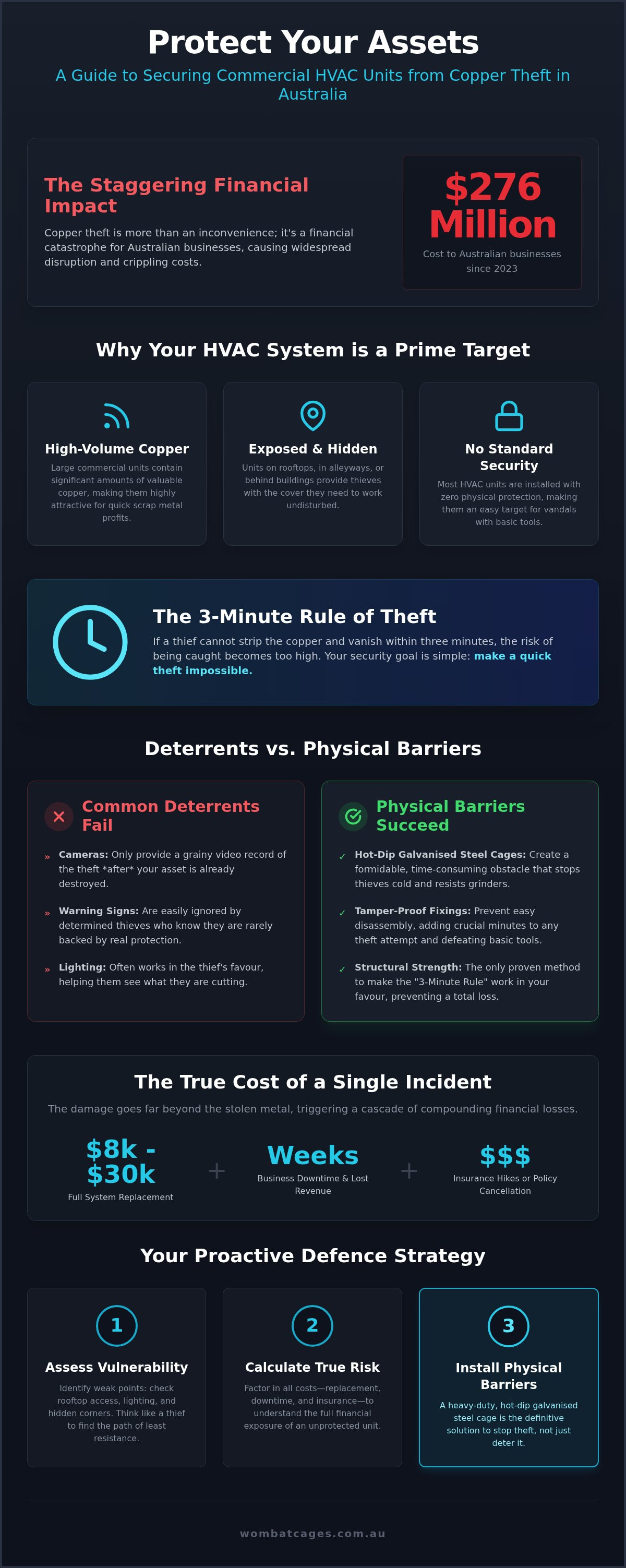
Copper theft has cost Australian utility providers and consumers more than $276 million since 2023. It is a staggering sum that represents thousands of ruined mornings for local business owners. You know the feeling of walking into a sweltering office only to find your cooling system stripped of its copper. Securing commercial HVAC units from theft is no longer an optional upgrade. It is a baseline requirement for protecting your bottom line. Most owners realise that cameras and signs don't actually stop a determined thief. They just provide a grainy video of your assets being destroyed.
This guide provides the definitive steps to protect your high-value HVAC equipment using hardened physical barriers. You'll learn how to install a permanent solution that stops vandals while maintaining full service access and equipment warranties. We will examine why hot-dip galvanised steel cages outperform other deterrents, how to manage rising scrap metal risks, and the best ways to lower your long-term insurance profile. It's time to stop reacting to theft and start preventing it with structural strength.
Key Takeaways
- Understand the true economic impact of copper theft and why basic deterrents like cameras fail to stop a theft in progress.
- Learn how to conduct a professional vulnerability assessment to identify hidden security gaps across your commercial property.
- Discover the definitive steps for securing commercial HVAC units from theft using hot-dip galvanised steel barriers.
- Find out how to balance maximum security with technician access and airflow requirements to protect your equipment's long-term performance.
- Compare single-system and multi-bay configurations to find the most efficient way to defend large banks of outdoor condensers.
The Rising Cost of HVAC Copper Theft in Australia
Thieves view your outdoor condensers as easy cash. Metal theft remains a low-risk, high-reward activity for vandals because copper is easy to move and hard to track. A thief might spend five minutes with a battery-powered grinder to strip fifty dollars worth of copper. For the property owner, that five-minute job results in a total loss. You aren't just losing the metal; you are losing the entire mechanical integrity of the system. The damage to the coils and internal components usually makes a simple repair impossible.
Calculating the true cost of an incident goes far beyond the repair bill. A single theft event often triggers massive insurance premium hikes or even policy cancellations. If your insurance claim is rejected due to a lack of physical security, the business absorbs the full blow. Business downtime is the silent killer for commercial tenants. When the cooling fails, staff productivity drops and customers walk out. Securing commercial HVAC units from theft is the only way to avoid these compounding financial disasters. In high-risk areas like Townsville or regional Queensland, the risk of repeat offences is particularly high if the site remains unprotected.
Why Commercial HVAC Units are Prime Targets
Large-scale condenser banks contain a high volume of copper piping. This makes them far more attractive than residential units. Thieves look for isolated locations like rooftops or rear alleyways that provide cover from public view. They move fast. A basic grinder can slice through copper lines and mounting brackets in seconds. Without a physical barrier, your assets are essentially sitting on the sidewalk waiting to be taken. The lack of national security standards for HVAC installations means most units are installed with zero protection against aggressive vandalism.
The Hidden Costs of HVAC Vandalism
Vandalism often causes secondary damage that is more expensive than the theft itself. Aggressive unit removal can lead to structural damage to the building's roof or walls. You also face the cost of refrigerant recharge and environmental compliance. As of January 1, 2026, all new commercial refrigeration equipment in Australia must use A2L or low-GWP refrigerants. This adds a layer of technical complexity and cost to any recovery effort. Industry estimates suggest the average cost of a full commercial HVAC replacement in 2026 typically falls between $8,000 and $30,000 depending on the specific capacity and site requirements. Protecting these assets is a matter of basic financial survival.
Vulnerability Assessment: Identifying Your Security Gaps
Securing commercial HVAC units from theft starts with a cold, hard look at your facility's layout. You need to see your property through the eyes of a vandal. Thieves look for the path of least resistance. They want high-value copper and a quick exit. Most successful thefts rely on the "Three-Minute Rule". If a criminal cannot strip the copper and vanish within three minutes, the risk of being caught usually becomes too high. Your goal is to make that three-minute window impossible to achieve.
Start by evaluating your physical perimeter. Units tucked away in hidden corners or behind industrial bins provide perfect cover for someone with a battery-powered grinder. While ground-level units are the most obvious targets, low-roof access is a growing concern. Thieves often use skips or delivery crates to climb onto roofs where they can work undisturbed. Line-of-sight from public roads can be a double-edged sword. Visibility might deter some, but it also advertises your assets to anyone driving past. A thorough audit identifies which units are most exposed so you can prioritise your security budget effectively.
Assessing Site Access and Lighting
Lighting is often misunderstood in commercial security. Does your lighting illuminate the thief for a witness to see, or does it simply help the thief see what they are cutting? Research from the Australian Institute of Criminology suggests that while environmental design is helpful, it is rarely enough to stop a determined intruder. Fencing and gate security in commercial zones are your first layers of defence. However, once a thief is inside the fence, they have all the time they need. Rooftop units are no longer safe just because they are off the ground. Modern vandals are agile and come prepared with ladders or climbing gear. Investing in a heavy-duty security cage turns an easy target into a hardened asset.
Equipment Type and Theft Risk
Different systems carry different risk profiles. Large package units are heavy and harder to move, but their external refrigerant lines and lagging are incredibly vulnerable. Split systems are often targeted because the condenser units are manageable in size and contain concentrated amounts of copper. Thieves will often hack through the lagging and pipes with total disregard for the machine's future function. While theft is the primary concern, you should also consider protecting AC units from accidental damage caused by forklifts or delivery vehicles. A single impact can be just as costly as a copper thief. Identifying these mechanical vulnerabilities allows you to choose a cage design that protects the most sensitive components without restricting essential airflow.
Comparing Security Layers: Deterrents vs. Physical Barriers
Electronic security systems often give property owners a false sense of safety. Cameras and alarms are deterrents. They rely on the threat of being caught to influence a criminal's behaviour. However, copper thieves are rarely deterred by a lens. Most wear masks to bypass facial recognition and move with such speed that police response times are irrelevant. A thief can strip a unit and be gone before a monitoring centre even finishes their first phone call. These systems are useful for evidence after the fact, but they don't prevent the initial destruction of your assets.
Securing commercial HVAC units from theft requires a shift from surveillance to physical denial. A visible steel security cage sends a clear psychological message to any vandal. It says the job will be loud, difficult, and time-consuming. Most criminals will simply move on to an easier, unprotected target. This one-off investment removes the need for ongoing monthly monitoring fees while providing a permanent solution that doesn't rely on Wi-Fi signals or power grids.
The Limitations of Electronic Security
Police and security guards can't be everywhere at once. In many Australian industrial zones, response times can stretch to twenty minutes or more. A copper theft is usually over in five. By the time someone arrives, the damage is done. You're left with a grainy video and a massive repair bill. Electronic systems also require constant maintenance. Sensors fail, batteries die, and software needs updates. A physical barrier doesn't have these vulnerabilities. It stands guard 24/7 without needing a subscription or a technician to check its signal.
The Case for Galvanised Steel Enclosures
Material choice is critical in the harsh Australian climate. Coastal and humid regions are notorious for salt-air corrosion. Cheap painted steel or lightweight alternatives will rust through within a few seasons. This compromises the structural integrity of the cage and looks unprofessional. Hot-dip galvanised steel provides a metallurgical bond that protects the metal from the inside out. It's built to last for decades, not just years. It's the standard for securing commercial HVAC units from theft in high-corrosion zones.
Maintaining your equipment is just as important as defending it. A well-designed cage uses an open mesh pattern to ensure maximum airflow. This prevents the unit from overheating and maintains its energy efficiency. It also allows technicians to perform routine servicing without removing the entire structure. For more detail on why this process is superior, read our Hot-dip galvanised condenser cages guide. These cages are bolted directly to the ground or wall, providing a rigid defence that resists aggressive tampering and environmental wear.
Step-by-Step: Securing Your Commercial HVAC System
Protecting your mechanical assets requires a methodical approach. You cannot simply throw a fence around a unit and hope for the best. Securing commercial HVAC units from theft involves a five-step process that ensures total protection without compromising system performance. Start with a full audit of every outdoor asset on your property. This includes checking rooftop units, ground-level condensers, and wall-mounted split systems. Once you have identified the targets, you can determine if you need a Single Split System Security Cage for isolated units or Multi-Bay Security Cages to defend large banks of condensers efficiently.
Professional installation is the final layer of defence. A cage is only as strong as its anchor points. Bolting the structure directly to concrete slabs or structural masonry walls prevents thieves from using long pry bars to lever the cage away. Regular inspections should follow. Every six months, check the security fixings and the integrity of the mesh. Look for signs of attempted tampering or loose bolts caused by vibration. This proactive maintenance ensures your "Dependable Guardian" remains unshakeable against both vandals and the elements.
Measuring for Airflow and Serviceability
Airflow is the lifeblood of your HVAC system. Restricting it leads to compressor overheating, higher energy bills, and eventual mechanical failure. When measuring for a cage, you must allow for adequate clearance between the unit and the steel mesh. An open mesh design is always superior to solid louvres because it allows heat to dissipate rapidly in the Australian sun. You must also ensure the cage dimensions allow for panel removal. A cage that blocks technician access will eventually be cut open by a frustrated repairman, destroying your security investment. Always verify that your chosen configuration provides enough room for a tradesperson to work safely without removing the entire structure.
Professional Installation Standards
DIY installation often fails under heavy leverage. Thieves don't just use grinders; they use crowbars and vehicle-mounted winches. High-quality cage installation services use heavy-duty masonry bolts and anti-tamper fixings that cannot be undone with standard tools. It is also critical to secure the refrigerant lines within the cage perimeter. If the copper lines are exposed between the cage and the wall, a thief will simply cut them there. A professional installer ensures the cage sits flush against the mounting surface, leaving no gaps for a blade or a bar to enter. This level of craftsmanship is what separates a genuine security barrier from a simple visual deterrent.
Selecting the Right Security Cage for Commercial Facilities
Commercial facilities face a scale of risk that residential properties simply don't. You aren't just protecting a single condenser; you are often defending an entire bank of assets worth tens of thousands of dollars. One-size-fits-all solutions rarely work in these environments. Custom sizing is essential because condenser dimensions vary significantly between brands and models. A cage that is too tight will restrict airflow and void your warranty. A cage that is too loose wastes valuable footprint in tight service corridors. Securing commercial HVAC units from theft at scale requires a strategic layout that balances unit density with technician accessibility.
Material choice determines how long your defence lasts. Aluminium is often marketed for its light weight, but it is far too soft for high-security commercial applications. A battery-powered grinder or even a heavy-duty pair of snips can make short work of aluminium mesh. Galvanised steel is the only viable option for high-risk industrial zones. It offers the hardness required to resist aggressive leverage and cutting. It stands up to the weight of an intruder and the force of their tools without buckling.
Configuring Multi-Bay Security Systems
Multi-bay cages are the standard for large-scale installations. They allow you to organise banks of units under a single, unified barrier. Shared wall designs are highly efficient for commercial properties. They reduce material costs and installation time while maintaining the structural integrity of the entire bank. Even in a multi-bay setup, individual unit access remains a priority. You must ensure a technician can service one condenser without exposing the rest of the bank to theft. This configuration keeps your site organised and your assets protected. For more technical details on these systems, see our Multi-unit AC security cage guide.
Durability and Asset Longevity
The Australian sun is brutal on building materials. UV radiation and heavy rain quickly degrade painted or plastic-coated barriers. Hot-dip galvanised steel thrives in these conditions. It provides a permanent physical security solution that won't rust, peel, or weaken over time. The long-term ROI is clear. You pay once for a hardened barrier rather than repeatedly paying for emergency repairs, refrigerant recharges, or full system replacements. It is a common-sense investment in asset protection that lowers your risk profile for years to come. If you are ready to harden your site against vandals, get a commercial security quote from Wombat Cages today.
Protect Your Business Assets Today
Copper theft is a growing financial threat, but it is entirely preventable with the right strategy. Electronic security systems only record the crime while it happens. A physical barrier provides the only definitive solution for securing commercial HVAC units from theft. By installing a hardened cage, you turn a vulnerable asset into a difficult target that thieves will simply avoid. You now understand how to assess your site for security gaps and why selecting hot-dip galvanised steel is critical for enduring the harsh Australian climate. Proper airflow and technician access ensure your equipment stays efficient while remaining fully protected.
Wombat Cages provides the structural strength needed to defend your property. We offer hot-dip galvanised steel construction for maximum durability and custom multi-bay configurations for large-scale facilities. Our cage installation services ensure your barriers are bolted securely to structural surfaces. Secure your commercial HVAC assets with Wombat Cages today. Take control of your site security and enjoy the peace of mind that comes with total protection. It is time to stop reacting to vandalism and start preventing it with a permanent, heavy-duty solution built to last for years.
Frequently Asked Questions
Will a security cage void my HVAC unit warranty?
No, a professionally installed cage will not void your manufacturer's warranty as long as it maintains required clearances. Manufacturers require specific airflow to prevent the compressor from overheating. Our open mesh design ensures these standards are met. By securing commercial HVAC units from theft without drilling into the unit itself, you preserve the mechanical integrity and the warranty. Always check your specific brand's clearance manual before finalising the installation.
How does a cage affect the airflow and efficiency of the air conditioner?
A cage with an open mesh design has a negligible effect on the efficiency of your air conditioner. We use high-tensile steel mesh that allows for maximum airflow while providing a rigid barrier against vandals. Solid covers or tight louvres can trap heat and force the compressor to work harder, which increases energy costs. Our designs focus on keeping the unit cool and operational even in the peak of the Australian summer.
Can technicians still service the HVAC unit once the cage is installed?
Yes, technicians can still perform routine maintenance and emergency repairs with the cage in place. We design our enclosures to allow for easy panel removal and tool access. A cage that blocks a tradesperson is a liability that often ends up being cut open during a service call. Our Single Split System Security Cage and multi-unit designs ensure that your maintenance schedule remains on track without compromising the security of the asset.
Is copper theft covered by standard commercial property insurance?
Coverage for copper theft depends on your specific policy, but insurers often require evidence of reasonable security measures. If a unit is left completely exposed in a high-risk area, a claim for theft or vandalism might be rejected. Securing commercial HVAC units from theft with a physical barrier demonstrates a proactive approach to risk management. This can help in the claims process and may even assist in lowering your long-term insurance premiums.
What is the best material for an outdoor AC security cage in Australia?
Hot-dip galvanised steel is the definitive material for Australian outdoor security cages. Unlike aluminium, which can be cut with basic hand tools, galvanised steel provides the hardness and structural integrity needed to stop a determined thief. The hot-dip process creates a metallurgical bond that protects the steel from rust and salt-air corrosion. This makes it ideal for coastal regions and humid environments where standard painted steel would fail within a few years.
How are the cages secured to the ground or wall to prevent removal?
Cages are fixed directly to concrete slabs or structural masonry walls using heavy-duty masonry bolts. This prevents thieves from using leverage or vehicle-mounted winches to pull the enclosure away from the unit. We also recommend using anti-tamper fixings that require specialised tools for removal. This creates a permanent installation that resists aggressive tampering and ensures the cage stays exactly where it was installed regardless of the force applied by a vandal.
Do I need a single cage for every unit or one large multi-bay cage?
Both configurations are effective, but the choice depends on the physical layout of your outdoor condensers. A Single Split System Security Cage is perfect for isolated units on walls or rooftops. If you have a bank of condensers grouped together, Multi-Bay Security Cages are more efficient. These multi-unit systems use shared walls to reduce the total footprint and material costs while providing a unified, hardened barrier for your entire mechanical plant.
How much does it cost to replace stolen copper from a commercial HVAC system?
The cost to replace stolen copper often runs into thousands of dollars because the entire system is usually destroyed during the theft. While the scrap value might be low, the repair bill includes new refrigerant, technical labour, and often a full system replacement. Industry data suggests a full commercial HVAC replacement in 2026 can cost between $8,000 and $30,000. This doesn't include the cost of business downtime or potential structural damage to your building.


