
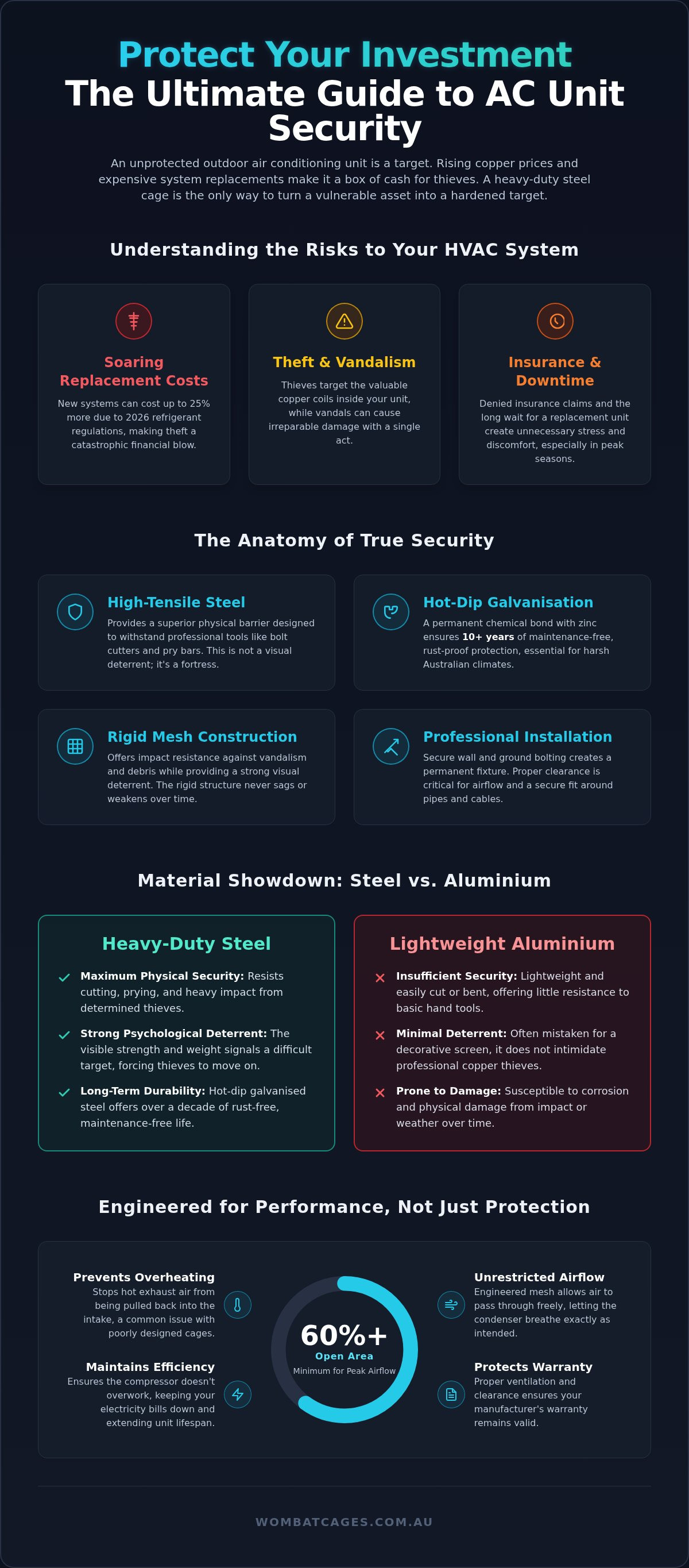
An unprotected outdoor condenser isn't just an appliance. It's a box of cash sitting on your property. With the price of copper rising and new HVAC systems costing up to 25 per cent more due to 2026 refrigerant regulations, thieves see your unit as an easy payday. You've likely worried about the cost of a total replacement or the stress of a denied insurance claim. It's a valid concern. Installing a heavy duty AC security cage is the only way to turn a vulnerable asset into a hardened target.
You shouldn't have to sacrifice your unit's efficiency for the sake of safety. This guide explains how high-tensile, hot-dip galvanised steel enclosures provide over a decade of maintenance-free protection. We will show you why professional-grade mesh won't restrict airflow or void your manufacturer's warranty. From meeting strict insurance requirements to stopping vandals in their tracks, you'll discover exactly how to secure your investment for the long haul. It's about getting total peace of mind without the technical headaches.
Key Takeaways
- True security requires high-tensile, hot-dip galvanised steel rather than simple visual deterrents. You need a physical barrier designed to withstand professional tools and heavy impact.
- Engineered mesh designs prevent overheating by maintaining maximum airflow. A properly constructed cage ensures your condenser breathes exactly as the manufacturer intended.
- Steel offers a superior physical and psychological barrier compared to lightweight aluminium. It provides the structural integrity needed to make copper theft physically impossible.
- Selecting the correct heavy duty AC security cage involves measuring specific clearance zones. Accounting for pipes, cables, and wall offsets is critical for a secure fit.
- Professional installation using wall and ground bolting creates a permanent security solution. This maintenance-free approach protects your HVAC investment for 10 years or more.
What Defines a Heavy-Duty AC Security Cage?
A heavy duty AC security cage is more than a simple metal box. It is a high-tensile steel fortress designed to make unauthorised access physically impossible. Many property owners mistake thin, decorative screens for actual security. These visual deterrents might stop a casual passerby, but they won't stand up to a determined thief with a pair of bolt cutters. Real protection comes from the weight of the metal and the quality of the industrial joins. You aren't just buying a cover; you're buying a permanent physical barrier.
The true benchmark of a heavy-duty build lies in its gauge thickness and weld integrity. Residential-grade brackets often fail because they lack the structural mass to resist prying or leverage. Professional copper thieves target these weak points with efficiency. A proper cage protects the critical HVAC system components from theft, accidental impact, and flying debris during storms. It turns a vulnerable condenser into a hardened asset that can withstand significant force without buckling or breaking.
The Role of Hot-Dip Galvanisation
Hot-dip galvanisation is a non-negotiable standard for Australian outdoor units. This process involves dipping the entire steel frame into a bath of molten zinc at roughly 450 degrees Celsius. It creates a permanent chemical bond that prevents oxygen and moisture from ever reaching the steel core. While powder-coated alternatives might look good on day one, they eventually chip, scratch, and peel. Once that surface layer fails, rust sets in and destroys the cage's integrity. In our harsh coastal and inland climates, a hot-dip finish is the only way to guarantee a maintenance-free life cycle of ten years or more.
Rigid Mesh vs. Flimsy Screens
Rigid mesh provides the impact resistance that flimsy screens or thin wire lack. It acts as a shield against vandalism and accidental damage from vehicles or garden equipment. Steel mesh also offers security through visibility. When a thief sees a heavy duty AC security cage, they see a difficult, time-consuming job. This immediate visual of a robust barrier often forces them to move on to an easier target. The mesh remains rigid over time, ensuring the structure never sags or loses its protective shape under pressure. It provides the perfect balance between high-level security and the essential airflow your unit needs to function at peak capacity.
Engineering for Airflow and HVAC Performance
A common myth suggests that wrapping a condenser in steel will cause it to overheat. This only happens with poor design. A professionally engineered heavy duty AC security cage prioritises the unit's thermal health as much as its safety. If a cage restricts air intake, the compressor works harder to compensate. This leads to higher electricity bills and premature mechanical failure. You need a solution that balances raw physical strength with the specific cubic metres of air per hour your system requires.
Calculating the open-area percentage is the most critical step in the design phase. High-efficiency condensers need a clear path for heat exchange to function as the manufacturer intended. We also consider the clearance zone during installation. If the cage sits too close to the unit, it can cause 'recirculation' where hot exhaust air is pulled back into the intake. This cycle kills efficiency and can eventually fry the electronics. Maintaining your HVAC warranty depends entirely on these airflow standards being met. Most manufacturers won't void a warranty if the protective enclosure allows for proper ventilation and clearances.
The Science of Open Mesh Design
Mesh aperture size is the sweet spot between security and performance. If the holes are too large, a thief can reach through to snip copper lines. If they're too small, they act like a solid wall to the fan. Solid or semi-solid enclosures are dangerous because they trap heat and lead to rapid compressor failure. For high-efficiency condensers, the open-air requirement is generally a minimum of 60 per cent of the total surface area of the cage panels. This ensures the fans move air without resistance. Copper theft is a serious crime that often involves the illegal release of refrigerants, a fact highlighted by the federal prosecution of AC unit theft in various jurisdictions.
Technician Access and Serviceability
Security shouldn't be a barrier for your local sparky or fridge mechanic. A cage that is welded shut is a liability. We design for the trade by ensuring service valves and electrical panels remain reachable. Removable front panels or hinged doors allow for routine maintenance without compromising the fixings. You can learn more about how we balance technician access AC cage requirements with high-level security. If a technician has to spend two hours just to get to the unit, your service bill will skyrocket. It's better to choose a professionally installed security cage that respects the needs of the people who keep your air running.
Comparing Security Materials: Steel vs. Aluminium
Choosing the right material is the difference between a permanent solution and a temporary fix. While aluminium is often marketed for its lightweight convenience, it lacks the raw mass required to stop a determined intruder. A heavy duty AC security cage made from high-tensile steel provides a superior physical and psychological barrier. It feels solid. It doesn't flex. Thieves looking for a quick score generally avoid steel because they know it requires specialised power tools and significant time to breach.
Tool resistance is where the materials diverge most sharply. A pair of manual bolt cutters or a cordless reciprocating saw will make short work of aluminium. Galvanised steel, however, resists these common theft methods by absorbing impact and dulling blades. This durability extends to environmental factors too. The Australian sun and coastal salt spray are brutal on outdoor assets. While untreated metals corrode within months, a heavy-duty steel build stands up to the elements for over a decade. It stays rigid and functional through heatwaves and storms alike.
Why Galvanised Steel is the Commercial Standard
Commercial and industrial sites don't use aluminium for a reason. They require an 'unbreakable' reputation to protect high-value infrastructure. Steel's resistance to prying is unmatched; you can't simply bend a panel out of the way to reach the copper lines. Industry data confirms a significant rise in HVAC theft, making these hardened targets essential for business owners. Investing in a galvanised steel AC cage ensures your security measures are as tough as the environment they inhabit. It is the gold standard for high-risk zones where asset loss isn't an option.
The Hidden Weaknesses of Lightweight Enclosures
Lightweight aluminium enclosures often come as flat-pack kits. While they are easy to transport, this modularity is a major security flaw. If a cage is easy to put together, it's usually easy to dismantle. Aluminium panels can be 'peeled' back or bent with a standard crowbar, leaving the condenser exposed. These thinner units also tend to rattle and vibrate as the unit runs. This creates noise pollution that can become a nuisance for neighbours or staff. A single heavy duty AC security cage might cost more upfront, but it outlasts three cheaper replacements that fail at the first sign of trouble. It is a one-time investment that ends the cycle of repair and replacement.
Site Assessment: Choosing Your Configuration
Evaluating your property is the first step toward permanent protection. A heavy duty AC security cage is only as strong as its installation and fit. You need to look beyond the unit itself and consider the entire environment. This systematic approach ensures your enclosure doesn't just look tough but performs under pressure. Assessing the site requires a few specific steps to get the configuration right.
- Step 1: Identify your unit type. Determine if you are securing a residential single split system or a massive commercial condenser. The physical footprint dictates the structural requirements.
- Step 2: Measure the clearance zone. Account for refrigerant pipes, electrical conduits, and wall offsets. A cage that is too small will choke the unit's airflow.
- Step 3: Evaluate the mounting surface. Confirm if you are bolting into a concrete pad or mounting directly to a brick wall. Concrete provides the highest level of security.
- Step 4: Determine the risk level. Assess if the unit is visible from the street or hidden in a secluded alleyway. Secluded areas often require the highest grade of physical reinforcement.
- Step 5: Select the bay configuration. Choose between a standard single cage or a multi-bay setup for condenser banks.
Mounting surfaces are a critical part of the assessment. If your unit sits on a thin garden bed or loose gravel, you'll need to install a proper concrete base before the cage can be fixed. Security is about the connection to the ground. Without a solid anchor point, a thief can simply pry the entire cage up. For wall-mounted units, we use heavy-duty fixings that bite deep into the masonry. This prevents the cage from being pulled away from the structure with a vehicle or a crowbar.
Single Split System Security
Most residential split systems sit on the ground or are mounted low on external walls. The cage must be designed to cover the critical copper pipe entry points. This is the most vulnerable area where thieves snip lines to bleed the gas and steal the metal. You want a no-nonsense aesthetic that projects strength. It should be clear to anyone looking that the unit is not worth the effort of a break-in attempt. A well-fitted cage provides a tidy, professional look that doesn't detract from your property's value.
Multi-Bay and Commercial HVAC Banks
Commercial properties often group condensers in rows or banks. Protecting these with individual cages is inefficient. A continuous run of security panels is a better solution. This is vital for shopping centre condenser protection where multiple high-value units are clustered together. For industrial projects, a multi unit AC security cage offers a streamlined, hardened barrier that is much harder to bypass than separate enclosures. To secure your facility today, you can view our range of heavy duty security cages and find the right fit for your condenser bank.
The Wombat Cages Approach: Set and Forget Security
Our philosophy is straightforward. We build gear that's tougher than the people trying to break it. A heavy duty AC security cage from Wombat Cages isn't a temporary deterrent; it's a permanent structural upgrade. We don't believe in flimsy flat-packs or thin wire mesh that can be snipped with a pair of pliers. Every enclosure we produce is a statement of intent that tells a thief their efforts are better spent elsewhere. It's about providing property owners with the quiet confidence that their high-value infrastructure is hardened against any threat.
The Wombat standard relies on two pillars: hot-dip galvanised steel and professional-grade fixings. This isn't just about strength; it's about longevity in the harsh Australian climate. We use a heavy-gauge steel that resists prying, cutting, and blunt force. Our fixings are selected to ensure that once the cage is in place, it stays there. We don't use standard screws that can be backed out with a common toolkit. Instead, we use security fasteners and permanent anchoring systems that require industrial equipment to remove. This level of detail is what separates a genuine security asset from a simple metal cover.
Customisation is at the core of what we do. No two sites are identical, and a one-size-fits-all approach often leaves gaps that thieves can exploit. We configure our cages to fit your specific site requirements perfectly, whether you're protecting a Single Split System Security Cage at a residential property or a massive bank of Multi-Bay Security Cages at a commercial facility. We account for every pipe, cable, and wall offset to ensure the cage fits like a glove while maintaining the necessary airflow for your unit to breathe.
Professional Installation vs. DIY
Proper anchoring is the difference between a secure unit and a stolen one. Many DIY kits fail because they aren't fixed correctly to the substrate. If a cage isn't bolted deep into a concrete pad or structural masonry, it's just a handle for a thief to use when prying the unit off its mount. Our professional installation team uses specialist tools-including heavy-duty hammer drills and security-bit drivers-to ensure every anchor point is rock solid. We also ensure that the cage doesn't interfere with future serviceability. A professional fitting means your fridge mechanic can still access the service valves and electrical panels without having to dismantle the security system. We leave the right clearances so your maintenance costs don't rise just because your security has improved.
Securing Your Assets Today
Don't wait for a Monday morning discovery of snipped copper lines and a missing condenser. Replacing a stolen unit can cost thousands of dollars and weeks of downtime. The process for securing your property is simple. We provide a clear, no-nonsense quote based on your specific unit types and site layout. Once you approve, we handle the professional install from start to finish. You can also review our copper theft air conditioner prevention checklist to identify other vulnerabilities on your property. Protect your investment before the thieves arrive. It's a small price to pay for a decade of maintenance-free peace of mind and total asset protection.
Secure Your HVAC Investment for the Long Term
Protecting your property from rising HVAC replacement costs requires more than a simple visual deterrent. You need a physical barrier that makes unauthorised access practically impossible. A heavy duty AC security cage built from high-tensile steel provides the structural hardening your site needs. It secures your condenser against professional copper thieves while maintaining the precise airflow required by your system's manufacturer. This ensures your unit runs efficiently without the risk of overheating or mechanical failure.
We provide nationwide commercial-grade protection that is hot-dip galvanised for long-term rust resistance. Our enclosures are designed for maximum airflow and easy technician access; they represent a permanent, maintenance-free upgrade for your facility. By choosing a professional installation, you avoid the common pitfalls of flimsy DIY kits and ensure your asset is bolted securely to the substrate for life. Take control of your site security now and stop the cycle of expensive repairs and insurance claims.
Don't wait for your unit to become another theft statistic. Secure your HVAC equipment with a heavy-duty Wombat Cage today and enjoy the peace of mind that comes with industrial-strength protection.
Frequently Asked Questions
Will a heavy-duty security cage void my air conditioner's warranty?
A professionally designed enclosure won't void your warranty if it maintains the manufacturer's required airflow and service clearances. Most HVAC brands specify a minimum distance for air intake and exhaust. As long as your heavy duty AC security cage respects these measurements, your warranty remains intact. We build our cages to exceed these ventilation standards so your unit runs efficiently while staying fully protected.
Can a determined thief still cut through a galvanised steel cage?
While no barrier is 100 per cent impenetrable, high-tensile galvanised steel makes theft physically exhausting and loud. A thief would need industrial-grade power tools and significant time to breach the mesh. Most criminals target easier units they can strip in seconds with hand tools. Our cages turn your condenser into a hardened target that isn't worth the risk or the noise of a break-in attempt.
How much clearance does my AC unit need inside the security cage?
Your unit typically needs between 100mm and 200mm of clearance on all sides to prevent air recirculation. The exact distance depends on your specific condenser model and its intake requirements. We measure each site carefully to ensure the cage doesn't choke the fan. Proper spacing allows for unrestricted heat exchange; this keeps your electricity bills low and prevents the compressor from working harder than it should.
Is a mesh cage better than a solid enclosure for my condenser?
Rigid mesh is significantly better than a solid enclosure because it allows the unit to breathe. Solid covers trap heat and cause the compressor to fail prematurely. Our mesh design provides high-impact resistance while ensuring the condenser receives the volume of air it needs. You get the benefit of a physical shield without the risk of thermal shutdown or reduced energy efficiency.
Do I need a concrete base to install a heavy-duty AC cage?
Bolting your cage to a concrete base is the only way to achieve maximum security. If you mount a cage on loose soil or gravel, a thief can simply pry the entire structure out of the ground. For units on garden beds, we recommend pouring a small concrete pad first. This provides a solid anchor point for our heavy-duty fixings; it ensures the cage stays exactly where it's installed.
How do technicians service the air conditioner once the cage is installed?
Technicians access the unit through removable front panels or dedicated service doors. We design our cages with the trade in mind; this ensures service valves and electrical points are always reachable. Your fridge mechanic won't have to dismantle the entire security system for a routine service. This smart design keeps your maintenance costs down while maintaining a high level of protection for the internal components.
What is the difference between powder-coated and hot-dip galvanised steel?
Hot-dip galvanisation involves dipping the steel into molten zinc to create a permanent metallurgical bond. It provides superior rust resistance compared to powder coating, which is just a surface layer of paint. In the harsh Australian climate, powder-coated steel eventually chips and corrodes. Hot-dip galvanised steel remains maintenance-free for over a decade; it is the industrial standard for any outdoor heavy duty AC security cage.
Can these cages be custom-made for multiple units or large commercial banks?
We specialise in custom configurations for both single units and large commercial condenser banks. Multi-bay cages provide a continuous run of security that is more efficient and cost-effective than installing separate enclosures. Whether you have a row of units at a shopping centre or a cluster at an industrial site, we can build a multi-bay solution that fits your specific layout perfectly.


