
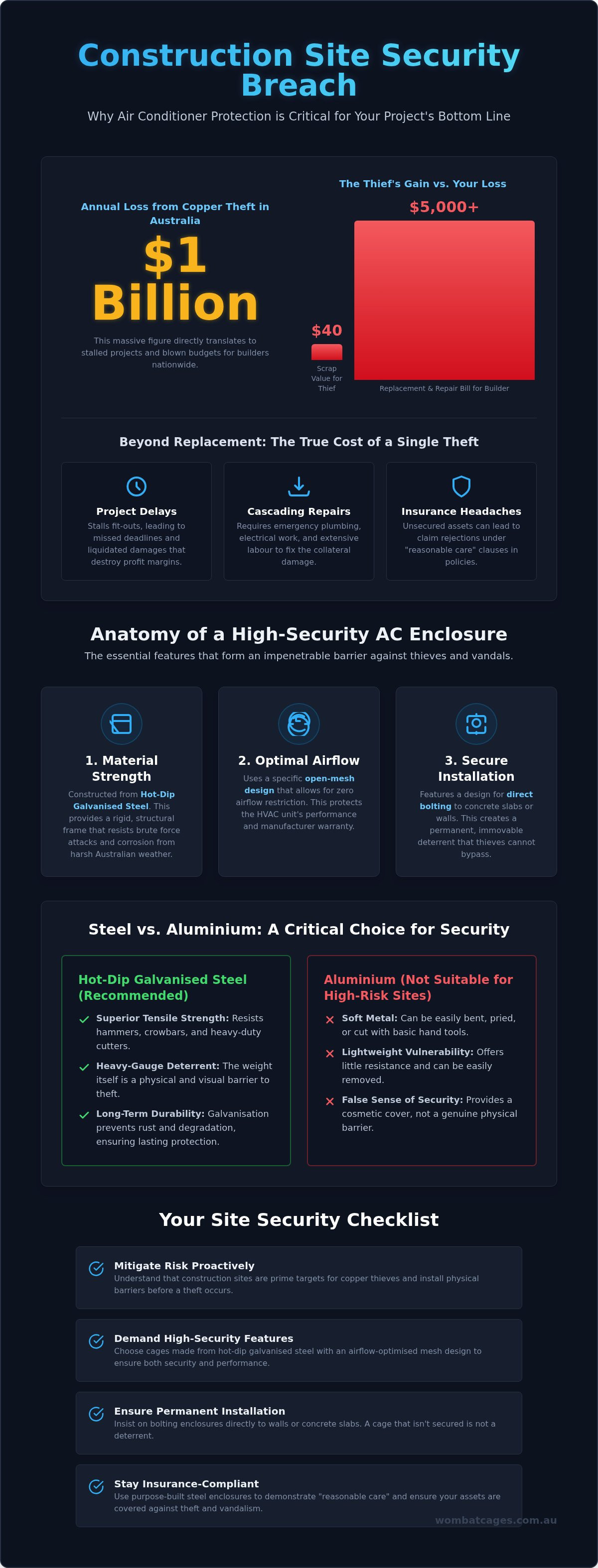
Did you know that copper theft from construction sites accounts for a staggering $1 billion in annual losses? It's a massive figure that translates to stalled projects and blown budgets for builders across Australia. Finding the right construction site air conditioner protection is no longer optional. You've likely felt the frustration of arriving on-site only to find a vandalised HVAC system. A thief walks away with $40 worth of scrap, but leaves you with a $5,000 replacement bill and weeks of scheduling headaches.
We understand that site security is a constant battle. This guide explains how to defend your site offices and new builds with heavy-duty steel enclosures. You'll learn how these cages create a physical barrier thieves can't bypass. We'll cover the benefits of galvanised steel, how to stay insurance-compliant, and why bolted-down cages are the only way to secure your assets. It's about moving from vulnerability to total protection. Let's get your site locked down.
Key Takeaways
- Understand why building sites are magnets for copper thieves and how to mitigate the risk of expensive project delays.
- Discover the essential features of effective construction site air conditioner protection, focusing on hot-dip galvanised steel and airflow-optimised mesh.
- Learn how to secure temporary site offices and dongas using modular multi-bay configurations that defend multiple units at once.
- Identify the critical steps for a secure installation, including the importance of bolting directly to walls or concrete slabs for a permanent deterrent.
- Explore how purpose-built steel enclosures provide an insurance-compliant security measure that stops vandals in their tracks.
Why Construction Sites Are High-Risk Zones for HVAC Theft
Construction sites are high-exposure zones. Once the tradies pack up for the day, these sites become quiet targets for opportunistic vandals. Construction equipment theft is a systemic problem across Australia. It isn't just about stolen tools or heavy machinery. HVAC units are increasingly in the crosshairs because they contain high-value copper. Standard installations often rely on flimsy plastic brackets or leave copper piping completely exposed. This is an open invitation for a thief with a pair of bolt cutters.
The Motivation Behind Copper Theft
The driver is simple: quick cash. While copper scrap prices fluctuate, the motivation for thieves remains constant. They target "soft" commercial sites where security is low. A $50 scrap metal haul for a thief often results in $5,000 worth of damage for the builder. Implementing effective construction site air conditioner protection is the only way to stop this cycle. You aren't just paying for a new condenser unit. You're paying for emergency plumbing, electrical work, and the labour to fix the mess. Then there are the project delays. A missing AC unit can stall an entire fit-out. This leads to missed deadlines and liquidated damages that eat your profit margins.
Insurance Requirements for Site Security
Insurers aren't in the business of paying for avoidable risks. Most commercial policies include a "reasonable care" clause. If you leave high-value assets unsecured, you might find your claim rejected. Physical barriers don't just stop the theft; they demonstrate that you've taken practical steps to defend the property. This due diligence is critical during the construction phase when site activity is high and monitoring is difficult.
Investing in a permanent deterrent like a steel cage is a common-sense move. It keeps your premiums manageable and ensures your site stays on schedule. In many cases, proving you have installed construction site air conditioner protection can even lead to an air conditioner cage insurance discount. It's about moving from a state of vulnerability to total protection. Don't wait for the first theft to occur before you act. Security should be part of the initial site setup, not an afterthought following a loss.
The Anatomy of a High-Security AC Enclosure
Effective construction site air conditioner protection starts with the materials. You can't rely on thin mesh or decorative covers found in retail stores. High-security enclosures require hot-dip galvanised steel. This material is the industry standard for a reason. It provides a rigid, structural frame that resists brute force. The galvanisation process involves dipping the steel in molten zinc. This creates a permanent bond. It ensures the cage won't rust or weaken when exposed to the harsh Australian sun or coastal salt air. It's built for utility. It's designed for defence.
Security is only half the battle. A cage that stops a thief but kills the machine is a failure. Rigid mesh is superior to solid panels for this exact reason. HVAC units require massive volumes of air to dissipate heat. Solid or poorly designed covers restrict this flow. This causes the compressor to work harder, leading to overheating and premature failure. Using a hot dip galvanised condenser cage with an open-mesh design keeps the air moving. It protects the asset without compromising the mechanical integrity of the system.
Steel vs Aluminium: Making the Right Choice
Many contractors consider aluminium because it's lightweight. This is a mistake for high-risk sites. Aluminium is a soft metal. It can be easily bent, pried, or cut with basic hand tools. Steel offers superior tensile strength. It stands up to hammers, crowbars, and heavy-duty wire cutters. When security is the priority, weight is your friend. A heavy-gauge steel frame is a visual and physical deterrent that aluminium simply can't match. If you're looking for a permanent solution, our Single Split System Security Cage provides the necessary structural rigidity.
Maintaining Optimal HVAC Performance
Manufacturer warranties are strict about ventilation. If a technician finds the unit has been suffocated by a security enclosure, your warranty is gone. Wombat Cages uses a specific mesh aperture. This allows for zero airflow restriction while remaining small enough to block hands and tools. Heavy-gauge wire adds another layer of defence. It resists standard wire cutters, forcing a thief to use noisier, more conspicuous tools. The goal is to make the theft too difficult and too loud to be worth the effort. Proper bolting mechanisms complete the setup. We secure the frame directly to concrete slabs or brickwork using tamper-proof fasteners. This ensures the entire enclosure stays exactly where you put it. It provides the peace of mind that only physical strength can deliver.
Protecting Site Offices and Temporary Dongas
Site offices and temporary dongas are often the first structures on a new development. They house expensive technology and provide essential climate control for staff. Because these units frequently sit on the perimeter or in remote, unlit areas, they become primary targets for theft. Effective construction site air conditioner protection must account for the unique layout of these mobile buildings. These units are often raised on blocks, leaving the underside and rear pipework exposed. This is where thieves strike first.
Exposed pipework is the most vulnerable point in any HVAC setup. A thief doesn't always want the whole condenser. They want the copper lines. They can strip metres of high-value copper in minutes if it's left uncovered. Our cages are designed to wrap around both the condenser and the entry points for the refrigerant lines. This makes it impossible to access the pipes without heavy-duty cutting tools. It turns a "soft" target into a hardened asset.
Builders need flexibility when it comes to temporary infrastructure. We offer both temporary and permanent installation options for site trailers. You can bolt cages directly to the trailer chassis or secure them to temporary concrete pads. When the project ends and the donga is moved, the cage moves with it. It's a portable security asset that provides long-term value across multiple projects. It's a common-sense investment for any fleet manager.
Multi-Bay Security for Large Site Compounds
Large developments often feature banks of site offices parked side-by-side. This results in rows of condensers that are difficult to monitor individually. Organising these units into a single secure enclosure is the most efficient way to manage site security. Using a multi unit AC security cage reduces the total hardware needed. It creates a clean, organised look for the site compound while providing a single, fortified point of entry. It's a cost-effective way to scale your protection as the site grows.
Vandal-Proofing Remote Equipment
Remote equipment faces threats beyond just professional thieves. Site machinery and delivery vehicles are a constant hazard in tight site layouts. A reversing forklift or a stray truck can easily crush an unprotected condenser, leading to expensive repairs and downtime. Steel cages act as a physical buffer. They are essential for protecting AC unit from accidental damage by creating a clear "no-go" zone. They also deter graffiti and intentional vandalism in high-risk areas. A rigid steel barrier sends a clear message that the site is under professional management.
Installation and Maintenance: What Site Managers Need to Know
Site managers have enough on their plates without worrying about stolen assets. Getting the installation right the first time is critical for long-term construction site air conditioner protection. Before a cage arrives, you need a clear plan. Check the surface type. Bolting into a solid concrete slab is ideal, but reinforced brickwork also works. Measure the clearances carefully. You need enough space for the cage to sit without touching the unit, allowing for vibration and thermal expansion. If the cage is too tight, it can rattle or even damage the condenser fins over time.
Electrical connections are often overlooked during security upgrades. A security cage must never block the isolator switch or the conduit entry points. If a technician can't reach the power quickly in an emergency, the installation becomes a safety hazard. We ensure the frame sits clear of all cabling and service valves. This keeps the unit compliant with Australian electrical standards while maintaining a high level of physical security. It's about finding the balance between a fortified barrier and a functional machine.
The 5-Step Professional Installation Process
A professional install ensures there are no weak points for a thief to exploit. We follow a methodical approach to ensure every cage is a permanent fixture on your site.
- Site assessment and clearance check: We confirm the unit dimensions and identify any surrounding obstacles or pipework that need protection.
- Frame positioning and alignment: The condenser is centred within the footprint to ensure zero airflow restriction.
- Drilling and securing heavy-duty masonry anchors: We use high-tensile bolts to fix the base or wall brackets directly to the structure.
- Final mesh assembly and security testing: The panels are bolted together using tamper-proof fasteners that resist standard tools.
- Compliance verification: We check that all service points remain accessible and the unit is operating at peak efficiency.
Ensuring Easy Technician Access
A cage that needs to be cut off for a simple refrigerant top-up is a waste of money. Our designs focus on modularity. We use technician-friendly layouts that allow for standard servicing without removing the entire structure. This reduces maintenance downtime and keeps your ongoing service costs low. A cage must be accessible for annual servicing to ensure the compressor continues to run efficiently and remains covered by the manufacturer's warranty. If you need a team that understands these technical requirements, book our Cage Installation Services to secure your assets properly.
Wombat Cages: National Asset Protection for Construction
Wombat Cages isn't just a supplier. We're a partner in asset protection. We understand that construction site air conditioner protection requires more than just a metal box. It requires a system built for the rigours of the Australian building industry. Our "Dependable Guardian" philosophy drives everything we manufacture. We don't focus on aesthetic flair. We focus on physical strength and long-term resilience. Every cage is purpose-built to withstand brute force and harsh weather. We provide national supply and professional installation across Australia. This ensures that whether you're managing a single residential build or a massive commercial site compound, your HVAC assets are secure.
Custom configuration is at the core of our service. No two site layouts are identical. We provide cages for any unit size or configuration. This includes everything from a split system security cage for a site office to massive multi-bay setups for apartment blocks. Our modular design allows for flexibility on-site. We work with site managers to ensure the protection fits the specific constraints of the environment. It's about providing a solution that is as much about common-sense prevention as it is about high-quality manufacturing.
Why Developers Choose Wombat Cages
Developers prioritise utility and durability. They need solutions that work without constant oversight. We have a proven track record in high-risk commercial environments. Our cages are made from hot-dip galvanised steel. This material withstands the toughest site conditions. It won't rust. It won't bend under pressure. We offer a no-nonsense approach to security. This reliability is why major contractors trust us to defend their high-value equipment. We handle the technical details so you can focus on the build. It's about moving from vulnerability to total protection.
Secure Your Site Assets Today
Securing your site shouldn't be a complex process. We've streamlined our quoting system for developers and contractors. You don't need to navigate abstract marketing jargon. We provide straightforward, action-oriented advice based on your site requirements. If you're managing national volume orders, we have the capacity to supply and install at scale. We move quickly because we know that an unsecured unit is a liability. Contact our specialists to discuss your project. We'll provide a tailored quote that covers everything from supply to final bolting. Don't leave your HVAC assets to chance. Protect your site with Wombat Cages. and get the peace of mind that comes with total protection.
Harden Your Site Against HVAC Theft
Leaving your site offices and new builds exposed is a gamble you don't need to take. You've seen how a few minutes of opportunistic vandalism leads to thousands in replacement costs and significant project delays. Effective construction site air conditioner protection requires more than just a visual deterrent. It demands a physical barrier that stops professional copper thieves in their tracks. By choosing hot-dip galvanised steel, you ensure maximum durability against both brute force and the harsh Australian climate. Specialist mesh designs keep the air flowing freely. This ensures your manufacturer's warranty stays intact while your assets stay secure.
We provide professional installation nationally. This gives you a consistent security standard across every development in your portfolio. Our cages are built for utility and long-term resilience. They represent a common-sense investment in site security. Don't wait for a theft to impact your bottom line or stall your schedule. Secure your equipment today and make the transition from vulnerability to total protection. It's time to lock down your assets with a solution that lasts.
Get a Professional Quote for Site Security
Frequently Asked Questions
Will a security cage void my air conditioner’s warranty?
A properly designed security cage won't void your manufacturer’s warranty. The main concern for HVAC manufacturers is restricted airflow, which can cause the compressor to overheat. Wombat Cages uses a specific open mesh design to ensure zero airflow restriction. This maintains the mechanical integrity of the system while providing robust construction site air conditioner protection. Always ensure your enclosure meets the ventilation requirements specified in the unit’s technical manual.
Can thieves still cut through the steel mesh of the cage?
Cutting through heavy-gauge, hot-dip galvanised steel is extremely difficult with standard hand tools. Most opportunistic thieves use bolt cutters or wire cutters, which are ineffective against our rigid steel frames. To breach the cage, a thief would need noisy power tools like an angle grinder. This creates a significant risk of detection on a quiet building site. The goal of a high-security enclosure is to make the theft too difficult and time-consuming to be worthwhile.
How much does it cost to replace stolen copper piping on a site?
Replacing stolen copper piping and the associated HVAC components often costs between $4,000 and $5,000. While a thief might only get $30 to $40 for the copper at a scrap yard, the damage they cause is extensive. You have to account for emergency plumbing labour, electrical repairs, and the cost of new refrigerant. These expenses don't include the financial impact of project delays or rising insurance premiums following a site theft incident.
Do these cages restrict airflow to the condenser unit?
No, our cages don't restrict airflow. We use a specialist open mesh design that allows the condenser to breathe as intended by the manufacturer. Maintaining a high volume of air movement is essential for the efficiency and longevity of the compressor. Poorly designed solid or perforated panels can lead to heat build-up and mechanical failure. Our focus is on providing maximum security without compromising the performance of your HVAC assets.
Can I install a security cage on a temporary site office or donga?
You can certainly install a security cage on a temporary site office or donga. These modular structures are often targeted because they sit in remote or unlit areas of a project. We can configure cages to bolt directly to the trailer chassis or a temporary concrete slab. This provides immediate construction site air conditioner protection for your staff's climate control. When the project finishes, the cage can be moved to your next site.
How do technicians access the unit for repairs once it is caged?
Technicians can access the unit easily through our modular panel design. We understand that annual servicing and occasional repairs are non-negotiable. Our cages are designed to allow a mechanic to perform standard maintenance without needing to dismantle the entire security structure. This reduces downtime and ensures your maintenance costs stay low. It provides a permanent security solution that remains practical for the tradespeople who need to work on the equipment.
Are the cages rust-proof for coastal construction sites?
Yes, our cages are highly resistant to rust and corrosion. We use hot-dip galvanised steel, which involves dipping the entire frame into molten zinc. This process creates a thick, protective layer that bonds to the steel. It is the industry standard for durability in harsh Australian outdoor environments. This makes our enclosures ideal for coastal construction sites where salt air would quickly degrade standard painted or untreated metal security covers.
What is the lead time for a national multi-bay cage order?
Lead times for national multi-bay cage orders depend on the specific configuration and volume required for your project. We provide custom quotes that include estimated delivery and installation timeframes for developers and contractors. Because we manage the process from supply to professional installation, we can often coordinate with your site schedule to minimise disruptions. Contact our specialists directly to discuss your project requirements and receive a tailored timeline for your site security upgrade.


