
A reversing ute or a stray rock from a lawnmower can write off your outdoor condenser unit instantly. It's a brutal reality for Australian property owners trying to protect ac unit from accidental damage. You've spent thousands on a high-efficiency system. Now you're stuck worrying about dented fins, copper theft, or a rogue football. It's too much stress for a machine that's supposed to make life comfortable.
This guide shows you how to shield your investment without compromising its performance. You don't have to choose between security and airflow. We'll break down why hot-dip galvanised steel is the standard for the harsh Australian sun. You'll learn about the benefits of open-mesh designs and how a professional cage installation provides total peace of mind. From avoiding $1,200 compressor replacements to maintaining your manufacturer's warranty, we've got the facts you need to secure your asset for the long haul.
Key Takeaways
- Identify the most common site hazards, from stray stones thrown by lawnmowers to reversing vehicles in tight driveways and loading zones.
- Understand why maintaining maximum airflow is critical to prevent compressor failure and keep your energy bills from skyrocketing.
- Discover the most effective ways to protect ac unit from accidental damage using heavy-duty barriers that provide genuine impact resistance.
- Learn why hot-dip galvanised steel is the superior choice for long-term durability and corrosion resistance in the punishing Australian sun.
- Ensure your security solution allows easy technician access so maintenance stays simple and your manufacturer's warranty remains intact.
Common Hazards: Why Your Outdoor Condenser is a Sitting Duck
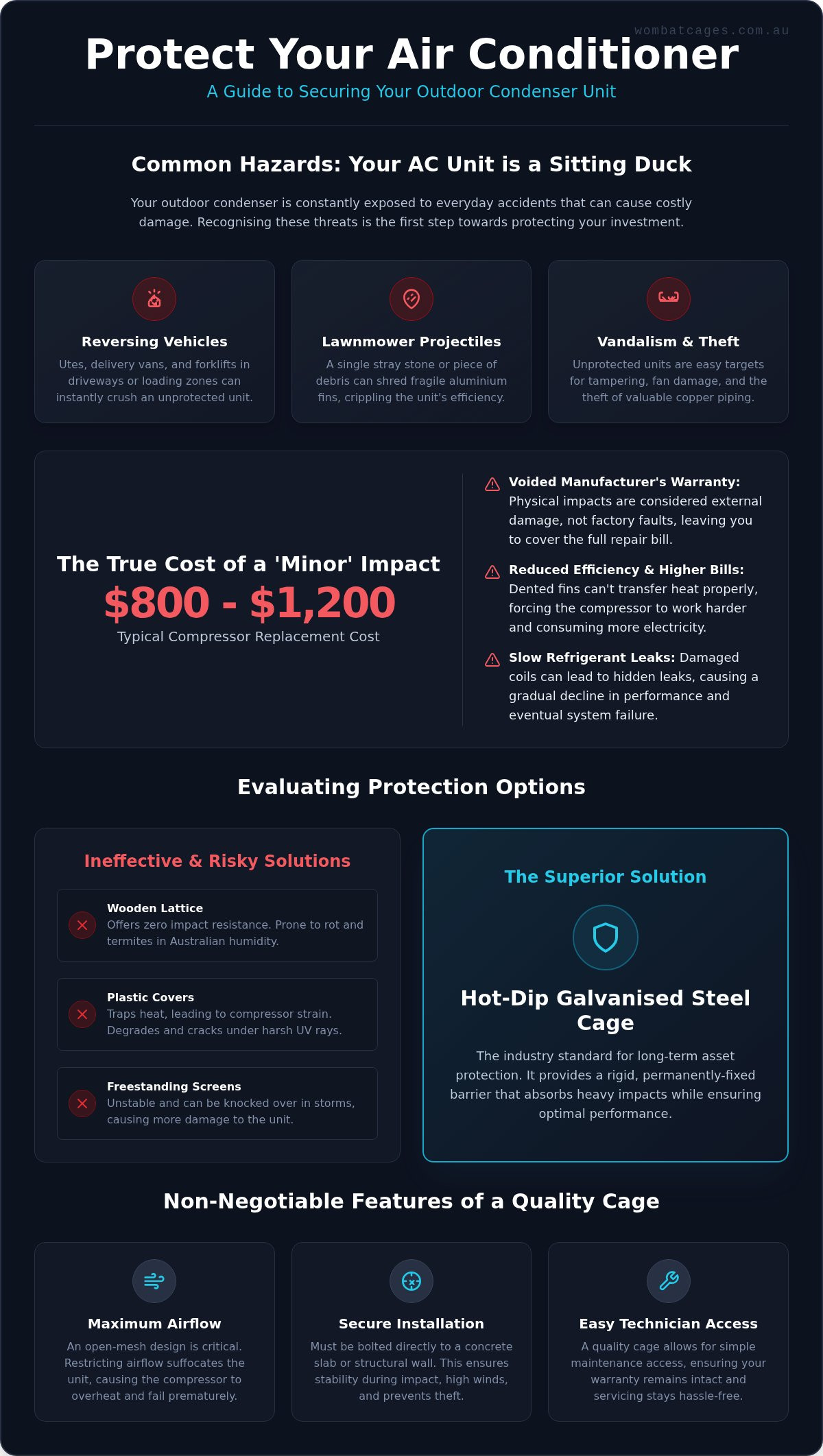
Your outdoor condenser is a sitting duck. It is often bolted to a side wall or tucked near a driveway. This makes it a prime target for everyday accidents. The 'Lawnmower Menace' is a constant threat. One stone kicked up by a mower blade can shred aluminium fins instantly. This ruins the unit's ability to shed heat. Understanding how air conditioning works helps you see why the condenser is so fragile. It relies on thin, exposed metal to exchange heat. Once those fins are crushed, efficiency drops. Your electricity bills start to climb immediately.
Driveways are high-risk zones. A reversing ute or a delivery van can crush a unit in seconds. Commercial loading zones are even worse. Forklifts and pallets are heavy. They don't just dent fins. They shear off entire pipe connections. Learning how to protect ac unit from accidental damage starts with recognising these daily threats. Most owners only think about protection after the first repair bill arrives. By then, the damage is done.
Backyard chaos adds another layer of risk. Kids playing cricket or dogs scratching at the unit cause steady wear. Stray footballs can bend fan guards. Falling gum tree branches during a storm are another hazard. These impacts are often sudden and violent. They leave you with a broken system right when you need it most. Physical protection is the only way to stop these random events from becoming expensive disasters.
The True Cost of a 'Minor' Impact
A small dent looks harmless. It isn't. Dented coils often lead to slow refrigerant leaks. These leaks cause the compressor to work harder. Eventually, it burns out. A compressor replacement is a major repair. It typically costs between $800 and $1,200. You might try 'fin combing' to straighten the metal. This is a tedious process. It rarely restores the unit to 100% efficiency. Manufacturers also have strict rules. They often reject warranty claims if they see evidence of physical impact. They'll call it external damage rather than a factory fault. You are left holding the bill for the entire repair.
Vandalism and Tampering Risks
It's not just about accidents. Vandalism is a growing concern. Unprotected units give easy access to isolation switches. Someone can shut your system down as a prank. Worse, they can jam objects into the fan blades. This destroys the motor in seconds. Open units also attract copper thieves. They see a quick payday in your pipes. Protecting your unit prevents these opportunistic crimes. It turns a vulnerable target into a hard one. You get security and longevity in one package.
Barriers vs. Brackets: Evaluating Physical Protection Options
Standard mounting brackets keep your unit off the ground. They don't protect it. To truly protect ac unit from accidental damage, you need a physical barrier that absorbs impact. Many owners try decorative solutions like wooden lattice. It looks nice in a garden. However, it offers zero resistance to a rogue lawnmower or a reversing car. Timber also rots in Australian humidity. It becomes a termite risk rather than a security feature.
Plastic covers are another common mistake. They often trap heat. This forces your system to work harder and leads to early failure. The Australian sun also destroys plastic through UV degradation. Within two years, these covers become brittle and crack. Perimeter fencing is better but usually too far from the unit. It leaves the condenser vulnerable to anything inside the yard. Steel cages are the only logical choice for structural integrity. They provide a rigid frame that handles heavy impacts while allowing the unit to breathe.
Why Material Choice Matters in Australia
Australia's climate is harsh. Untreated timber and thin plastics won't last five seasons. Even aluminium has its limits. It is a soft metal. A significant impact will buckle an aluminium frame easily. Hot-dip galvanised steel is the industry standard for a reason. The galvanising process creates a metallurgical bond between the zinc and the steel. This prevents rust even in coastal areas. It is a "fit and forget" solution. You install it once and it defends your unit for decades.
Fixed vs. Freestanding Enclosures
Stability is everything. A freestanding decorative cover is a liability. It can tip over during a storm and damage the very unit it was meant to shield. In high-wind zones, an unbolted enclosure becomes a projectile. Security cages must be bolted directly to a concrete slab or a structural wall. This rigid mounting ensures the cage stays put during an impact. It also makes theft nearly impossible. A high-quality steel enclosure provides the permanence required for long-term asset protection. You wouldn't leave your front door unlocked. Don't leave your most expensive appliance unbolted and exposed.
The Airflow Factor: Why Open Mesh Design is Non-Negotiable
Airflow is the lifeblood of your cooling system. A condenser works by moving massive volumes of air across its coils to dump heat. If you block that air, you kill the machine. Solid covers or tight wooden slats act like a chokehold. They trap hot discharge air and force it back into the intake. This cycle is called heat recirculation. It causes the compressor to overheat and eventually burn out. To effectively protect ac unit from accidental damage, the barrier must be almost invisible to the wind.
Open mesh design is the only engineering solution that balances impact resistance with thermodynamics. The aperture size refers to the gap between the wires. It must be large enough to allow unrestricted intake. Small holes clog with dust, lint, and pet hair. Large holes let in stones and debris. A precise mesh strike-rate ensures the fan motor doesn't struggle against static pressure. This keeps the unit running at peak efficiency even on a 40-degree Australian summer day. You get the strength of steel without the cost of a choked system.
Preventing Heat Recirculation
Discharge air leaves the top of the unit at high velocity. If it hits a solid roof or a tight screen, it bounces back down. This raises the ambient temperature around the coils. The system then tries to cool your house using 60-degree air instead of 30-degree air. It is a recipe for a major mechanical failure and a massive power bill. A minimum clearance of 500mm must be maintained on all intake sides to ensure the condenser can draw in sufficient air for the cooling cycle. This gap prevents the unit from "suffocating" inside its own enclosure.
Technician Access and Servicing
Protection shouldn't be a permanent obstacle. Every AC unit needs a service call at some point. If a technician has to spend an hour dismantling a poorly designed cage, your service bill will skyrocket. Good cage design uses a modular approach. It should be bolted together so panels can be removed for full access to the manifold and electrical housing. This accessibility is a core part of how to protect ac unit from accidental damage without creating a maintenance nightmare. Open mesh also allows for visual checks of the fan and coils without picking up a single tool. This makes routine maintenance faster and cheaper. It ensures your system stays in top shape while remaining behind a physical shield.
Installation Best Practices: Securing Your Unit for the Long Term
A solid installation is the difference between a secure asset and a rattling liability. Don't start drilling until you've measured the unit properly. You need enough breathing room to ensure the cage never touches the condenser housing. This prevents metal-on-metal vibration. It also allows for the natural thermal expansion of the unit during a brutal heatwave. Surface preparation is the next critical step. Bolting to a reinforced concrete slab is the preferred method for ground units. If your system is on wall-mounted brackets, the cage must be fixed into the building's structural frame. Standard masonry plugs won't cut it. You need heavy-duty sleeve anchors or chem-set bolts to ensure the cage stays rigid under pressure.
Integrating the cage with existing pipework requires foresight. You can't just hack a hole in the mesh. Professional designs include specific entry points for refrigerant lines and electrical conduit. This keeps the installation clean and prevents opportunistic thieves from getting a grip on the copper piping. A professional installation is the definitive way to protect ac unit from accidental damage on high-traffic sites. It ensures the barrier is a permanent part of the building infrastructure rather than a flimsy afterthought.
DIY vs. Professional Installation
Drilling into a concrete slab without a hammer drill and the right masonry bits is a recipe for a botched job. A professional installation ensures the cage is perfectly level. This is vital. If the cage is skewed, it can rub against the unit. This causes noise and eventual rust at the contact points. A pro finish also includes the use of tamper-proof fixings. These require specialised tools to remove. It makes your AC unit a hard target for vandals. If you want a secure, rattle-free result, consider booking our Cage Installation Services to handle the heavy lifting.
Configuring for Multiple Units
Commercial sites often have banks of condensers lined up in a row. A multi-bay approach is far more efficient than individual cages. It creates a unified defensive barrier. Using Multi-Bay Security Cages allows for shared internal walls. This reduces the overall footprint while keeping each unit individually accessible for repairs. It is the most effective way to protect ac unit from accidental damage while maintaining a professional appearance. This is essential for large-scale property management where multiple split systems serve different zones of a building. Each unit stays protected, but technicians can still perform maintenance without interfering with the neighbouring condensers.
Wombat Cages: Heavy-Duty Protection That Doesn't Compromise
Wombat Cages doesn't build for aesthetics. We build for permanence. Our philosophy is simple. Use hot-dip galvanised steel to create a barrier that outlasts the condenser it protects. This isn't just about looks. It's about structural integrity in the face of the harsh Australian sun and coastal salt. A Single Split System Security Cage provides a rigid shield against every common backyard hazard. It is the definitive way to protect ac unit from accidental damage. We don't use flimsy aluminium. We use heavy-duty steel that stays exactly where it's bolted. It is purpose-built for those who value utility and long-term resilience.
The rigid mesh design is engineered for utility. It stops the 'lawnmower menace' and flying debris. Stones bounce off. Debris stays out. Yet, the open aperture ensures your unit never suffocates. For larger properties or commercial sites, Multi-Bay Security Cages offer the same industrial-grade resilience in a scalable format. It's Australian-made protection for Australian conditions. You get a solution that handles the pressure of high-traffic zones without restricting the critical airflow your system needs to function.
Beyond Accidental Damage: Preventing Copper Theft
Accidental impacts aren't the only threat. Opportunistic theft is a major risk for exposed units. A Wombat Cage turns a vulnerable target into a difficult one. The bolted-down advantage means a thief can't just lift the cover and start cutting pipes. They need heavy tools and time. Most will just move on to an easier target. You can read more about how to protect your AC unit from theft on our blog. It's about creating a formidable deterrent that defends your copper and your wallet from opportunistic vandals.
Secure Your Investment Today
Think of a cage as a physical insurance policy. A single service call for a minor repair can cost up to $250. A major compressor replacement can hit $1,200. These costs are avoidable when you have a physical barrier in place. You get total peace of mind. No more worrying about the kids' football or a stray rock from the mower. This is the 'Dependable Guardian' approach to property management. It's a common-sense solution that saves money over the life of your HVAC system. Contact the team today for a custom quote on your protection needs. We can help you choose the right Single Split System Security Cage or organise professional Cage Installation Services to get the job done right.
Secure Your Cooling System for the Long Haul
Your outdoor condenser is an expensive asset. It doesn't take much to cause a total write-off. A stray stone from a mower or a reversing ute can end its service life in seconds. You now know that flimsy timber screens or plastic covers are a waste of time. They don't stop genuine impacts and they often choke your system. Only a rigid, open-mesh steel barrier provides the impact resistance you need to protect ac unit from accidental damage effectively.
Wombat Cages are hot-dip galvanised for maximum rust resistance in our harsh climate. They are bolted directly to your wall or concrete slab for total peace of mind. We design every cage specifically for Australian airflow requirements. This ensures your unit stays efficient while remaining completely defended. Don't wait for the first expensive repair bill to take action. It is a simple, fit and forget solution for any property owner. Take the next step and request a quote for your custom galvanised steel cage from Wombat Cages. Secure your investment today and stop worrying about backyard accidents.
Frequently Asked Questions
Will a security cage void my air conditioner's warranty?
A properly designed cage won't void your warranty because it doesn't interfere with the mechanical operation of the unit. Manufacturers require specific clearances to ensure the compressor doesn't overheat. As long as your cage maintains the recommended breathing room and uses an open mesh that doesn't restrict air movement, your warranty remains intact. It's always a good idea to check your specific brand's installation manual for their exact clearance requirements before fitting any enclosure.
Does a steel mesh cage restrict the airflow of my AC unit?
An open mesh design ensures that airflow remains unrestricted. While solid covers or tight slats can cause heat recirculation, industrial-grade steel mesh allows the fan to discharge air freely. This is the most effective way to protect ac unit from accidental damage while maintaining peak energy efficiency. The aperture size in the mesh is specifically engineered to stop physical debris without creating a barrier for the wind.
What is the best material for an outdoor AC security enclosure?
Hot-dip galvanised steel is the superior choice for the Australian climate. Unlike timber, it won't rot or attract termites. Unlike plastic, it won't become brittle under high UV exposure. While some people look at aluminium, it lacks the structural hardness needed to stop a vehicle or heavy machinery impact. Galvanised steel provides a fit and forget solution that offers maximum resistance to rust and physical force for the long term.
Can a technician still service my air conditioner if it's in a cage?
Yes, a professional cage is designed with maintenance in mind. Wombat Cages are modular, meaning panels can be removed to give a technician full access to the manifold, electrical housing, and internal components. This ensures that routine servicing or emergency repairs can be carried out without having to decommission the entire security system. Open mesh also allows for quick visual inspections of the coils and fan without removing any bolts.
How do I measure my AC unit for a custom-fit security cage?
To get a correct fit, measure the height, width, and depth of your condenser unit. You must then add the manufacturer’s required clearance to these dimensions. Usually, this means adding at least 500mm to the intake sides and top to ensure proper ventilation. Providing these total dimensions ensures the cage doesn't sit too close to the unit. This prevents vibration noise and ensures the system can breathe properly during the peak of summer.
Is a wooden fence better than a steel cage for protecting my AC?
A wooden fence is a poor substitute for a steel cage. Timber lacks the impact resistance to stop a reversing car or a heavy lawnmower. It also restricts airflow more than mesh, which can lead to system inefficiency. To protect ac unit from accidental damage properly, you need a material that doesn't warp or decay. A hot-dip galvanised steel cage is a permanent, industrial-grade barrier that provides genuine security and lasts decades.
Can these cages prevent copper theft as well as accidental damage?
Yes, these cages are a formidable deterrent against copper theft. Thieves target air conditioners because the copper piping is usually exposed and easy to cut. By wrapping the unit in a rigid steel mesh that is bolted directly to the ground or wall, you make the unit a hard target. Most opportunists will move on to an unprotected property rather than spend time trying to break through heavy-duty steel with specialised tools.
How is the cage secured to my property?
The cage is secured using heavy-duty bolts and tamper-proof fixings. For units sitting on the ground, the frame is bolted directly into a reinforced concrete slab. For wall-mounted systems, the cage is fixed into the structural framework of the building. This rigid mounting ensures the cage won't rattle or move during high winds. It also prevents the enclosure from being easily removed by vandals or thieves looking for a quick and quiet payout.


