
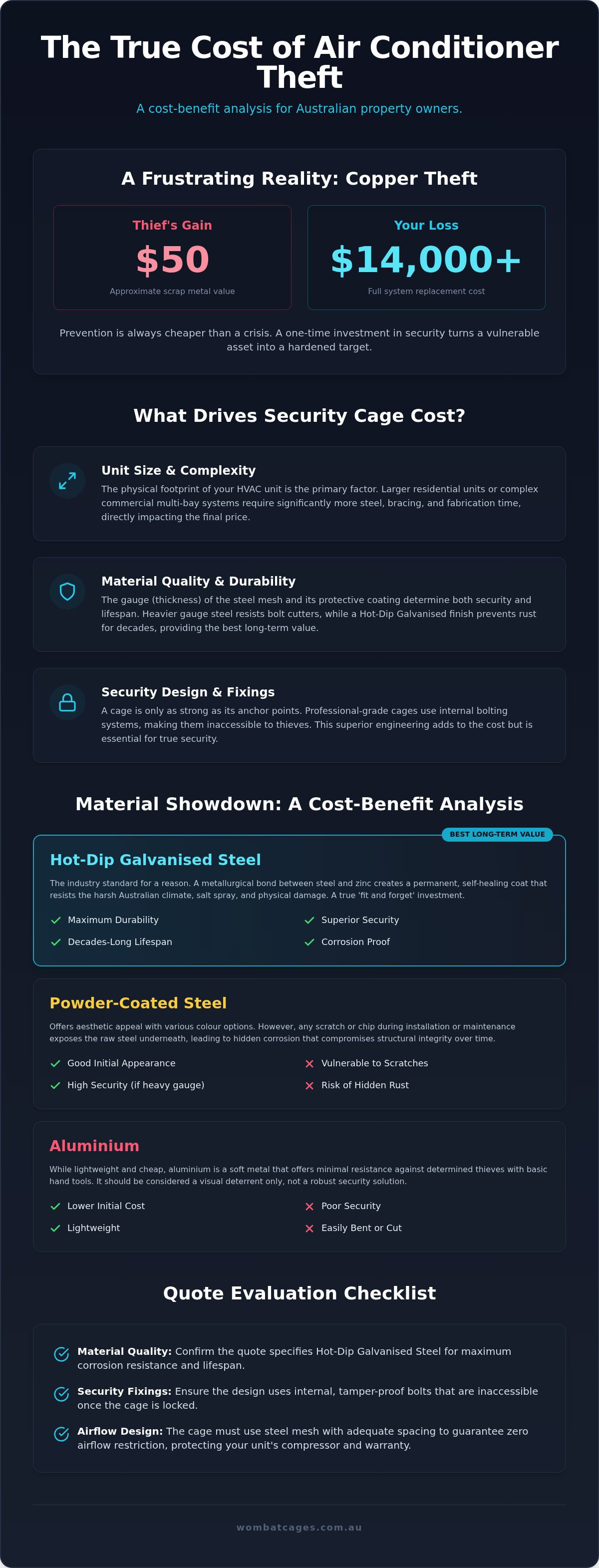
A thief might walk away with fifty dollars from a scrap yard for your stolen copper. You, however, are left with a replacement bill that can top fourteen thousand dollars. It's a frustrating reality for Australian property owners. You shouldn't have to worry about your HVAC unit being stripped for parts in the middle of the night. When you weigh up the air conditioner security cage cost against the price of a total system replacement, the choice is clear. Prevention is always cheaper than a crisis.
Protecting your equipment requires a clear-eyed look at the investment needed for long-term security. This guide breaks down the factors that drive pricing, from material durability to professional installation requirements. We'll show you how to budget for protection that lasts a decade. You'll learn how to justify the spend to stakeholders and gain the confidence to choose a cage built for the long haul. We'll also examine why hot-dip galvanised steel is the industry standard for resisting both bolt cutters and the harsh Australian climate. It's about turning a vulnerable asset into a hardened target.
Key Takeaways
- Identify the primary variables, including unit size and steel weight, that determine the total air conditioner security cage cost for your property.
- Discover why hot-dip galvanised steel provides the best long-term value and protection against the harsh Australian climate.
- Evaluate how site-specific factors like mounting surfaces and rooftop access influence the complexity and labour requirements of your installation.
- Understand the financial risk of copper theft and how a one-time security investment outlasts the lifespan of the HVAC unit itself.
- Use our final checklist to verify material quality and security fixings before approving any contractor quote.
Understanding the Variables: What Drives Security Cage Cost?
Calculating your air conditioner security cage cost involves more than just measuring a box. It's a calculation of risk versus resilience. Every project starts with the physical footprint of the equipment. A larger unit needs more steel. Heavier steel costs more to source and weld. It's a direct relationship between material volume and the final invoice. You aren't just buying metal. You're buying a calculated barrier designed to withstand a specific level of force.
The Impact of Unit Size on Pricing
Size is the most obvious driver of manufacturing expenses. A standard residential condenser usually requires a compact, single split system security cage. These are streamlined for efficiency and common footprints. Commercial properties often house complex Heating, ventilation, and air conditioning (HVAC) systems with multiple outdoor units grouped together. Protecting these requires multi-bay security cages. These custom banks use significantly more raw material. Increased height and depth requirements don't just add weight. They require extra internal bracing to maintain structural integrity. More steel and more welding time naturally increase the total air conditioner security cage cost.
Material Quality and Long-Term Value
Raw steel is vulnerable. It rusts within months when exposed to the Australian elements. Hot-dip galvanisation is the industry standard for a reason. This process involves dipping the entire fabricated cage into a bath of molten zinc. It creates a permanent, metallurgical bond that protects the steel inside and out. While this finishing process adds to the initial price, it prevents the cage from becoming a rusted eyesore that needs replacing in three years. It's the definition of a "fit and forget" investment.
The gauge of the steel mesh also dictates the price. Cheap enclosures use thin, flexible mesh. It's easy to bypass with basic hand tools. Professional-grade cages use a heavier material gauge. This thickness provides the impact resistance needed to stop a smash-and-grab attempt. You want a mesh that's heavy enough to resist bolt cutters but open enough to ensure zero airflow restriction. Achieving that balance requires high-quality materials.
Security is also about the fixings. A cage is only as strong as its anchor points. High-security designs use internal bolting systems. These are bolted directly to walls or ground slabs. Because the fixings are located inside the cage, they're inaccessible to thieves once the unit is locked. This level of engineering requires more precise fabrication labour than a simple external tab system, but it's the only way to ensure the cage stays where you put it.
Galvanised Steel vs. Alternatives: A Cost-Benefit Analysis
Choosing the right material is the biggest factor in your total air conditioner security cage cost. You have options. Some property owners look at aluminium for its lower weight and lower price point. It's a mistake in a security context. Aluminium is a soft metal. It offers little resistance against determined vandals using basic hand tools. If you want a barrier that actually defends your asset, you need the structural rigidity of steel. It's about buying protection, not just a decoration.
Powder-coated finishes are another common alternative. They offer aesthetic appeal. They come in various colours to match your building. But there is a hidden risk. If the powder coating is scratched during installation or maintenance, the raw steel underneath is exposed. Corrosion starts immediately. It spreads under the coating where you can't see it. By the time you notice the rust, the structural integrity is often compromised. You end up paying for a second cage much sooner than expected.
The Durability of Hot-Dip Galvanisation
Hot-dip galvanisation is a metallurgical bond between steel and zinc. This isn't just a surface layer. It's a chemical reaction that creates a series of zinc-iron alloy layers. It doesn't chip. It doesn't peel. For Australian properties near the coast, this is essential. It resists salt spray. It handles extreme UV exposure without degrading. When you factor in the "fit and forget" nature of this material, the lifetime air conditioner security cage cost drops significantly compared to cheaper alternatives that require constant repainting or replacement.
Comparing Structural Integrity
A cage must protect without suffocating. Poorly designed enclosures or those using solid panels can cause the unit to overheat. This leads to compressor failure and voided warranties. Steel mesh provides superior ventilation. It allows for maximum airflow while maintaining a rigid physical barrier. Reports on Theft within the HVAC industry highlight that visible, heavy-duty barriers are the best deterrent. You can find more detail in our guide on Hot-Dip Galvanised Condenser Cages: The Ultimate Guide to HVAC Protection.
Maintenance requirements are minimal with galvanised steel. You don't need to worry about rust treatment or structural sagging. It stays rigid for decades. If you are looking for a high-durability security cage, focus on the material specs first. The initial spend on quality steel pays for itself by preventing the thousand-dollar headaches associated with theft and corrosion.
Installation Factors: DIY vs. Professional Labour Costs
Installation complexity dictates a large part of the total air conditioner security cage cost. It's not just the price of the steel. It's the time spent securing it to the substrate. A DIY approach might seem like a way to save money. It often leads to compromised security. A cage that isn't bolted correctly is just a nuisance, not a real barrier. Professional installation ensures the enclosure performs under pressure.
The surface type is the first variable. Mounting a cage to a thick, level concrete slab is straightforward. It's the gold standard for stability. Bolting into limestone or old brickwork is different. It requires specialised anchors and more careful drilling to avoid cracking the wall. Site access also shifts the labour quote. Ground-level residential jobs are fast. Restricted commercial rooftops involve lifting equipment and safety harnesses. These logistical hurdles add labour hours to the project.
Securing the Perimeter: Fixing Methods
Stability is everything. Ground-mounted cages are essential for large multi-bay condenser banks. They provide maximum rigidity against prying force. Wall-mounted enclosures serve a dual purpose. They stop thieves and prevent accidental vehicle impacts in tight driveways or loading docks. Many police departments advise that physical barriers are the most effective way to stop copper theft. Professional bolting ensures the cage itself isn't stolen. If a thief can't remove the barrier, they can't get to the copper piping inside.
The Value of Professional Installation
Technicians need room to work. A poorly installed cage blocks access to service valves and electrical panels. This leads to higher HVAC maintenance bills later on. Professional installers ensure the correct clearance for airflow and serviceability. This maintains the efficiency of your system and protects the compressor from overheating. You also avoid the risk of piercing refrigerant lines or electrical conduits during the mounting process. It's a precise job. You can find more details in our guide on How to Protect Your AC Unit from Accidental Damage: The Ultimate Installation Guide.
Labour time varies by site. A standard fit for a single split system might take an hour. Custom alignments for uneven ground or multi-unit banks take longer. The hardware used also impacts the final air conditioner security cage cost. High-quality installs use heavy-duty security bolts. These are designed to be tamper-proof. Once they are set, they aren't coming out without specialised tools. It's about building a permanent defence for your asset.
The Cost of Inaction: Replacement vs. Protection
A thief sees easy money. You see a massive liability. The air conditioner security cage cost is a fraction of the price you'll pay once a vandal hits your property. Copper theft is the primary driver for AC unit vandalism across Australia. Thieves aren't careful. They rip out copper coils and piping with brute force. They don't care about the refrigerant gas they release or the electrical lines they sever. You're left with a total system failure.
Replacing a condenser unit is expensive. It's not just the hardware. You have to pay for licensed plumbing labour and electrical work. You also have to pay for a full recharge of refrigerant gas. This gas is costly and subject to strict environmental regulations. For commercial property owners, the bill grows even larger. Losing climate control leads to business downtime. It impacts employee productivity and can drive customers away. It's a hidden cost that far outweighs the price of physical protection.
The Anatomy of an AC Theft
Thieves target the copper inside your condenser because it's easy to trade for quick cash. They can strip a unit in minutes using basic tools. They often cut lines haphazardly, which destroys the internal components of the HVAC system. Copper theft often causes damage exceeding the value of the stolen metal. This means a hundred dollars of scrap metal for a thief results in thousands of dollars of repairs for you. It's an uneven trade that leaves you vulnerable.
Risk Mitigation and Insurance
Relying on insurance isn't a complete strategy. Every claim involves an excess payment. Multiple claims can lead to higher premiums or even the loss of your coverage. Proactive protection is a one-off expense that stops the cycle of recurring repair bills. You can learn more about how to handle the paperwork in our guide to Air Conditioner Theft Insurance Claims: A Property Owner’s Guide to Protection.
Security cages are a loss mitigation feature. They show your insurer that you're serious about asset protection. Some companies may even offer discounts for verified physical security measures. It's a pragmatic way to lower your long-term risk profile. Don't wait for a theft to occur before you act. You can secure your equipment now with a heavy-duty enclosure designed to outlast the AC unit itself.
Final Checklist: Evaluating Your Security Cage Quote
When you receive a quote, don't just look at the bottom line. The lowest air conditioner security cage cost often hides shortcuts in material quality or fixing security. You need to verify that the price includes genuine hot-dip galvanised steel. This is the only way to ensure the enclosure outlasts the HVAC unit itself. If the quote mentions zinc-plated or powder-coated finishes without a galvanised base, you are looking at a future rust problem. It's a false economy.
Check the fine print for the fixing specifications. A professional quote should include heavy-duty security bolts designed for your specific substrate, whether it's a concrete slab or a brick wall. Internal bolting systems are superior. They can't be accessed once the cage is locked. If the hardware isn't tamper-proof, the cage is just a temporary obstacle. You want a permanent defence that resists prying and unscrewing.
Technician access is the final piece of the puzzle. Ask if the design allows for easy servicing without removing the entire structure. A cage that requires a two-hour dismantle every time a filter needs cleaning will spike your maintenance bills. Look for an open mesh design. It ensures zero airflow restriction and provides clear visibility for inspections. This protects your compressor from overheating and keeps your warranty intact.
Maximising Asset Protection
Rigid steel mesh is essential for resisting impact and cutting tools. Flimsy thin-gauge wire might look like a deterrent, but it won't stop a determined thief with a pair of snips. For businesses with several units, a custom fit for multi-unit condenser banks is the most efficient way to secure the perimeter. You can find more specific advice in our Commercial AC Security Cage: The Buyer’s Guide to HVAC Asset Protection.
Next Steps for Your Property
The best way to get an accurate air conditioner security cage cost is to request a site-specific quote. Provide the exact dimensions of your unit and photos of the mounting surface. This allows for a precise calculation of the steel and labour required. Organising professional installation is the final step in ensuring total stability. Choose a provider that understands the specific security risks in the Australian market. It's a one-time investment that delivers permanent peace of mind. Secure your asset today.
Secure Your Asset for the Long Term
Protecting your property requires a shift from viewing security as an expense to seeing it as a vital investment. We've broken down the specific variables that dictate the air conditioner security cage cost. From material gauge to precise fixing methods, every choice impacts your property's resilience. Choosing heavy-duty hot-dip galvanised steel means you're investing in a "fit and forget" solution that handles the Australian sun and salt spray with ease. It's a pragmatic move that stops thieves in their tracks and ensures your climate control stays operational through the hottest months.
Wombat Cages provides the physical strength your HVAC system needs. Our enclosures are custom-built for Australian conditions and feature robust construction that outlasts the equipment it defends. We offer professional installation available nationwide to ensure your unit is locked down correctly from day one. You don't have to wait for a theft to occur before you take action. Get a no-nonsense quote for your AC security cage today. Don't leave your equipment exposed when a permanent, hard-wearing solution is just a quote away. It's time to trade vulnerability for total peace of mind.
Frequently Asked Questions
How much does an air conditioner security cage cost on average?
Industry data shows that standard residential cages often range from approximately $488 to $985 depending on the model. Rooftop units for commercial buildings are significantly larger and can exceed $2,000. However, the total air conditioner security cage cost is best viewed as a long-term insurance policy. While base prices vary, the true value lies in the material's durability and the quality of the security fixings included in the package.
Is it cheaper to buy a DIY AC cage or pay for professional installation?
Buying a DIY unit avoids immediate labour fees, but professional installation provides a higher level of security. Expert installers use specialised anchors and ensure the cage is level and rigid against the substrate. This prevents vandals from simply prying the entire enclosure off the wall. Investing in professional services also protects your AC unit from accidental damage during the mounting process, which can save you from expensive refrigerant line repairs.
Will a security cage affect the efficiency or cost of running my AC?
A well-designed cage won't restrict airflow or increase your electricity bills. Wombat Cages uses an open mesh design specifically engineered to maintain the manufacturer's required clearance. This ensures your condenser can breathe properly even on the hottest Australian days. Poorly designed solid-panel enclosures can cause the compressor to work harder and overheat. Choosing a high-quality mesh cage protects your asset without compromising the efficiency of your cooling system.
Do insurance companies require security cages for outdoor condensers?
While most insurers don't strictly mandate security cages, many recognise them as a valid loss mitigation feature. Installing a physical barrier can reduce the likelihood of a claim and may help you secure premium discounts from certain providers. Proactive protection demonstrates that you are taking reasonable steps to secure your property. It's a pragmatic way to avoid the high excess payments and premium hikes associated with multiple copper theft claims.
What is the most cost-effective material for an outdoor AC cage?
Hot-dip galvanised steel is the most cost-effective choice because it outlasts the AC unit itself. It's a one-time investment that resists rust and physical attacks. Aluminium might seem cheaper or lighter, but it's a soft metal that is easily cut with basic hand tools. Over a ten-year period, the durability of galvanised steel avoids the replacement costs associated with corrosion or successful theft attempts. It is the gold standard for Australian conditions.
Can I install a security cage myself to save on labour costs?
You can install a cage yourself, but you must have the correct tools and hardware to ensure it's effective. Security depends on the cage being bolted directly into a concrete slab or solid wall with tamper-proof fixings. Many property owners find that the air conditioner security cage cost for professional installation is justified by the peace of mind it provides. Professionals ensure the cage is perfectly aligned and won't vibrate or damage the refrigerant lines.
How does a multi-bay cage cost compare to multiple single cages?
Multi-bay security cages are generally more efficient for commercial properties with several units grouped together. Using a single multi-bay enclosure often reduces the total material and labour required compared to installing individual cages for every unit. This configuration also creates a cleaner, more organised appearance for HVAC banks. It hardens the entire perimeter at once, making it much harder for thieves to find a weak point in your cooling infrastructure.
Does the cost of a security cage include maintenance access?
High-quality security cages are designed with technician access in mind. The cost of a professional enclosure includes a layout that allows for routine servicing and inspections without needing to dismantle the entire structure. This prevents future labour costs during HVAC maintenance calls. Wombat Cages ensures that service valves and electrical panels remain accessible. It's a design feature that balances the need for total physical protection with the practical requirements of mechanical upkeep.


