
A camera can record interference with an AC unit, but it can’t physically stop someone reaching the condenser. That is the key difference in the security camera vs physical cage for AC unit decision, and it matters if you’re relying on footage to prevent damage or theft.
It’s reasonable to want visibility without creating new problems. A camera can help you monitor an exposed unit and review activity, but footage alone won’t block access. A cage creates a physical obstacle, yet it must be designed and positioned to preserve airflow and leave technicians room to service the unit.
This guide compares what each option can and can’t do, including the limits of camera monitoring and the practical checks to make before enclosing an outdoor AC unit. You’ll learn how to match protection to site risks, when a cage may be enough, and when combining a barrier with monitoring makes more sense. The goal is a proportionate setup that addresses a real need.
Key Takeaways
- In the security camera vs physical cage for AC unit comparison, cameras help monitor activity while cages create a physical obstacle.
- Match protection to the risk you’re addressing, whether that’s attempted theft, vandalism or accidental contact.
- Check the unit’s exposure, the property layout and whether your priority is monitoring, restricting access or both.
- Confirm that any cage design allows airflow and gives technicians room to access the outdoor unit.
- A physical cage can complement site monitoring, but neither measure guarantees protection from theft.
Security camera vs physical cage for an AC unit: what each one does
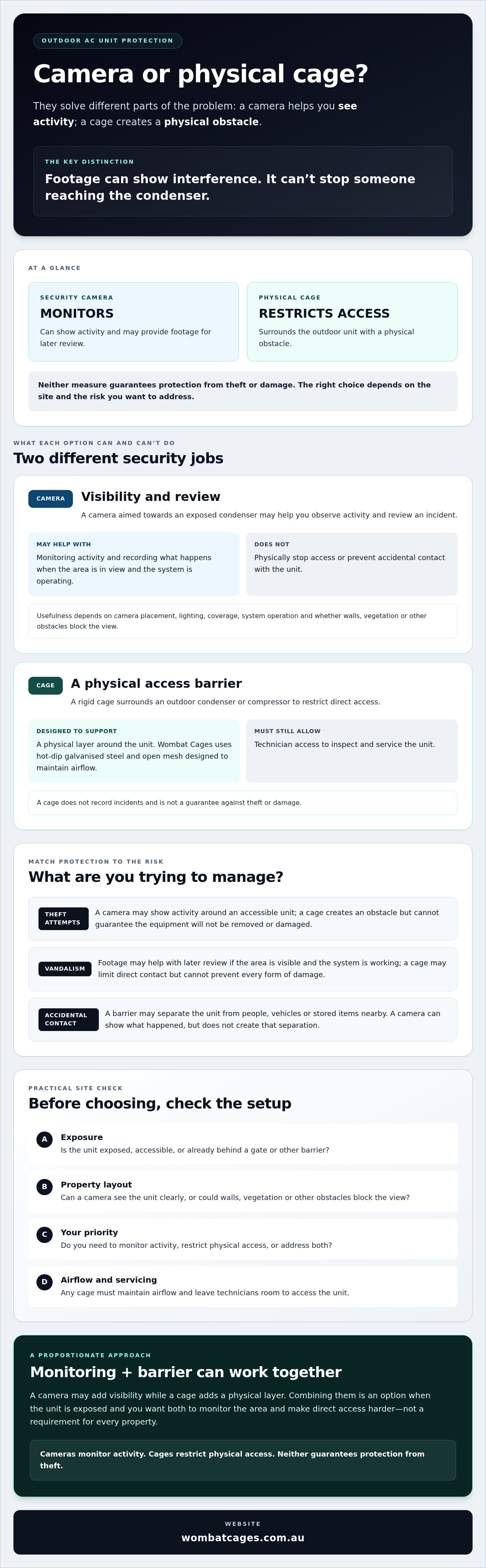
A camera monitors activity around an outdoor AC unit. A cage physically restricts access to the condenser or compressor. That is the core difference in the security camera vs physical cage for AC unit comparison: one supports observation, the other creates a physical barrier.
Surveillance records or shows activity; physical access control puts an obstacle between people and the equipment. Both can contribute to site security, but neither guarantees the unit cannot be interfered with or damaged. They address different parts of the problem. The broader idea of physical security measures includes both surveillance and barriers.
| Consideration | Security camera | Physical cage |
|---|---|---|
| Prevention | Visible monitoring may discourage interference, but doesn’t block access. | Creates a physical obstacle around the outdoor unit. |
| Detection and evidence | May capture activity for later review, depending on coverage and system operation. | Doesn’t record an incident or identify who approached the unit. |
| Ongoing oversight | Requires a working system and suitable placement to provide useful monitoring. | Provides a fixed barrier without monitoring activity. |
| Servicing | Doesn’t usually change physical access for a technician. | Must allow appropriate access to inspect and service the unit. |
| Site suitability | Depends on placement, lighting, coverage and system operation. | Depends on the unit, available space and a design that maintains airflow. |
What a security camera can do for an outdoor AC unit
A camera aimed towards an exposed condenser may help you observe activity and review an incident. Its usefulness depends on what it can see, the lighting, the coverage area and whether the system is operating when needed. Check that the unit falls within the camera’s view and consider whether nearby walls, vegetation or other obstacles could block it. A camera can record activity, but it can’t physically stop someone reaching the unit or prevent accidental contact.
What a physical AC-unit cage is designed to do
A rigid cage surrounds an outdoor condenser or compressor to restrict direct access. Wombat Cages uses hot-dip galvanised steel and open mesh designed to maintain airflow while allowing technician access. The cage is a practical physical layer, not a guarantee against theft or damage. For more detail on choosing a suitable enclosure, see the split system security cage guide.
The choice isn’t always one or the other. A camera may add visibility, while a cage adds a barrier. Whether either option, or both, suits the site depends on the unit’s position and the protection you need.
How cameras and AC security cages respond to different risks
The right measure depends on what you’re trying to manage. A unit beside a public walkway may face different risks from a condenser tucked behind a locked gate. Theft attempts, vandalism and accidental contact call for different responses, so start by assessing how exposed the equipment is rather than assuming every site needs the same setup.
- Theft attempts: A camera may show activity around an accessible unit. A cage creates a physical obstacle, but doesn’t guarantee the equipment can’t be removed or damaged. The Air Conditioning Contractors of America discusses practical responses to HVAC equipment theft, including physical barriers.
- Vandalism: Camera footage may help with later incident review if the area is in view and the system is operating. A cage may limit direct contact with the condenser, though it can’t prevent every form of damage.
- Accidental contact: Where people, vehicles or stored items could bump the unit, a barrier may help separate it from nearby activity. A camera can show what happened, but doesn’t create that separation.
Cameras monitor activity; cages restrict physical access. Used together, they can provide both visibility and a physical layer. That combination is an option, not a requirement for every property. Consider it if the unit is exposed and you want to monitor the area as well as make direct access harder.
Can a camera stop someone reaching an AC condenser?
No. A camera monitors; it doesn’t form a physical barrier around the condenser. A visible camera and usable footage may support oversight, but neither guarantees someone will intervene during an incident. If the concern is direct access, consider whether monitoring alone addresses that risk or whether a physical obstacle is also needed.
Can a cage still allow airflow and technician access?
It can, if the enclosure is designed for the unit and site. Open mesh allows airflow around outdoor equipment while keeping a barrier in place. Access needs planning too, so a technician can reach the unit for servicing. Wombat Cages uses hot-dip galvanised steel cages with open mesh designed for airflow and service access. See the hot-dip galvanised condenser cage guide for more detail.
For an exposed condenser, a cage may be a useful physical layer alongside site monitoring. If you’re assessing a cage for one unit or several, you can discuss cage configuration and installation with Wombat Cages.
Camera or physical cage for an AC unit: compare the trade-offs
The best choice in the security camera vs physical cage for AC unit decision depends on the equipment, the property layout and what you need protection to do. A camera can help oversee several parts of a site. A cage focuses on restricting direct access to one outdoor unit. Neither is a universal answer.
| Trade-off | Security camera | Physical cage |
|---|---|---|
| Physical access | Monitors an area but doesn’t enclose or block access to the condenser. | Creates a barrier around the specific outdoor unit. |
| Monitoring | May cover multiple areas, depending on placement and system operation. | Doesn’t provide a view of activity elsewhere on the property. |
| Incident review | May provide footage to review if the relevant activity is in view and recorded. | Doesn’t record or report activity. |
| Upkeep | Needs to remain correctly positioned and operational to be useful. | Needs to remain secure and leave the unit accessible for servicing. |
| Service access | Doesn’t usually change the technician’s physical access to the unit. | Must be planned around the equipment and service requirements. |
When a security camera may be the more suitable first step
If your priority is monitoring activity across a driveway, equipment area and other parts of a property, a camera may offer broader oversight than a barrier around one unit. Its usefulness still depends on suitable placement, coverage and reliable operation. Check that the condenser is in view and that the camera is positioned to capture the area you want to monitor. Coverage alone doesn’t physically enclose or restrict access to the unit.
When a physical cage may better match the problem
If the main concern is direct access to a particular outdoor unit, a cage addresses that point physically. Before specifying one, check the available space, suitable mounting surfaces, airflow around the equipment and room for a technician to service it. For more context on managing theft risks and protection measures, read the AC theft insurance claims guide.
Where both site-wide oversight and a barrier around exposed equipment matter, cameras and cages can work as complementary measures. A camera supports monitoring; a cage restricts physical access to the condenser. Use both only if they address distinct needs at your site, rather than adding layers without a clear purpose.
How to choose protection for your AC unit: a practical site checklist
Make the decision from the site, not the technology. This four-step check helps clarify whether you need to monitor activity, restrict physical access to an outdoor unit, or address both.
- Identify exposure. Note where the unit sits, who can reach it and whether nearby walkways, vehicles or stored items create access or contact risks.
- Define the goal. Decide whether your priority is broader monitoring, limiting direct access to the condenser, or both. Be specific about the problem you want to address.
- Assess the site. Check camera sight lines and lighting, plus the space around the unit, airflow, technician access and possible fixing surfaces for a cage.
- Compare measures. Match the setup to the exposure and practical requirements. A camera may support site-wide oversight; a cage may suit a specific unit that needs a physical barrier.
Assess the unit, its surroundings and access points
Walk around the equipment and note access routes, nearby obstacles and points where a person or vehicle could come into contact with it. If considering a camera, check whether branches, walls or other objects obstruct the view, and whether the unit remains visible after dark. Ask a qualified AC technician to advise on the unit’s required clearance and service access before planning an enclosure.
Decide whether one measure or a layered setup fits
Choose according to the site’s priorities, not the appeal of a particular technology. A cage may address direct access to an exposed unit; cameras may help monitor a wider area. If both needs matter, consider combining them, but assess the site rather than treating either measure as a complete solution on its own.
Before installing a cage, confirm there’s room for it, that airflow won’t be restricted and that a technician can reach the equipment. Check that the proposed fixing surfaces are suitable for the installation. For more practical considerations around positioning and protection, read the AC protection installation guide.
Use the security camera vs physical cage for AC unit comparison to identify the job each measure needs to do at your property. If a cage looks appropriate, ask Wombat Cages about cage configuration and installation for your outdoor unit.
Physical AC security cages: a practical barrier that can work alongside cameras
A cage adds a physical layer around an outdoor condenser or compressor. It can make direct access harder, while a camera may help you monitor activity around the equipment. They do different jobs. A cage is not a guarantee against theft or damage, and it doesn’t replace broader site monitoring where that’s needed.
Wombat Cages manufactures and installs hot-dip galvanised steel security cages. The open-mesh design is intended to maintain airflow and allow technician access. Those details matter: an enclosure needs to suit the operating unit, not simply surround it. In the security camera vs physical cage for AC unit decision, consider whether restricting access to the condenser is the gap a barrier would address.
What to check before arranging a cage
Start with the equipment and the space around it. Confirm the unit’s dimensions, surrounding clearances and the practical access a technician needs for servicing. Ask a qualified AC technician to confirm required clearance before finalising an enclosure. Also identify suitable wall or ground surfaces for fixing the frame, as installation requires an appropriate mounting point.
These checks help avoid a cage that crowds the unit, limits access or doesn’t suit the site. The layout can differ between a condenser fixed near a wall and one positioned on an open ground surface, so assess the actual location rather than assuming one configuration fits all.
Discuss a suitable cage configuration
For one outdoor split-system unit, a single-unit cage may suit the site. Where several units sit side by side, a multi-bay configuration may be more appropriate. The right arrangement depends on the number and position of the units, available fixing surfaces and the access needed for servicing.
Wombat Cages supplies and professionally installs hot-dip galvanised steel cages, with frames bolted to wall or ground surfaces as suited to the installation. A camera can remain part of the wider site security plan; the cage provides a physical layer around the equipment. Both may make sense where you need monitoring as well as restricted access.
For a practical next step, discuss an AC security cage for your site with Wombat Cages. Share the unit arrangement and site conditions to help establish whether a single split-system cage or multi-bay configuration is worth considering.
Choose protection that fits your AC unit and site
The security camera vs physical cage for AC unit decision comes down to the job you need done. Cameras help monitor activity and may support incident review. A cage creates a physical obstacle around an outdoor condenser. If both wider oversight and restricted access matter, the two measures can work together.
Before choosing a cage, consider the unit’s position, airflow, technician access and suitable fixing surfaces. Wombat Cages makes hot-dip galvanised steel cages with open mesh designed to maintain airflow and allow service access. Single-unit and multi-bay configurations suit different equipment layouts, with professional installation available.
A cage is a practical layer of protection, not a guarantee against theft or damage. Match the configuration to your site and the access your AC technician needs. To discuss a suitable cage and professional installation, talk with Wombat Cages about a physical security cage for your AC unit.
With a clear plan, you can protect your equipment sensibly while keeping it accessible for servicing.
Frequently Asked Questions
Is a security camera enough to protect an outdoor AC unit?
A security camera can help monitor an outdoor AC unit, but it doesn’t physically prevent someone reaching it. If the condenser is exposed, footage may support incident review when the activity is captured and the system is operating. It can’t guarantee intervention or stop damage. Consider whether your main priority is seeing activity across the property or restricting direct access to the equipment. A camera and a cage address different needs.
Can a physical cage stop AC condenser theft?
A cage creates a physical obstacle around the condenser, which can make direct access more difficult, but it can’t guarantee the unit won’t be stolen or damaged. Its usefulness depends on the cage, how it’s fixed in place and whether it suits the equipment and site. Check that the enclosure leaves the unit room to operate and can be accessed for servicing. Treat a cage as one practical security layer, not complete protection.
Should I use a security camera and a cage together?
Use both if you need to monitor activity and restrict direct access to an exposed outdoor unit. A camera may provide visibility across the property, while a cage physically encloses the condenser. The combination isn’t necessary for every site. Consider the unit’s position, access routes and what you want each measure to achieve. If one measure addresses the actual concern, adding another may not be needed.
Will an AC security cage restrict airflow?
It shouldn’t be assumed that every enclosure will suit every unit. Wombat Cages uses an open-mesh design intended to maintain airflow around outdoor condensers and compressors. The cage still needs to be configured for the equipment and installed with suitable clearance. Before finalising an enclosure, ask a qualified AC technician to confirm the unit’s required clearances. That check helps ensure a physical barrier doesn’t compromise the equipment’s operating or servicing needs.
Can a technician service an air conditioner inside a security cage?
Yes, a cage can be designed to allow technician access, but the layout needs to suit the unit and the work required. Wombat Cages’ open-mesh cages are designed to allow service access. Before installation, confirm practical access requirements with a qualified AC technician, including how the unit needs to be reached. A well-planned enclosure should provide a physical barrier without making routine servicing impractical.
What should I consider when choosing between a camera and an AC cage?
Start by identifying the main concern. If you want visibility across several areas, consider a camera and assess its placement, coverage and operation. If you need to restrict direct access to a particular condenser, consider a cage. Check the unit’s surroundings, airflow, service access and suitable fixing surfaces before choosing an enclosure. The security camera vs physical cage for AC unit decision depends on your site and whether you need monitoring, a physical barrier or both.


