
Could a simple cage around an outdoor air conditioner trigger an approval process? It can. The body corporate rules for AC unit cages depend on your scheme, where the unit sits and how the cage would be fixed. If installation affects an external wall, balcony or other common property, check the requirements before work begins.
Start by identifying who makes the decision and what information they need. By-laws, approval pathways and decision-makers vary between schemes, and terminology differs across Australia. The proposal may also need to address the building’s appearance, airflow and access for future maintenance.
This guide explains which scheme documents to review, who to contact and what to include in an approval request. It also covers practical details to check about the proposed cage and installation, including how they may affect common property. A purpose-built open-mesh cage may be one option to consider, but it doesn’t replace checking your scheme’s requirements or getting permission where needed.
Key Takeaways
- Check your scheme’s current by-laws, plans and committee guidance for rules on external fixtures, appearance, noise and access.
- The body corporate rules for AC unit cages depend on the scheme, the cage location and how it would be attached, so don’t assume approval is or isn’t required.
- Ask the body corporate manager or relevant committee which approval process applies before arranging installation.
- Make your request easier to assess with photos, a marked-up location plan, cage specifications and proposed fixing details.
- Once permission is confirmed, compare a single-unit or multi-bay cage arrangement against the number and placement of your outdoor units.
Body corporate rules for AC unit cages: why approval may matter
The practical answer is that requirements depend on your scheme documents and the laws that apply in your state or territory. The phrase body corporate rules for AC unit cages doesn’t refer to one Australia-wide approval process. A cage may need scheme review if installation involves common property, changes the building’s exterior or affects a shared area.
Scheme approval is separate from any building, safety or installation requirements that may apply. Check those with the relevant authority and installer, and confirm the air conditioner manufacturer’s requirements. Scheme consent alone doesn’t confirm that every other requirement has been met.
Can an AC unit cage affect common property?
It may, depending on the unit’s location and the proposed fixing method. A cage fixed to an external wall, slab or ground could involve an area the scheme owns or manages. Even a freestanding cage may occupy a shared garden or affect a walkway or access route. Boundaries and common-property definitions vary, so don’t assume an area is yours to alter just because it’s beside your lot.
Check your plan, strata records and scheme documents before drawing conclusions. If the cage will be visible from outside, its appearance may also be considered. Check clearances too: the cage must not obstruct shared access or prevent a technician from reaching the outdoor unit. These details can affect whether the proposal needs review.
Why there is no single Australia-wide body corporate rule
Australian schemes use different terms and are governed by jurisdiction-specific rules. You may encounter “body corporate”, “owners corporation” or “strata scheme”. If you’re unfamiliar with how individual lots and shared areas fit together, this overview of strata title provides useful background.
Start with the official strata or community titles information for your state or territory, then ask your scheme manager how the rules apply to your proposed cage. The manager can point you to the relevant process. Check the governing documents and applicable official guidance for the specific requirements.
This guide is general information, not legal advice. Rules and approval pathways can differ between schemes, even within the same jurisdiction. Confirm the details before ordering or installing a cage, particularly if the proposed fixing could affect common property or shared access.
Which by-laws and scheme documents should you check for an AC cage?
Start with the documents that govern your scheme. The body corporate rules for AC unit cages may be covered across several records, not just a general renovation rule. Check the current by-laws, scheme rules, strata plan and any application forms, renovation guidance or committee instructions. Relevant meeting minutes or earlier decisions about external equipment may also show how the scheme has handled similar proposals.
- By-laws and rules: Look for conditions on external fixtures, alterations, exclusive-use areas and building appearance.
- Plans and strata records: Check the lot boundaries and whether the proposed fixing location is private property or common property.
- Committee guidance: Find out whether there’s an application form, required evidence or a stated decision-maker.
- Other relevant clauses: Note any provisions about noise, maintenance access or keeping shared areas clear.
What to look for in by-laws and renovation rules
Read the wording closely. A rule about external changes may apply even if the cage is small, while an exclusive-use area may still have conditions attached. Check whether the documents specify how to apply and what information to provide. If a clause is unclear, don’t treat silence as permission. Ask the manager or committee how it applies to your proposed cage.
Jurisdiction can affect the rules. For example, Queensland Government guidance on Improving common property outlines approval considerations for improvements, including air conditioning. Its criteria and process relate to Queensland, so don’t assume they apply in another state or territory, or to every cage proposal.
Who can confirm the applicable process?
Contact your strata or body corporate manager first and request the relevant requirements in writing. Ask which documents apply, what evidence the scheme needs and who will assess the proposal. Then check with the committee whether an owner vote or another process may be needed. The right pathway depends on your scheme and location, so verify jurisdiction-specific guidance through the relevant official source.
If the documents conflict or the boundary between private and common property is uncertain, get advice from a qualified local strata professional before proceeding. Once you know what the scheme needs to assess, share the proposed cage design and installation details with the committee. For an example of available AC cage options, compare the design with the scheme’s requirements before deciding.
Is an AC unit cage a minor change or an alteration needing approval?
There’s no reliable shortcut based on calling a cage “minor”, “temporary” or “removable”. The approval pathway depends on the applicable scheme rules and the proposal itself. A cage that sits beside a unit without obstructing anyone may raise different questions from one fixed to a shared wall or placed across a common access route. Only your scheme’s process can determine what approval is required.
An open-mesh design doesn’t automatically avoid review either. The mesh may support airflow and technician access, but the scheme may still need to consider where the cage sits, how it’s fixed and what it looks like. Treat these as practical details to disclose, not proof that approval is or isn’t needed.
Does fixing the cage to a wall or ground change the approval question?
Attachment matters because it identifies the surfaces that may be affected. Ask the installer to document the proposed fixing locations and surfaces. Give that information to the scheme manager and ask whether those surfaces are common property, private property or subject to restrictions. Describe a freestanding cage clearly too, especially if it could occupy a shared area or interfere with access.
Could airflow, appearance or servicing access be raised?
Yes. These are practical points the committee may want to assess. Ask the air-conditioning technician or manufacturer to confirm the unit’s required clearances and relevant access needs. Include the cage design and position in your proposal. You can describe open mesh as a feature intended to maintain airflow and allow technician access, but it doesn’t replace checking the equipment requirements.
Use this comparison to identify what to confirm before submitting the proposal:
- Wall or ground fixing: Could the fixing affect common property? Ask the manager to confirm the surface’s status and the scheme’s process.
- Visible location: Could the cage change the building’s external appearance? Ask whether appearance rules apply.
- Shared area nearby: Could it narrow a path or restrict access? Check the proposed location against shared access needs.
- Airflow and servicing: Could the design affect clearances or technician access? Confirm requirements with the manufacturer or technician and include them in your application.
These checks help you describe the proposal in concrete terms. Don’t assume the same label or approval route applies across Australian schemes. Confirm the relevant process before ordering or installing, and provide enough detail for the decision-maker to assess the location, attachment and design.
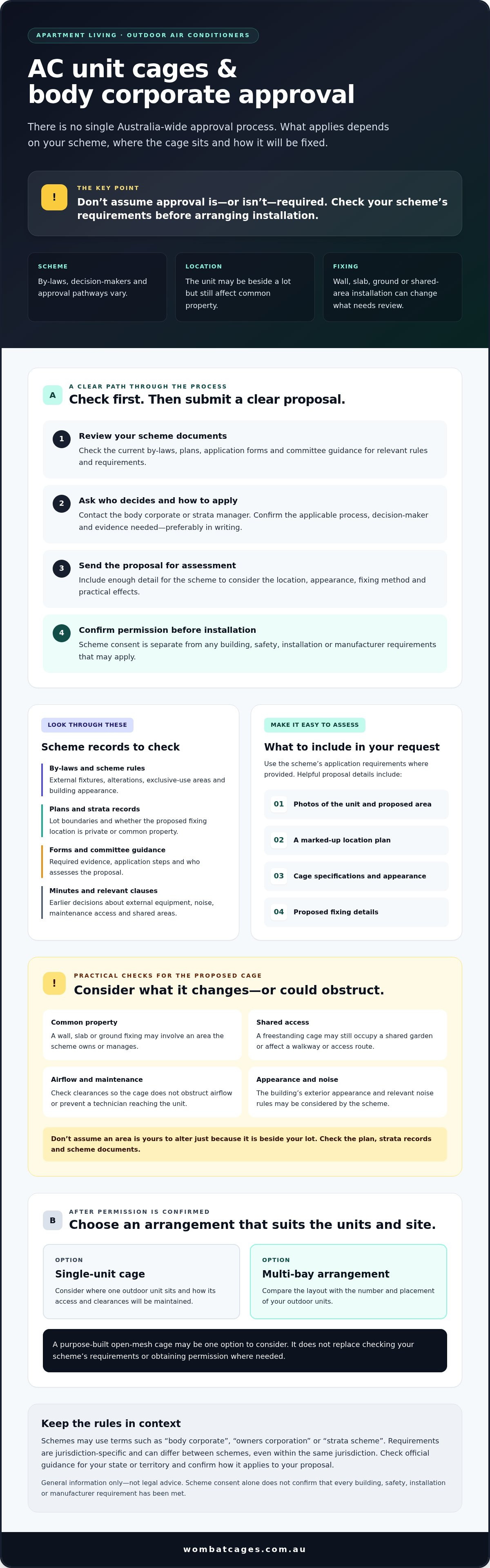
How to request body corporate approval for an AC unit cage
A clear application gives the decision-maker something specific to assess. Follow your scheme’s process, and don’t book installation until you’ve confirmed the required approval and received written permission where applicable.
- Review the scheme documents. Check the current by-laws, application requirements and guidance relevant to external fixtures or alterations.
- Ask the manager about the process. Confirm who considers the request, what evidence is needed and whether another approval step may apply.
- Prepare the proposal. Gather photos, a marked-up location plan, cage specifications and proposed fixing details.
- Submit it for consideration. Include the installer’s details and available information about airflow, clearances and technician access.
- Wait for written confirmation. Keep the response with your scheme records and clarify any conditions before scheduling work.
What information should an approval request include?
Describe the outdoor AC unit and proposed cage, including its location, dimensions and visible finish. Add photos showing nearby walls, boundaries, paths and access points, then mark the intended cage position on a plan. Include proposed fixing locations and identify the surfaces that may be affected. Confirm measurements and fixing details with the installer before submitting them.
Make servicing and equipment requirements easy to assess. Attach available confirmation from the AC technician or manufacturer about required clearances, airflow and access. A cage may use open mesh to support airflow and technician access, but those features don’t replace checking the equipment requirements or scheme rules.
What if the rules are unclear or approval is declined?
Ask which rule or requirement applies and request the reasons for the decision in writing. Check whether the scheme offers a review or resubmission process. If concerns relate to position, appearance, fixings or access, ask whether revised details could address them. Don’t treat an unclear response as permission to proceed.
If you’re considering challenging a decision or the applicable process remains uncertain, seek advice from a qualified local strata professional before taking action. Once the scheme’s requirements are clear, assess the cage design and installation plan against them. Review AC cage supply and installation options as part of preparing a proposal for your committee.
After approval: choose an AC cage that suits the unit and scheme
Choose and install a cage only after confirming the scheme’s approval requirements and any conditions attached to permission. Then match the arrangement to the outdoor units, approved location and access needs. The body corporate rules for AC unit cages still matter at this stage: approval relates to the design and installation details the scheme considered.
What should a body corporate-approved cage provide?
Start with fit and function. A single-unit cage may suit one outdoor condenser, while a multi-bay arrangement can enclose several units where their placement allows. Check the layout against the approved location and make sure the cage won’t obstruct shared access or prevent routine servicing.
Wombat Cages supplies hot-dip galvanised steel cages for outdoor AC units. The open-mesh design is intended to support airflow and technician access, but the AC professional or manufacturer should confirm the required clearances for your equipment. For a broader overview, look for the published guide Split System Security Cage: The Ultimate Guide to HVAC Protection.
Material and construction are only part of the decision. The cage design, location, fixing details and scheme conditions all need to align. A cage doesn’t automatically comply with scheme rules or remove the need to check equipment requirements.
Plan installation around approval, access and maintenance
Before booking work, compare the approved proposal with the installation plan. Confirm the fixing locations and any conditions with the scheme manager. If the proposed design or attachment details have changed, check whether the change needs further consideration instead of assuming the earlier approval covers it.
Coordinate with an AC technician to check manufacturer requirements, clearances and servicing access. Keep those checks in view when assessing a cage intended to reduce the risk of accidental contact with the outdoor unit. A purpose-built cage may be an option to discuss, but it doesn’t replace careful placement or technical advice.
Wombat Cages offers supply and professional installation of single-unit and multi-bay security cages. If you’re considering an arrangement, discuss the proposed cage and installation details with Wombat Cages, then share the relevant design information with your scheme before work is scheduled. You can also look for a published guide on protecting an AC unit from accidental damage for further general considerations.
Plan your AC cage installation with confidence
Confirm what your scheme requires before choosing a cage or booking installation. Check the relevant by-laws and plans, ask the manager which approval process applies, and wait for written confirmation before work begins. The body corporate rules for AC unit cages depend on your scheme and the proposed location, attachment and design.
Once the requirements are clear, match the cage to the number and placement of your outdoor units. Wombat Cages supplies hot-dip galvanised steel cages for outdoor condensers and compressors, with an open-mesh design intended to maintain airflow and technician access. Single-unit and multi-bay configurations are available, along with professional installation. Confirm clearances with your AC professional, and share the proposed design and installation details with your committee.
Discuss an AC security cage for your property and take the next step with a clear plan. Check first, give your scheme the relevant details, then choose an arrangement that suits the unit and approved location.
Frequently Asked Questions
Do I need body corporate approval to install an AC unit cage?
You may need approval, particularly if the cage attaches to common property, changes the building’s exterior or affects a shared area. The body corporate rules for AC unit cages depend on your scheme documents, the proposed location and the applicable state or territory process. Check the current by-laws and plans, then ask the scheme manager which approval pathway applies before ordering or installing the cage.
Can a body corporate stop me installing an air conditioner cage?
The scheme may refuse a proposal or require changes, depending on its rules and the proposal’s effect on the building or shared areas. Ask for the decision and reasons in writing, including the relevant rule or concern. If the issue is placement, appearance, fixing details or access, find out whether revised plans could address it. For a dispute about your rights or the decision process, seek qualified local strata advice.
What should I include in an AC cage approval request?
Include a clear description of the outdoor unit and proposed cage, its location, dimensions, visible finish and fixing details. Add photos of nearby walls, boundaries, paths and access points, plus a marked-up plan showing the proposed position. Include installer details and, where available, information from the AC technician or manufacturer about airflow, required clearances and servicing access. Ask the manager whether your scheme requires a specific form or other evidence.
Does an open-mesh AC cage still need body corporate approval?
It may. An open-mesh design can support airflow and technician access, but those features don’t automatically exempt a cage from scheme approval. The location, attachment points, appearance and effect on shared access may still matter. Check the scheme documents and ask the manager whether the proposal needs approval. Confirm equipment clearances with the AC technician or manufacturer, and include those details in your application where available.
Can I attach an AC cage to a common property wall?
Don’t attach a cage to a wall until you’ve confirmed the wall’s status and the scheme’s requirements. A wall that appears to serve your lot may still be common property or subject to restrictions. Check the strata plan and records, then ask the scheme manager to confirm whether the proposed fixing location is permitted and what approval process applies. Give them the proposed fixing details before arranging installation.
What happens if I install an AC cage without approval?
Installing without required approval could lead to a dispute with the scheme and a request to address or remove the unauthorised work. The outcome and any enforcement process depend on the applicable rules and jurisdiction. Don’t assume a small, removable or freestanding cage is exempt. If installation has already occurred, contact the scheme manager promptly, ask how to resolve the issue and seek local strata advice if needed.
Who should I contact about body corporate rules for an AC unit cage?
Start with your strata or body corporate manager. Ask for the current by-laws, relevant plans, written application requirements and the name of the person or committee that considers the proposal. Check your state or territory’s official strata information for jurisdiction-specific guidance. If the documents are unclear or you’re disputing a decision, speak with a qualified local strata professional. Confirm the scheme process before scheduling installation.


