
What if a cage that looks large enough still blocks servicing or crowds the condenser? A custom size condenser security cage needs to suit more than the unit’s outside measurements. Available space, nearby pipes and wiring, airflow and technician access all matter. Check those details before settling on a design.
A cage should fit the equipment and site without making routine maintenance harder. Guessing at clearances can lead to a poor fit, so measure the condenser, note surrounding obstacles and check how the unit needs to be accessed. Confirm any specific clearance and fixing requirements before ordering.
This guide explains which dimensions and site details to prepare, what to include in an enquiry, and how single-unit cages compare with multi-bay configurations. It also covers how open mesh supports airflow and technician access. Wombat Cages supplies custom-configured hot-dip galvanised steel cages and can arrange a quote and professional installation, helping you assess the options for your site.
Key Takeaways
- A custom size condenser security cage can suit non-standard equipment or a restricted installation space, but check the site and unit details first.
- Follow the supplier’s measuring instructions, record the condenser’s width, height and depth, and confirm where each measurement should be taken.
- Choose between a single split-system cage and a multi-bay layout based on the number and arrangement of units, while allowing for servicing access.
- Prepare dimensions, photos, unit count and details of nearby obstacles and fixing surfaces to clarify the required configuration.
- Wombat Cages supplies custom-configured hot-dip galvanised steel cages and offers professional installation. Confirm the configuration before arranging installation.
When does a custom size condenser security cage make sense?
A custom condenser security cage is configured around the outdoor equipment and its installation site, taking account of fit, layout and fixing needs. A cage may fit around the unit but still leave too little room for a technician to reach it or for the equipment to operate as intended. Check those factors as well as the unit’s dimensions.
Outdoor condensers form part of Heating, ventilation, and air conditioning (HVAC) systems. A security cage needs to suit the equipment’s position and surroundings, not just its overall size. Open mesh supports airflow and technician access, but the proposed layout and clearances still need to be checked for the installation.
What makes a condenser cage a custom size?
Custom sizing means considering the cage’s dimensions and layout in relation to the unit and where it sits. One outdoor split-system condenser may need a different arrangement from several units positioned side by side. The unit count, available footprint and possible fixing points all affect the configuration.
Wombat Cages supplies custom-configured hot-dip galvanised steel cages in single split-system and multi-bay configurations. Confirm the final dimensions and setup for the site. A tailored configuration can account for the equipment and location, but it does not replace checking measurements and access requirements.
When might a standard configuration fall short?
Consider whether a standard layout will work if the condenser has an unusual footprint, the installation space is tight, or nearby pipes and walls limit where the cage can sit. Ground conditions matter too. A frame secured to a wall, the ground or both needs fixing points that suit the actual surfaces.
These conditions don’t automatically mean a custom cage is necessary. Compare the standard option with the unit’s position and the space around it first. Check for anything that could obstruct placement, fixing or future servicing, then include those details when discussing the configuration.
Physical fit is only part of the decision. The cage should leave practical access for servicing without crowding the condenser. If a standard layout seems close, confirm the measurements, site conditions and servicing needs before proceeding. This gives you a sound basis for choosing a standard or custom configuration.
How to measure a condenser before requesting a custom cage
Start with the supplier’s measuring instructions. A custom size condenser security cage needs to account for the outdoor unit and the space around it, but the supplier should confirm which points to measure and how to allow for access. Don’t guess clearances or assume the cage dimensions should match the unit exactly.
Which dimensions and site details should you record?
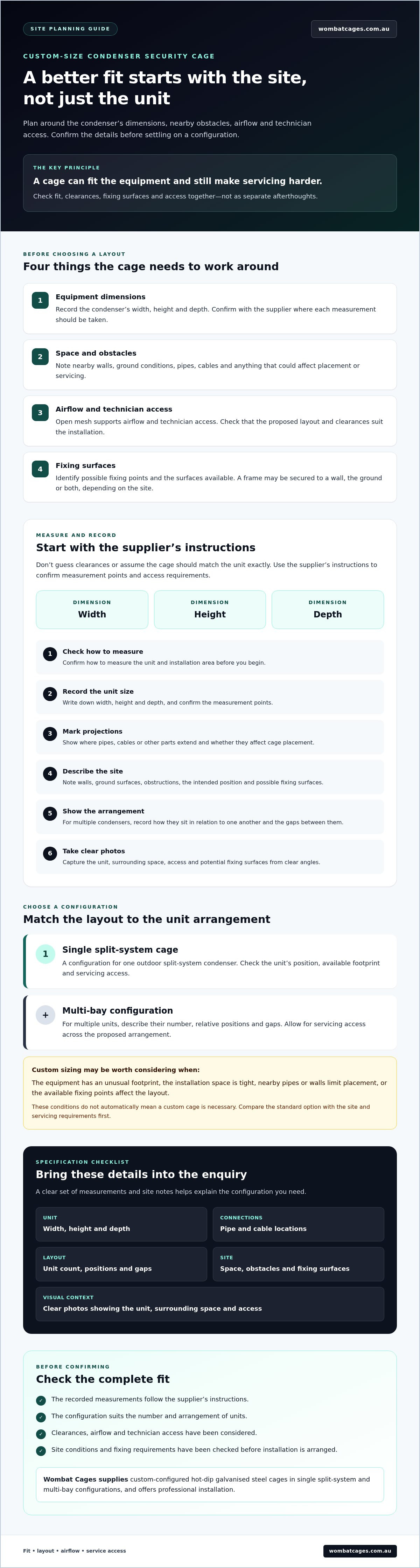
Use this preparation sequence before requesting a quote:
- Check the instructions. Ask the supplier how to measure the unit and installation area before you begin.
- Record the unit dimensions. Note its width, height and depth, then confirm the measurement points with the supplier.
- Mark projections. Note where pipes, cables or other parts extend from the unit and whether they affect the proposed cage position.
- Describe the site. Record nearby walls, ground surfaces, obstructions and the intended cage position. Note which surfaces may be available for fixing.
- Show the layout. For multiple condensers, record how they sit in relation to one another and the gaps between them.
- Take photos. Capture the unit, surrounding space and potential fixing surfaces from clear angles. Include enough context to show access around the equipment.
A useful enquiry includes the condenser’s width, height and depth, pipe and cable locations, unit arrangement, clear photos, and details of the space and fixing surfaces.
How can you reduce measurement errors?
Measure carefully and write down each figure as you take it. Label a simple sketch so the width, height and depth are easy to distinguish. For several units, draw their relative positions and mark the gaps rather than relying on a description such as “side by side”.
Photos can show details that measurements can’t. Include the available access, nearby obstacles and surfaces where the cage may be secured. Don’t assume a wall or ground surface is suitable for fixing. If you know what it’s made of or its condition, include that information.
These details help start the discussion, but they don’t settle the final dimensions. Ask Wombat Cages to confirm the measurement points, configuration and any required allowances before proceeding. Flag unclear measurements or site constraints so they can be reviewed rather than treated as confirmed.
Once you’ve gathered the details, you can discuss a cage configuration with Wombat Cages and clarify what information is needed for a quote.
Choose a custom cage configuration without compromising access
The right configuration depends on how many outdoor units need protection and how they’re arranged. A single split-system cage is intended for one condenser. Where several units sit side by side, a multi-bay layout may be more suitable. Either way, consider routine servicing as well as the physical footprint.
Single condenser or multiple units side by side?
Start with the equipment count and layout. A single-unit configuration is considered around one condenser and its position. A multi-bay arrangement is designed for multiple units side by side. It’s not simply a matter of adding width: the space between units, surrounding obstacles and available fixing surfaces can all affect the proposed setup.
Use this comparison to identify what to discuss before confirming a custom size condenser security cage:
| Configuration | Site information to provide | Servicing considerations |
|---|---|---|
| Single split-system cage | Unit position, nearby walls or obstacles, and potential fixing surfaces. | Which sides or areas need to remain accessible for routine service? |
| Multi-bay cage | Number and arrangement of units, gaps between them, site boundaries and fixing surfaces. | Can a technician reach the service areas of each condenser without access being blocked by another unit or the cage layout? |
Wombat Cages supplies both single split-system and multi-bay configurations. Use the table as a planning aid, then confirm the final arrangement and dimensions for your site.
How should servicing access shape the design?
Before finalising the specification, ask the air conditioning technician which panels, sides or connection areas they need to reach during routine service. Consider how they’ll approach each unit and whether the proposed cage position could obstruct that work. Don’t assume an opening on one side is enough, as access needs depend on the equipment and its placement.
Wombat Cages uses an open mesh design to support airflow and technician access. The mesh also lets you see the equipment inside the enclosure. These features address common concerns about enclosing a condenser, but the layout, clearances and access requirements still need checking for the specific installation.
Confirm servicing needs with the air conditioning technician, then share them when discussing the cage configuration. A practical design should secure the units while leaving the technician a workable way to reach them.
Prepare a custom condenser cage specification for a quote
A clear enquiry gives the supplier a useful starting point for assessing the equipment, layout and installation site. Include what you’ve measured and observed, and separate confirmed details from anything you’re unsure about. This helps avoid assumptions in the specification for a custom size condenser security cage.
What information helps a supplier assess the job?
Prepare a short checklist before requesting a quote. Include:
- Equipment: condenser make or model, if known, its measured width, height and depth, and how many units need a cage.
- Position and layout: where the equipment sits, how multiple units are arranged, and the intended cage position.
- Obstacles: nearby walls, pipes, cables or other features that could affect cage placement or access.
- Fixing surfaces: describe the visible wall and ground surfaces where the frame may be secured. Installation can involve bolting the frame to walls and ground, so site conditions matter.
- Visual references: labelled photos of the unit and surrounding area, plus a simple sketch showing measurements, obstacles and proposed position.
Mark uncertain measurements clearly instead of presenting a guess as a confirmed figure. Photos should show the equipment and enough of the wider site to explain its location and potential fixing points. If you’re unsure how to measure a particular part, flag it for confirmation.
What should you confirm before approving a configuration?
Check that the proposed setup has been considered against the equipment and available space. Confirm how technicians will reach the condenser for servicing, and raise access concerns with the air conditioning technician. A measurement alone does not settle clearance or fixing requirements.
You can provide details such as the number of units, their location and clear photos. Other matters may need confirmation by the supplier or installer, including final dimensions, configuration and site-specific installation details. Ask who will confirm each point before proceeding. Discuss the fixing surface rather than assuming it is suitable based on a photo.
Wombat Cages supplies custom-configured hot-dip galvanised steel cages and offers professional installation. To start with the information you’ve gathered, prepare your cage enquiry with Wombat Cages.
Order a custom size condenser security cage with confidence
A well-prepared enquiry makes it easier to move from measurements to installation. Treat the proposed cage as a configuration to confirm, not a guaranteed fit based on dimensions alone. The condenser, available space, servicing access and fixing surfaces all need to be considered for the site.
Wombat Cages supplies custom-configured hot-dip galvanised steel cages for single split systems and multiple units side by side, and offers professional installation. Follow these steps to move the job forward:
- Gather the details. Bring together unit measurements, equipment count, site photos and notes about obstacles and fixing surfaces.
- Request a quote. Send the information you have and clearly flag anything uncertain, such as a measurement or the condition of a potential fixing surface.
- Confirm the configuration. Check the proposed dimensions and layout against the condenser, site and technician access needs. Ask how unknowns will be resolved before approving the setup.
- Arrange installation. Confirm the location and access arrangements with the supplier, and establish which wall or ground fixing details need checking on site.
What happens after you send your measurements?
Your measurements, photos and site notes provide a starting point for discussing the cage and quote. Before approving a configuration, ask how the proposed arrangement accounts for the unit, surrounding space, servicing access and installation surfaces. Raise uncertain measurements or access obstructions directly rather than relying on an assumption.
Confirm who will check site-specific installation requirements and what information they need from you. The appropriate fixing approach depends on the actual surfaces and conditions, so don’t presume the details from a distance. Clarify these points before the configuration is finalised.
How do you prepare for professional installation?
Clear the intended installation location and explain any access constraints when arranging the work. Ask which wall or ground fixing details need to be checked and whether additional site information is required. Installation can involve securing the frame to walls and ground, but the method and requirements should be confirmed for your site.
Before work is arranged, check that the configuration still allows for servicing and that any unresolved measurements or access concerns have been discussed. These checks help match the cage to the equipment and installation conditions without assuming every site is the same.
Ready to take the next step? Request a custom cage quote from Wombat Cages with the details you’ve gathered.
Make your next cage enquiry count
A custom size condenser security cage should be planned around both the equipment and its site. Record the condenser’s width, height and depth, note nearby obstructions and fixing surfaces, and confirm measurement points with the supplier. Also check how technicians will reach the unit for servicing before approving a configuration.
Wombat Cages supplies custom-configured hot-dip galvanised steel security cages in single split-system and multi-bay configurations. The open mesh design supports airflow and technician access, and professional on-site installation is available. Confirm final dimensions, layout and fixing details for your specific unit and site.
With clear measurements, photos and access details ready, you can make a more informed enquiry. Request a custom cage quote from Wombat Cages and take the next step towards a practical fit for your equipment and installation site.
Frequently Asked Questions
What measurements do I need for a custom size condenser security cage?
Record the condenser’s width, height and depth, and confirm with the supplier where to take each measurement. Note pipes, cables or other projections, plus nearby walls, ground surfaces and obstacles. For multiple units, include their arrangement and the gaps between them. Label the measurements on a simple sketch and take clear photos of the equipment and proposed cage location.
Can a condenser security cage be made to fit an unusual outdoor unit?
A custom configuration can be considered for an unusual unit footprint or a site that doesn’t suit a standard layout. The cage dimensions and arrangement need to be assessed against the equipment, available space, fixing surfaces and servicing access. Provide the unit measurements and photos, then ask the supplier to confirm the proposed configuration. Check measurements before approving the design.
How much clearance should a custom AC condenser cage allow?
There isn’t one clearance figure that applies to every condenser and installation. The required space depends on the unit, its position, airflow needs and access for servicing. Don’t simply add an allowance or match the cage tightly to the equipment. Follow the supplier’s measuring instructions and confirm the proposed dimensions with them. An air conditioning technician can also advise which areas need to remain accessible during routine service.
Will a custom security cage restrict airflow or make servicing harder?
An unsuitable layout could obstruct access, so discuss servicing needs before confirming the design. Wombat Cages uses an open mesh design that supports airflow and technician access, but the arrangement still needs to suit the equipment and site. Ask the air conditioning technician which sides or panels they need to reach, then confirm those requirements with the supplier alongside the proposed cage dimensions and position.
Can one custom cage protect multiple air conditioner condensers?
A multi-bay cage can be configured for multiple condensers arranged side by side. For an accurate assessment, provide the number of units, how they’re positioned and the gaps between them. Include nearby obstacles and available fixing surfaces too. Confirm the final layout for the equipment and site, with servicing access considered for each condenser. Don’t assume a multi-bay arrangement will suit every unit configuration without checking first.
Can a condenser security cage be fixed to a wall or ground surface?
Installation can involve bolting the cage frame to walls and ground, depending on the site. Describe the available surfaces and include clear photos so the supplier can understand the proposed fixing locations. Don’t assume a surface is suitable based on appearance alone. Ask which site details need checking and confirm the fixing approach before approving the configuration or arranging installation.
How do I request a quote for a custom condenser security cage?
Send the supplier the condenser’s measured width, height and depth, the number of units, and details of the proposed location. Add labelled photos or a sketch showing obstacles, nearby walls and ground surfaces, and mark any uncertain measurements. Mention technician access needs as well. Wombat Cages can arrange a quote for custom-configured hot-dip galvanised steel cages and professional installation. Confirm the final configuration and site requirements before proceeding.


