
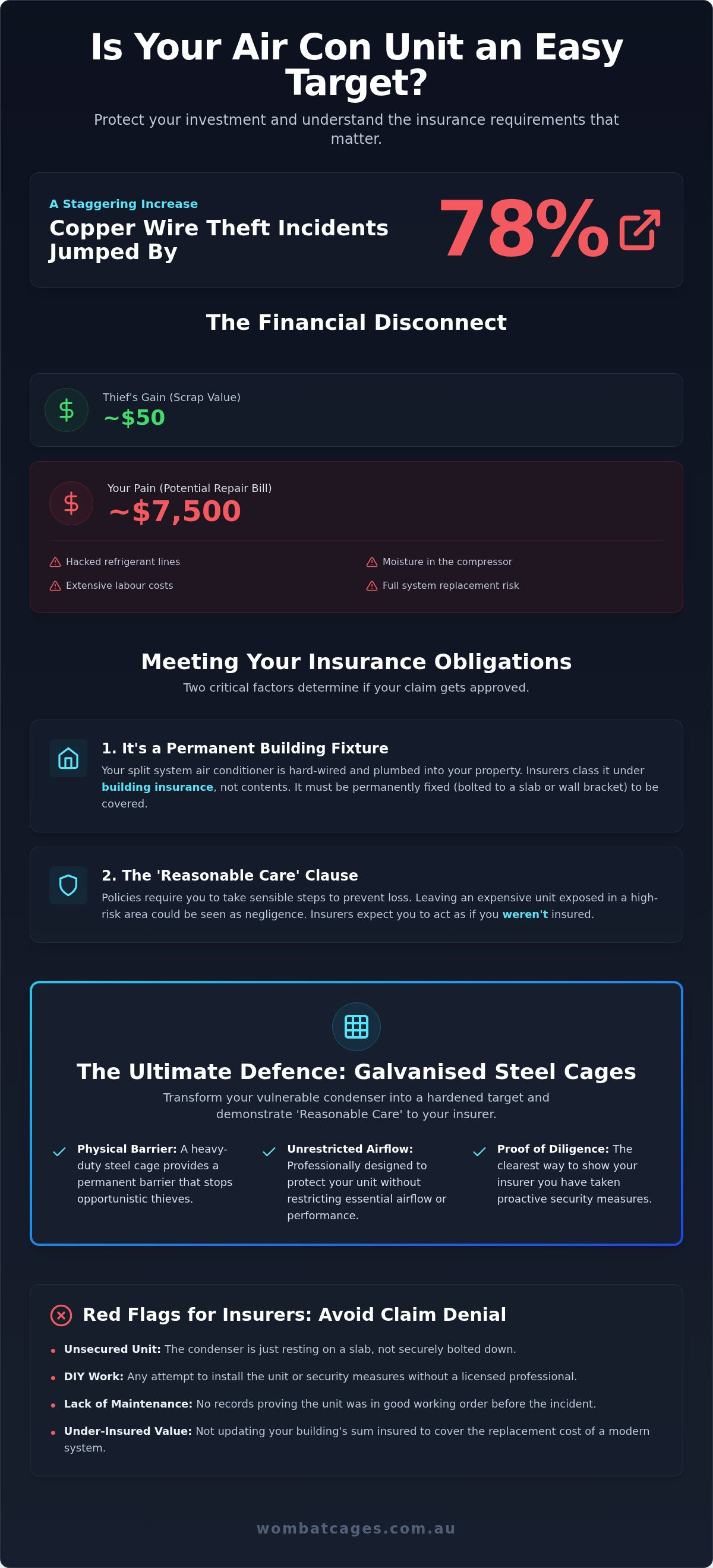
Did you know that copper wire theft incidents jumped by 78 per cent in early 2026? It's a staggering figure. It puts every Australian property owner on high alert. You likely feel the same anxiety as your neighbours. You worry about waking up to a mangled outdoor unit and a repair bill reaching $7,500. You pay for insurance to avoid these disasters. But there's a catch. Many owners don't realise that insurance requirements for AC unit protection often hinge on taking reasonable care of the asset.
Deciphering complex policy fine print is frustrating. You want certainty. You need to know your claim won't be rejected because of a technicality. This article helps you meet those insurance obligations. It shows you how to physically secure your unit against opportunistic thieves. We'll walk you through a practical security audit. We'll explain why a heavy-duty steel barrier is your best defence. Learn how to transform your vulnerable condenser into a hardened target. Gain total peace of mind.
Key Takeaways
- Understand why split systems are classed as permanent building fixtures. This distinction is critical for your insurance coverage.
- Meet specific insurance requirements for AC unit protection by demonstrating reasonable care through physical security measures.
- Discover why the repair costs from copper theft often reach $7,500. This far exceeds the measly scrap value of the metal.
- Follow a practical visual audit to check if your condenser is bolted securely or just resting on a slab.
- Learn why hot-dip galvanised steel cages provide a permanent barrier that stops thieves without restricting essential airflow.
Understanding Insurance Coverage for Outdoor AC Units
Your outdoor condenser isn't just an appliance. It's a permanent building fixture. This distinction is vital when meeting insurance requirements for AC unit protection. Most Australian insurers categorise split systems under building insurance because they're hard-wired and plumbed into the structure. They aren't contents like a kettle or a toaster. If you can't pick it up and take it with you when you move, it's part of the building.
Standard building policies usually list "covered perils" like fire, storm damage, and theft. However, Metal theft presents a unique challenge for property owners. While the policy covers the physical loss, you'll likely face a significant financial gap. A thief might only walk away with $50 worth of copper. Your repair bill could easily hit $7,500 if the refrigerant lines are hacked and moisture enters the compressor. You're left covering the excess and any costs that exceed your policy limits. It's a massive headache for a tiny scrap payout.
Fixed Units vs. Portable Systems
Permanence is the key to coverage. A condenser bolted to a concrete slab or fixed to a wall bracket is a fixture. Window units that slide in and out of a frame often fall into a grey area. Portable coolers are strictly contents. If it's not physically attached to the building, it's not part of the building insurance. Always ensure your installation is permanent to avoid claim disputes later.
The Impact of the Sum Insured
Don't overlook your HVAC system when calculating your building's total value. Technology evolves fast. Modern, energy-efficient units cost more than the old units they replace. If you haven't updated your sum insured lately, you're at risk. You might find yourself under-insured after a total system loss. Inflation on materials and labour also pushes replacement costs higher every year. It's a good idea to review these figures annually.
Commercial vs. Residential Policy Differences
Commercial property owners face different hurdles. Excesses are typically much higher than residential policies. A $2,000 excess might make a small copper repair claim financially pointless. Commercial policies also offer business interruption clauses. If your server room overheats because the AC was stripped, you lose more than just hardware. Landlords should check their specific landlord insurance. It often includes extra protection for malicious damage caused by intruders.
The 'Reasonable Care' Requirement: What Insurers Expect
Insurance policies aren't a blank cheque. Most contain a "duty of care" or "reasonable care" clause. This means you must take sensible steps to prevent loss or damage to your property. If you live in an area where crime rates are climbing, leaving an expensive condenser unit completely exposed is a significant risk. Insurers expect you to act as if you weren't insured at all. They want to see that you've made a genuine effort to protect your assets from known threats.
Leaving a unit vulnerable in a dark alleyway or an unsecured side yard might be viewed as negligence during a claim review. While insurance typically covers theft, it isn't a substitute for basic physical security. A claim assessment often looks at the environment and the measures you had in place. Preventing Copper Theft requires a proactive approach rather than a reactive one. If an assessor decides you were careless, they might deny the claim or reduce the payout. Robust physical protection is the link between a theft event and a successful settlement. It proves you took the insurance requirements for AC unit protection seriously.
Defining Negligence in Asset Protection
Negligence is often about what you didn't do. Leaving a side gate swinging open is a common mistake. Placing a unit in a spot where it's visible from the street without any barrier is another. When you install a Single Split System Security Cage, you create a clear record of diligence. It's a physical statement that you've secured the asset. This makes it much harder for an insurer to argue that you failed to take reasonable steps to mitigate the risk of theft.
The Role of Professional Installation
DIY work is a major red flag for insurance companies. If you try to mount your own security cage or modify the HVAC unit's housing without the right qualifications, you might void your entire policy. Always use licensed trades for any work involving your AC system. This ensures the installation remains compliant with Australian building codes and safety standards. Keep all your invoices and maintenance logs in a safe place. These documents prove the unit was in good working order and professionally secured before any incident occurred. A well-maintained and professionally secured unit is far easier to defend during a claim dispute.
Copper Theft vs. General Vandalism: Navigating Policy Limits
Thieves use a "strip-out" method that leaves your condenser in ruins. They don't have time for precision tools. They use bolt cutters or reciprocating saws to hack through refrigerant lines and electrical cables. This isn't just theft. It's violent vandalism. While a criminal might only net $20 to $50 from the scrap yard, the Impact of HVAC Theft on Property Claims is often massive. Repairing the damage or replacing the entire system can cost between $1,000 and $7,500. This massive financial gap is why understanding your policy is vital.
Australian building insurance usually includes "malicious damage" clauses. This covers intentional harm caused by third parties. However, there's a difference between a stolen unit and a vandalised one. If a thief takes the whole unit, it's a straightforward theft claim. If they rip out the guts for the copper, it's often processed as malicious damage. Both scenarios fall under the umbrella of insurance requirements for AC unit protection, but the way you document the damage changes how the claim is handled. Always take photos before touching anything to ensure the assessor sees the "strip-out" exactly as it happened.
Why Copper is the Primary Target
The incentive is simple: money. As of August 2026, clean copper wire sells for $3.00 to $4.50 per pound. A standard residential unit holds 10 to 20 pounds of the stuff. Thieves target the exposed pipework leading into the condenser because it's the easiest point of entry. They want the high-grade metal inside the coils. For a deeper look at these risks, read our Air Conditioner Copper Theft: A Complete Guide to Protecting Your Property. Understanding the thief's motivation helps you identify the weakest points of your installation.
Exclusions: Wear, Tear, and Gradual Damage
Don't confuse theft damage with general maintenance issues. Insurance doesn't cover rust, corrosion, or mechanical failure. These are "gradual" events. If your unit sits unprotected, it's more likely to suffer from the elements. A lack of physical security leads to faster deterioration. If a thief hacks your lines and you don't notice for weeks, moisture enters the system. The resulting internal corrosion might be excluded from your claim because it wasn't a "sudden" event. Insurers draw a hard line between a one-off crime and the slow decline of a neglected asset. Keep your unit secured and your maintenance logs updated to prove the damage was sudden and criminal.
Your AC Protection Checklist: Meeting Insurance Standards
Prevention is cheaper than a claim. Most property owners assume their policy covers everything without question. But if your unit is just sitting loose on a plastic pad, you might be in for a shock. Meeting insurance requirements for AC unit protection starts with a thorough visual audit. Review your current Product Disclosure Statement (PDS) for any specific security requirements. Walk around your property. Look at your condenser through the eyes of a thief. If it looks easy to strip, it probably is.
The Physical Security Audit
Check the mounting first. A unit bolted directly to a concrete slab or brick wall is much harder to move. If it's just resting on the ground, it's a prime target for opportunistic criminals. Use this list to evaluate your setup:
- Mounting: Ensure the unit is secured to a concrete slab or brick wall.
- Access: Check for easy entry points like low fences or unlocked side gates.
- Pipework: Verify that copper lines are not exposed or easily snipped.
- Visibility: Assess if the unit is visible from the street or a nearby alleyway.
Following these steps helps you satisfy the insurance requirements for AC unit protection while physically hardening your property.
Documentation and Evidence
Proof is everything during a claim dispute. Take clear, dated photos of your unit and all surrounding security features. These images serve as evidence that you've exercised reasonable care. Keep all receipts for professional installations and any security upgrades you've made. Store your insurance policy number and claims contact in a safe place. If a theft occurs, you'll need this information immediately to start the process. Having a documented history of your security efforts makes it much harder for an insurer to dispute your diligence.
Risk Mitigation Strategies
Consider adding sensor lighting near the outdoor unit. Thieves hate being in the spotlight. CCTV cameras that specifically cover the HVAC area can also act as a deterrent. While these measures help, they don't physically stop a thief with bolt cutters. A permanent barrier is the most effective solution. You can protect your outdoor unit with a heavy-duty steel enclosure that blocks access while allowing for airflow. These cages are purpose-built to defend high-value assets. They ensure you meet the highest standards of property protection and insurance compliance.
Investing in Galvanised Steel Cages to Minimise Risk
Hot-dip galvanised steel is the gold standard for HVAC security. It's not just about strength. It's about staying power. A heavy-duty enclosure creates a permanent physical barrier that satisfies the most stringent insurance requirements for AC unit protection. When an insurance assessor sees a unit bolted to the structure inside a steel frame, the "reasonable care" box is ticked immediately. You aren't just hoping for the best. You're actively defending your property.
A rigid mesh design serves a dual purpose. It prevents bolt cutters and saws from reaching the copper lines while ensuring maximum airflow. Airflow is non-negotiable for HVAC efficiency. If you block the air, you kill the compressor. Our cages provide the necessary clearance to keep your system running cool under the Australian sun. The "deterrent effect" is your silent partner in asset protection. Thieves look for the path of least resistance. A steel cage bolted directly to the wall and ground makes a statement. It tells a criminal that this job will take too long and make too much noise. They move on to an easier target elsewhere.
Why Galvanised Steel Beats Alternatives
Aluminium is too soft for serious security. It can be bent or cut with basic hand tools. Timber rots in the rain and warps in the heat. Galvanised steel handles the harsh Australian climate without rusting or corroding. It offers a superior strength-to-weight ratio that ensures the cage remains a rigid, unmoving obstacle. The "no-nonsense" industrial aesthetic also serves as a visual warning. It signals to anyone looking that the owner has invested in high-level security. It's a pragmatic choice for long-term resilience.
The Wombat Cages Advantage
We provide protection that fits your specific needs. Whether you require a Single Split System Security Cage or Multi-Bay Security Cages, our configurations are purpose-built for durability. The design allows for easy technician access during routine servicing. You don't have to sacrifice maintenance for security. For more details on the claim process, read our guide on Air Conditioner Theft Insurance Claims: A Property Owner’s Guide to Protection. To understand the full scope of physical barriers, check out our Split System Security Cage: The Ultimate Guide to HVAC Protection. We help you meet insurance requirements for AC unit protection with a solution that lasts as long as your building.
Hardening Your Assets for Long-Term Protection
Copper theft is a persistent threat. It costs Australian property owners thousands every year. Insurance is a vital safety net. It isn't a substitute for real-world security. Meeting insurance requirements for AC unit protection requires you to demonstrate reasonable care. Move beyond hope. Install a physical barrier that stops thieves before they start. A documented audit and a secure mounting are your best defences during a claim assessment.
Don't leave your condenser vulnerable. We offer a national Australian supply of heavy-duty theft deterrents. Our enclosures feature hot-dip galvanised steel construction. They're built to last in the harsh Australian climate. It's a pragmatic, no-nonsense solution for those who value durability and strength. Secure your AC unit with a Wombat Cage today. Take control of your property security. You've worked hard for your assets. Make sure they stay exactly where they belong.
Frequently Asked Questions
Does home insurance cover air conditioner theft?
Yes, most Australian home insurance policies cover air conditioner theft. Because the condenser is hard-wired and plumbed into the building, it's classed as a permanent fixture under building insurance rather than contents. You're covered for the replacement value of the unit if a criminal removes it. However, you'll still need to pay your nominated excess. Always check your Product Disclosure Statement to confirm your specific policy includes theft of external fixtures.
Will my insurance premium go up if I claim for copper theft?
Claiming for copper theft can lead to higher premiums in the future. Insurers view multiple claims as an increased risk profile. You might also lose your no-claim bonus, which often results in a significant price jump at renewal time. Given that repair costs can reach $7,500, making a claim is often necessary. This makes physical prevention even more valuable. It keeps your claims history clean and your annual costs predictable.
What is the "reasonable care" clause in Australian insurance?
The "reasonable care" clause is a standard requirement in Australian insurance contracts. It means you must take sensible steps to protect your property from known risks. If you live in an area with rising theft rates and do nothing to secure an exposed unit, an insurer might argue you were negligent. Taking proactive measures like installing a steel enclosure demonstrates that you've fulfilled your duty to mitigate potential losses.
Do I need a security cage to be covered by insurance?
Most insurers don't explicitly mandate a cage, but it helps you meet the insurance requirements for AC unit protection. By installing a physical barrier, you provide clear evidence of reasonable care. If a theft occurs despite the cage, your claim is much harder to dispute. It shows you weren't negligent. While not always a policy requirement, it's a common-sense step that simplifies the settlement process after an incident.
Can I get a discount on insurance for installing an AC cage?
You won't always get a direct premium discount for installing a security cage. Unlike monitored house alarms, AC cages aren't a universal discount trigger for all Australian insurers. However, some commercial providers may look favourably on property hardening measures during their risk assessment. The real financial benefit is avoiding the high cost of a $1,000 to $2,000 excess and the subsequent premium hikes that follow a major theft claim.
Does landlord insurance cover AC units in rental properties?
Landlord insurance typically covers AC units against theft and malicious damage. This is essential because rental properties are often targeted when they're vacant between tenancies. The policy covers the cost to repair or replace the unit if it's stripped for copper. Some policies also include loss of rent if the property becomes uninhabitable due to the AC failure. Check your specific landlord policy to ensure external fixtures are fully protected.
What happens if a thief damages my unit but doesn’t steal anything?
If a thief damages your unit without stealing the copper, you're still covered. This scenario falls under the "malicious damage" section of your building policy. Even if the thief was interrupted, the cost to fix hacked refrigerant lines or a dented casing is substantial. You'll process the claim the same way as a theft. Take photos of the damage immediately. This evidence is crucial for proving the event was sudden and intentional.
Is copper theft covered under "malicious damage" or "theft"?
Copper theft is often a mix of both malicious damage and theft. The removal of the metal is theft, but the violent hacking of lines and internal components is malicious damage. Most Australian building policies cover both, so your claim should proceed regardless of the label. The key is documenting the "strip-out" method used by the criminal. This helps the insurer categorise the loss correctly and ensures you receive the full payout for repairs.


