
A high wind rating can look reassuring, but it may not tell you how a cage will perform once it is fixed at your property. An air conditioner cage wind resistance rating only means something when you know what was tested, under which conditions, and whether those conditions match your site and installation.
It’s reasonable to want a clear number before choosing protection for an outdoor air conditioner. The catch is that wind exposure, mounting surfaces and fixings vary from one property to another. A cage also needs to protect the unit without blocking airflow or making technician access difficult.
This guide explains what a wind resistance claim can and can’t prove, and what evidence to ask for before relying on it. You’ll learn which site details can affect wind performance, why cage construction and secure fixing need to be considered together, and how to compare options using practical questions rather than an unexplained rating. The aim is a sounder decision based on the cage, the site and the installation as a whole.
Key Takeaways
- An air conditioner cage wind resistance rating is useful only when its test basis, conditions and tested configuration are clear.
- Ask whether a claim is supported by test documentation or an engineering assessment, rather than relying on an unexplained figure.
- Open mesh still experiences wind forces, so consider how panels, frames and fixings work together.
- Record your site’s exposure, unit dimensions, mounting surface and access needs to help assess the right configuration.
- Hot-dip galvanised steel, open mesh and secure fixing are relevant features, but they don’t prove wind performance on their own.
What does an air conditioner cage wind resistance rating mean?
An air conditioner cage wind resistance rating is a claim about how a particular cage performed, or is expected to perform, under stated wind conditions. It does not confirm on its own that the cage is suitable for every site or installation.
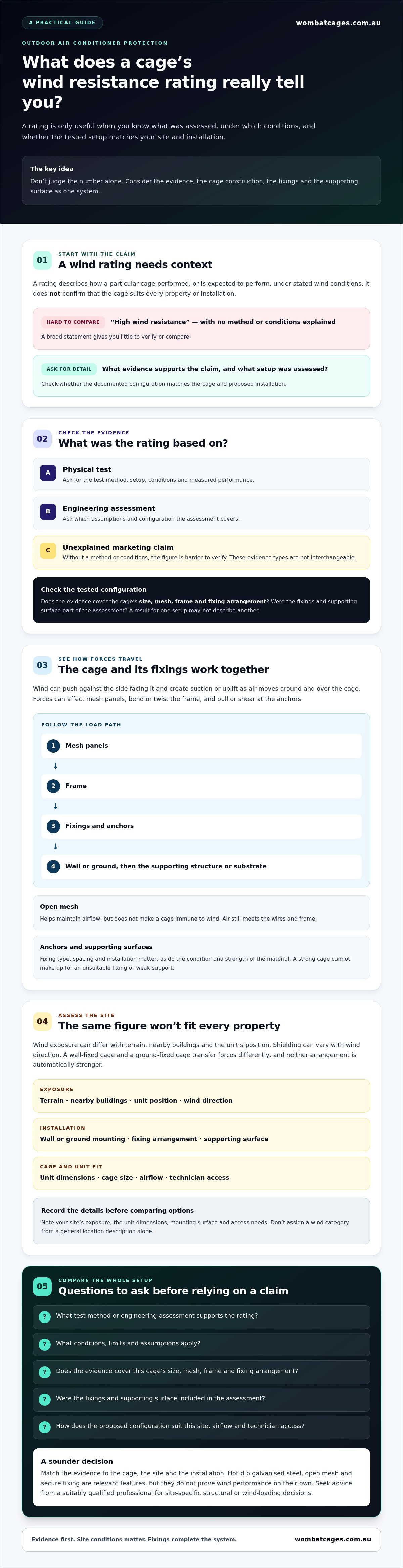
The number only has value when its basis is clear. It might come from a physical test of a cage, an engineering assessment using specified assumptions, or general marketing language. These are not interchangeable. Ask what evidence supports the claim and what was actually assessed. A broad statement such as “high wind resistance”, without a method or conditions, gives you little to compare.
Wind load describes the forces wind applies to a structure. For a plain-language overview of the concept and the forces involved, see What does a wind load rating mean? A cage claim should still be checked against evidence for the cage itself, rather than inferred from a general explanation of wind loading.
What information should a wind rating include?
Ask for the test method, test setup and measured performance behind the stated rating. Then check that the evidence covers the cage you’re considering, including its size, mesh, frame and fixing arrangement. A result for one configuration may not describe a different size or a different way of fixing the cage in place.
Look for the limits as well as the headline figure. What conditions was the cage assessed under? Were the fixings and supporting surface part of the assessment? If documentation isn’t available, that doesn’t automatically mean the cage will fail. It does mean the claim is harder to verify, so ask for clarification before relying on it.
Does one rating apply to every Australian site?
No single product figure automatically accounts for every property. Wind exposure can differ with terrain, nearby buildings and the position of the unit. A cage fixed to a suitable wall may face different conditions from one installed on a ground surface. The mounting method and fixings also affect how forces are transferred.
Use a rating as one piece of information, not as site approval. Check whether the documented configuration matches the proposed cage and installation, then seek advice from a suitably qualified professional for site-specific structural or wind-loading decisions. This is especially important where exposure or the supporting surface raises questions. The useful question isn’t just “What’s the rating?” It’s “What evidence supports it, and does it apply here?”
How wind loads act on an AC cage and its fixings
Wind pushes against the side facing it and can create suction or uplift as air moves around and over the cage. These forces can act on mesh panels, bend or twist the frame, and pull or shear at the anchors. The exact forces depend on the wind and the shape, position and surroundings of the enclosure.
Open mesh helps maintain airflow, but it doesn’t make a cage immune to wind. Air still meets the wires and frame, creating forces that the structure must transfer safely. In practical terms, the load path runs from the mesh to the frame, through the fixings and into the wall or ground, then into the supporting structure or substrate. A strong cage cannot make up for an unsuitable fixing or weak support.
That’s why an air conditioner cage wind resistance rating should be considered alongside the way the cage is secured. Guidance on anchoring rooftop equipment also highlights the need to consider the equipment, connections and supporting structure as a system.
Which site conditions can change wind exposure?
A unit in an open, exposed position may face different wind conditions from one partly shielded by nearby buildings. The amount of shielding can also vary with wind direction. The cage’s position around the unit and the space around it can affect how air flows and where pressure or suction acts. Don’t assign a wind category from a general location description alone. Site-specific wind-loading decisions need assessment by a suitably qualified professional.
Why anchors and mounting surfaces matter
Anchor performance depends on more than the fixing itself. Type, spacing and installation all matter, as do the condition and strength of the material it enters. A wall-fixed cage transfers forces into the wall; a ground-fixed cage transfers them through its base and anchors into the supporting surface. Neither arrangement is automatically stronger. The right choice depends on the cage design and the actual mounting conditions.
Wombat Cages’ installations can fix frames to walls or ground surfaces. Ask how the proposed configuration suits your site, and have any structural concerns assessed before installation. For context on mounting approaches, see the guide to bolted versus freestanding cage installation. You can also review outdoor AC security cage options when comparing configurations.
How to compare air conditioner cage wind resistance claims
A headline figure is only a starting point. Compare what was assessed, how it was assessed and whether the evidence applies to the cage and installation you’re considering. Use this checklist: compare the evidence, tested configuration and installation conditions together.
| What to compare | What to check | How to read it |
|---|---|---|
| Stated rating | Is a figure given with units, test conditions and a clear basis? | A number without context is difficult to verify or compare. |
| Test evidence | Is there a complete test report or engineering document? | Give more weight to traceable documentation than a supplier statement alone. |
| Configuration | Do cage dimensions, mesh, frame and panel attachments match the proposed cage? | Evidence for one setup may not apply to another. |
| Fixings | Does the evidence describe anchor type, placement and supporting surface? | Fixing details affect how loads transfer from the cage into its support. |
| Limitations | Does the document state assumptions, exclusions or conditions for use? | These boundaries help show whether the evidence suits your installation. |
Frame rigidity and the way mesh panels attach to the frame are also worth checking. Look for clear descriptions or drawings, rather than assuming a cage is robust from appearance alone. The air conditioner cage wind resistance rating should be backed by evidence for the relevant configuration, not inferred from the material or general product claims.
What evidence should buyers request from a supplier?
Ask for the complete test report or engineering documentation, not just a headline number or summary. Check who prepared or assessed it, what method and setup were used, and what limitations are recorded. Then compare the documented cage dimensions and fixing arrangement with the proposed installation. If details don’t match, ask what that means for the claim.
A supplier statement can help explain a product, but it isn’t the same as independent test documentation or a site-specific engineering assessment. Missing documents aren’t proof of failure; they are a reason to ask more questions before relying on a figure.
How do cage design and airflow fit into the comparison?
Wind evidence answers a different question from airflow and service access. Check that the design leaves suitable clearance around the outdoor unit and allows technician access, as well as asking how the frame and mesh are secured. Wombat Cages’ open mesh design is intended to maintain airflow and allow access, but those features don’t establish a wind rating.
Hot-dip galvanising relates to steel protection, not proof of wind strength. For more on that distinction, read this hot-dip galvanised condenser cage guidance. Treat material, airflow and documented wind performance as separate checks.
How to assess your site before choosing a wind-resistant cage
A product claim can’t account for conditions at your property unless the relevant site details are understood. Before comparing an air conditioner cage wind resistance rating, gather clear information about the unit, its surroundings and where the cage could be fixed. This gives a supplier or qualified installer something practical to review, rather than relying on a general description of the site.
What should you record before requesting a quote?
Work through these checks and keep the details together:
- Exposure: Note whether the unit is in an open position or partly sheltered. Record nearby buildings or other obstructions and which sides of the cage appear exposed.
- Unit and clearances: Measure the outdoor condenser’s width, height and depth. Note the space around it, including access needed for servicing.
- Mounting position: Record whether the proposed cage would attach to a wall, ground surface or another support. Photograph the location and the visible condition of that surface.
- Access constraints: Include gates, narrow paths, overhead obstructions or other features that could affect installation or future technician access.
Take an overall photo to show the unit in its surroundings, then closer photos of the likely fixing points. Include measurements in your notes and label the images. Don’t rely on photos alone. They can show context, but may not establish what the supporting surface is made of or whether it’s suitable for fixings.
When is professional assessment important?
Get qualified advice if the site is unusually exposed, the supporting structure or substrate is uncertain, or you can’t tell whether the proposed fixing arrangement is suitable. An installer can review the fit and installation conditions. Where structural or wind-loading requirements need assessment, seek advice from a suitably qualified professional. Don’t select a cage solely because a general product claim appears to match a broad description of your area.
For general installation context, see this AC cage installation and protection guidance. It can help frame practical fit and access questions, but it isn’t evidence of a wind rating or a substitute for site-specific assessment.
Once your measurements and photos are ready, explore AC cage and installation options and share the site details for review.
Choosing an AC cage: match the evidence to the installation
Make the decision in sequence: check what wind-related evidence exists, confirm it covers the cage configuration you’re considering, then assess whether the installation conditions match. A figure that relates to a different size, frame or fixing arrangement may not tell you much about the proposed setup. If documentation is unavailable, treat the claim as unverified and ask what supporting information can be provided.
Hot-dip galvanised steel, open mesh and secure fixing are useful features for durability, airflow and installation. They are not, by themselves, proof of wind performance. An air conditioner cage wind resistance rating is relevant only if the evidence and installation details align with your actual site.
Questions to ask before you commit
Use these questions to pin down what a claim covers and what still needs checking:
- What wind-related test or engineering evidence is available, and which exact cage configuration does it cover?
- Do the documented dimensions, frame and mesh match the cage being proposed?
- How will the cage be fixed, and is the wall, ground or other supporting surface suitable for that method?
- How will the installation maintain airflow, technician access and the air conditioner manufacturer’s required clearances?
Clear answers let you separate product information from site-specific decisions. Where structural suitability or wind-loading requirements remain uncertain, ask a suitably qualified professional to advise before proceeding.
What Wombat Cages can help you assess
Wombat Cages supplies custom-configured hot-dip galvanised steel cages for outdoor condensers and compressors, in single-unit and multi-bay configurations, and provides cage installation services. Its open mesh design is intended to maintain airflow and allow technician access. Frames can be fixed to walls or ground surfaces, with the appropriate arrangement depending on the site.
Share the unit dimensions, site photos, proposed mounting surface and any wind-related documentation you’ve received. These details can support a practical discussion about fit and fixing requirements. They don’t establish a wind rating, and no rating should be assumed without evidence for the relevant configuration. Wombat Cages supplies and installs cages; it doesn’t repair air conditioners.
Ready to discuss the cage configuration and installation details for your site? Discuss a cage configuration with Wombat Cages.
Choose protection that fits your site
A useful air conditioner cage wind resistance rating needs evidence behind it, and that evidence must match the cage configuration and installation. The number alone can’t confirm suitability for your property. Check how the cage is fixed and whether the actual mounting surface and site conditions have been considered.
Material and design still matter for everyday function. Wombat Cages supplies hot-dip galvanised steel cages with an open mesh design intended to maintain airflow and technician access. Single-unit and multi-bay options are available, with professional installation. These features don’t replace documented wind evidence or site-specific advice where needed.
Have your unit measurements, site photos and mounting details ready for a practical discussion. Discuss your AC cage requirements with Wombat Cages. With the right questions and a careful assessment, you can make a more informed choice for your property.
Frequently Asked Questions
Is there a standard wind resistance rating for air conditioner cages?
There isn’t one universal rating you can assume applies to every AC cage and Australian site. A supplier may provide test results or an engineering assessment, but the method, conditions and cage configuration matter. Ask what the figure is based on and whether it applies to the proposed installation. If site-specific wind-loading requirements are uncertain, seek advice from a suitably qualified professional rather than relying on a generic claim.
What does an air conditioner cage wind resistance rating tell you?
An air conditioner cage wind resistance rating describes claimed or assessed performance under particular conditions. Its value depends on the supporting evidence: a test report, an engineering assessment or simply a supplier statement. Check the cage size, frame, mesh and fixing arrangement covered, along with any recorded limitations. The rating doesn’t automatically confirm that the cage will perform the same way when installed on a different surface or at another property.
Can an AC cage withstand strong winds if it has open mesh?
Open mesh doesn’t make a cage immune to wind forces. Air can pass through, but wind still loads the mesh and frame, and forces can transfer to the fixings and supporting surface. Whether a particular cage is appropriate depends on its design, evidence and installation conditions. Open mesh can support airflow and technician access, but those practical benefits aren’t proof of wind performance. Check documented evidence for the exact configuration.
How do I know whether a cage’s wind rating suits my property?
Compare the rating’s evidence and test conditions with your actual site and proposed installation. Consider exposure, nearby buildings, the unit’s position, cage dimensions and the supporting surface. Photos and measurements can help a supplier or installer understand the setup, but they may not establish structural suitability. If the site is exposed or the wind-loading requirements are unclear, ask a suitably qualified professional to assess the conditions before choosing based on a product figure.
Do the cage fixings affect wind resistance?
Yes. Wind forces pass from the cage frame through its anchors into the wall, ground or other support. The fixing type, spacing and installation all matter, as does the condition and suitability of the substrate. A cage’s evidence may not apply if the tested fixing arrangement differs from the one used on site. Ask how the proposed cage will be secured and get the supporting surface assessed if its condition or strength is uncertain.
Can an air conditioner cage affect airflow or servicing?
It can if the cage is poorly sized or positioned. Check that the design leaves suitable clearance around the outdoor unit and that technicians can reach it for servicing. Follow the air conditioner manufacturer’s clearance guidance, and confirm that cage panels or fixings won’t obstruct access. An open mesh design is intended to maintain airflow and technician access, but the fit still needs to suit the specific unit and installation.
Should I ask for an engineering report before choosing an AC cage?
Ask for a test report or engineering documentation if a wind performance figure is being used to support your decision. Check who prepared it, what configuration and fixing method it covers, and what limitations it records. Whether further site-specific engineering advice is needed depends on the property and its structural conditions. If exposure, substrate suitability or wind-loading requirements are uncertain, seek qualified advice rather than treating a general supplier claim as site approval.


