
A security cage can put an outdoor air conditioner at risk if it’s fitted without checking airflow, service access and fixing strength. These air conditioner cage installation mistakes can turn a protective barrier into an obstacle for the unit and the technician working on it.
It makes sense to want a sturdy cage around an exposed condenser or compressor, but strength alone isn’t enough. A poor fit could restrict airflow, while unsuitable fixings or a weak mounting surface may leave the cage insecure. Blocking panels or service points can also make routine maintenance harder.
This guide explains common planning and fitting errors to avoid before installation begins. Learn what to check around clearances, airflow, access and mounting surfaces, and which details to confirm with the unit documentation, an HVAC technician or your installer. Every unit and site is different, so don’t guess at required spacing or fixing points. A properly configured cage should protect the outdoor unit without interfering with its operation or future servicing.
Key Takeaways
- Check the air conditioner manufacturer’s clearance guidance before deciding on cage size or position.
- Keep cage bars and panels clear of required air intake and discharge areas, and preserve access for servicing.
- Measure the unit and surrounding working space, then have the proposed wall or ground fixing points assessed for suitability.
- Use this checklist to spot air conditioner cage installation mistakes early. Leave technical clearance and fixing decisions to an HVAC technician or installer.
- Choose a cage configuration that suits the unit and site. Open mesh can support airflow and technician access when the cage is correctly fitted.
Air conditioner cage installation mistakes: why fit matters
A security cage should protect an outdoor air conditioner without getting in the way of its operation or future servicing. The cage needs to suit both the unit and its location, not just cover the equipment. Some air conditioner cage installation mistakes begin before fitting, when measurements, clearances or fixing surfaces haven’t been checked.
A sound cage installation checks three things: airflow, service access and secure fixing. These checks work together. A sturdy cage still needs to leave the unit’s required openings and service points unobstructed, with fixing points suited to the wall or ground surface. Don’t assume one layout or clearance suits every model.
An air conditioner is part of a wider Heating, ventilation, and air conditioning (HVAC) system, where equipment is designed to operate within specified conditions. Before choosing a cage position, check the manufacturer’s documentation for the unit’s clearance requirements. If the instructions aren’t clear, ask an HVAC technician or installer to assess the proposed fit.
What can go wrong when a cage is poorly planned?
A cage that’s too close, incorrectly positioned or awkwardly configured may obstruct access to service panels or conflict with the clearances specified for that unit. That can make inspection and maintenance more difficult. Check the proposed cage against the equipment layout, rather than relying on a general measurement or assuming the same spacing works for every condenser.
A cage is a physical security barrier. It isn’t an air-conditioning repair, a promise about operating performance or a guarantee against theft. Its value depends on suitable design, placement and fixing. Keep those limits clear when discussing what the cage is expected to do.
Which AC equipment does this guide cover?
This guide focuses on external cages fitted around outdoor split-system condensers and compressors. It covers planning and fitting a barrier around outdoor equipment, not indoor units or mechanical repairs to an air conditioner.
For broader context on selecting a cage for a split system, see the split system security cage guide. Whatever configuration you consider, confirm the unit-specific requirements and site conditions before installation begins.
Air conditioner cage mistakes that restrict airflow or block servicing
A cage can enclose a condenser and still be poorly positioned. If bars or solid panels cross an air intake or discharge path, they may interfere with the clear space the unit needs. Check the manufacturer’s documentation for the specific model before deciding on cage dimensions or placement. There’s no single clearance figure that can safely be applied to every unit.
Check airflow and service clearances against the specific air conditioner, not a universal measurement. This is one of the practical air conditioner cage installation mistakes to catch before fixings go in. An HVAC technician or installer can help confirm which sides need open space and whether the proposed cage leaves those areas clear.
How can an AC cage restrict airflow?
Start by identifying where the unit draws air in and where it discharges it. Ask the installer or HVAC technician to check that cage bars, panels, nearby walls and other obstructions don’t conflict with these paths. An open mesh design is intended to maintain airflow, but mesh alone doesn’t guarantee a suitable fit. The cage’s position and clearance around the unit still matter.
Obstructing outdoor coils is a broader HVAC concern. Common HVAC Mistakes explains that restricted airflow can reduce efficiency and increase power use. Treat that as a reason to check for obstructions, not as proof that a particular cage will affect every unit. Confirm the required clearances in the manufacturer’s instructions.
Can a cage make servicing harder?
Yes. A frame that blocks a service panel or leaves too little room to reach the equipment can complicate inspection and maintenance. Before the cage is fixed in place, ask whether a technician can reach the unit’s service points and access it safely. The layout should account for the equipment’s servicing needs, not just its external dimensions.
Wombat Cages’ open mesh cages are designed to allow technician access, but the final fit and placement still need to suit the site and unit. For more detail on planning this, read technician access for servicing caged AC units. If access or clearance is uncertain, discuss the proposed configuration with an installer before work begins. You can also review Wombat Cages’ cage options and installation service as part of that planning.
Poor measurements, placement and fixing: common AC cage errors
A cage measured only against the condenser can still be the wrong fit. The surrounding space matters too. A close fence, wall, drain or narrow access path may affect where the frame can sit and how the unit can be reached. Good planning accounts for both the equipment and the site before a cage is selected or configured.
What should be measured before installation?
Record the outdoor unit’s dimensions, then assess the working area around it. Note nearby walls, fences, drainage paths and other obstacles that could affect cage placement. Check the manufacturer’s documentation for unit-specific clearances and discuss any uncertainty with an HVAC technician or installer.
Measurements are a starting point, not final approval. The installer should confirm that the proposed cage fits the actual equipment and site conditions. A layout that looks workable on paper may leave awkward access, sit too close to a fixed obstacle or create avoidable contact with the unit. These are air conditioner cage installation mistakes worth resolving before any frame is secured.
Position the cage to protect the equipment without pressing against it or obstructing access. LG’s guidance on common HVAC installation mistakes discusses how incorrect sizing and poor positioning can affect an air-conditioning installation. For a cage, the practical lesson is to assess placement in context rather than choosing a fit from the unit’s dimensions alone.
Why does the mounting surface matter?
Walls and ground surfaces vary in condition and construction. Don’t assume a surface is suitable just because it appears solid. Loose, damaged or poorly assessed fixing points may weaken the cage’s security. The appropriate fixing approach depends on the site, so have an installer assess the surface and determine how the frame should be secured. Avoid choosing anchor types or installation dimensions by guesswork.
Wombat Cages’ installation involves bolting frames to wall and ground surfaces, with the fixing approach considered in relation to the site. This helps address fit and fixing questions before work begins. For a focused comparison of mounting approaches, see bolted versus freestanding AC cage installation.
Before installation, walk through the proposed position with the installer. Confirm the cage won’t obstruct required clearances, prevent access or sit where routine movement around the unit could cause contact. A careful site check is more useful than relying on a standard layout that may not suit your property.
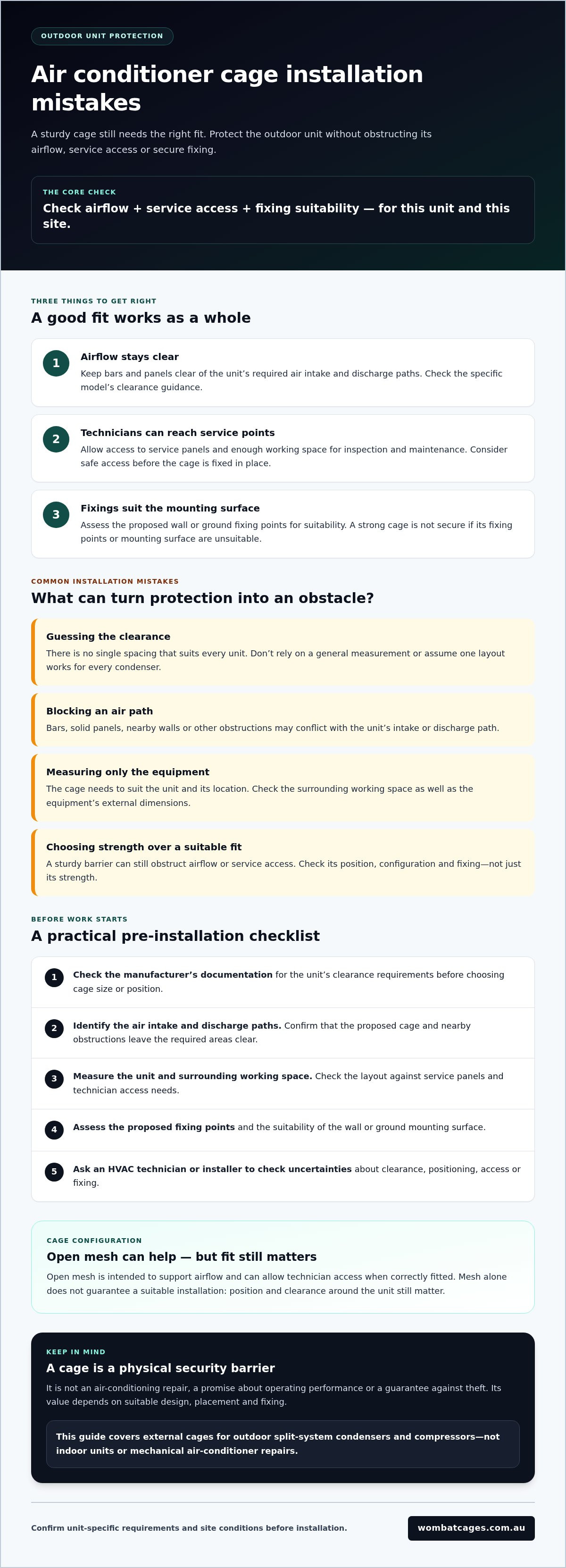
How to spot AC cage installation mistakes before work starts
A quick walk-around can flag obvious issues, but it can’t confirm every technical detail. Use this checklist to discuss the plan before the cage is fixed in place. You can observe the layout and raise questions. The installer or HVAC technician should confirm unit-specific clearances and whether the mounting surface is suitable.
A five-point check before the installer begins
- 1. Check the fit. Compare the proposed cage size and position with the outdoor unit and available space. Look for obvious clashes with nearby walls, fences or other obstacles.
- 2. Look at airflow paths. Ask whether the cage bars or panels could obstruct the unit’s air intake or discharge. The installer or HVAC technician should check the manufacturer’s clearance guidance.
- 3. Consider service access. Identify service panels and ask how a technician will reach them for inspection or maintenance. Don’t assume access will be straightforward once the cage is installed.
- 4. Inspect the proposed fixing area visually. Note visible cracks, loose material, damage or uneven ground around the planned fixing points. Share these observations, but remember they don’t establish whether the surface can support the installation.
- 5. Confirm the fixing plan. Ask how the installer assessed the wall or ground surface and how the cage will be secured. Fixing choices depend on site conditions, so don’t select anchors or dimensions yourself.
This checklist separates what you can see from what needs a technical assessment. A visible obstacle is easy to point out. Required clearances, the suitability of a fixing surface and the final installation method need confirmation from the installer or an HVAC technician.
What should you ask the installer?
Keep the conversation direct. Ask: “How does this position meet the air conditioner manufacturer’s clearance guidance?” “How will the cage allow access for servicing and inspection?” and “How have you assessed the fixing points for this surface?” These questions help clarify the plan without asking you to make technical decisions.
If the unit documentation is unclear, the site differs from what was expected, or you can’t see how airflow, access or fixings have been accounted for, pause and request clarification before installation. Resolve the concern before the cage is secured, not after it’s in the way.
For help assessing cage fit and installation options, discuss your cage installation requirements with Wombat Cages.
Avoid AC cage installation mistakes with the right fit and installer
The right cage is matched to the outdoor unit, the site and the work a technician needs to do later. A cage that fits the equipment but clashes with a wall, blocks access or relies on unsuitable fixing points misses the mark. Avoiding air conditioner cage installation mistakes means treating fit, placement and installation as one decision.
A purpose-built open mesh cage can provide a physical security barrier while allowing airflow and technician access. Those features still depend on correct positioning and fit. Check the air conditioner manufacturer’s clearance guidance, and confirm that the proposed layout leaves service points reachable. No cage can promise to prevent every theft or resolve problems with the air conditioner itself.
When should you seek professional installation?
Ask an installer for advice if clearances are uncertain, the unit sits close to walls or other obstacles, or you’re unsure whether the mounting surface is suitable. Fixing choices depend on the actual wall or ground conditions, so leave assessment and the structural fixing plan to an installer familiar with the site. Don’t guess at fixings or proceed if the proposed position hasn’t been explained.
For an overview of the process, read this AC cage installation guide. It can help you understand what to discuss before work begins.
What does a well-fitted security cage need to achieve?
A well-fitted cage should enclose the outdoor condenser without obstructing the manufacturer’s specified clearances. It should leave technicians room to reach the equipment for inspection and servicing, and be secured using fixing points assessed for the site. Ask the installer to explain how the proposed configuration addresses all three needs before installation.
Wombat Cages supplies and installs hot-dip galvanised steel cages for outdoor AC equipment, including single split-system and multi-bay configurations. The open mesh design is intended to maintain airflow and allow technician access, while installation involves bolting frames to wall and ground surfaces. The correct configuration and fixing still depend on the unit and site.
If you’re weighing up cage supply or installation and want to discuss the fit for your site, contact Wombat Cages about cage options and installation.
Choose a cage that fits the unit and the site
The key to avoiding air conditioner cage installation mistakes is to check the fit before work begins. Confirm the unit’s manufacturer-specified clearances, keep airflow paths and service points accessible, and have the mounting surface assessed. If any part of the proposed position or fixing plan is unclear, ask the installer or an HVAC technician before proceeding.
A purpose-built cage can provide a physical barrier without blocking the practical needs of the outdoor condenser or compressor. Wombat Cages supplies hot-dip galvanised steel cages with an open mesh design intended to maintain airflow and allow technician access. Professional installation includes fixing frames to wall and ground surfaces, with the site and equipment considered as part of the fit.
If you’re considering a cage for your outdoor unit, ask Wombat Cages about a properly fitted AC security cage. A clear plan for fit, access and fixing is a solid place to start.
Frequently Asked Questions
Can an air conditioner security cage restrict airflow?
Yes, a poorly positioned cage can obstruct the unit’s air intake or discharge. An open mesh design is intended to allow airflow, but the cage still needs to fit the equipment and sit clear of required air paths. Check the manufacturer’s instructions for the specific unit, and ask an HVAC technician or installer to confirm the proposed placement before it’s fixed in place.
How much clearance should there be around an AC security cage?
There’s no single clearance measurement that suits every air conditioner. Required space depends on the unit and its installation instructions. Check the manufacturer’s documentation, including the clearances around air intake and discharge areas, then ask an HVAC technician or installer to assess how the cage will fit the site. Don’t rely on a general measurement if it hasn’t been confirmed for your model.
Can I install an air conditioner security cage myself?
You may be able to fit a cage yourself, but the dimensions, placement and fixings need careful consideration. The mounting surface may not be suitable, and an incorrect position could obstruct airflow or make servicing harder. If you’re uncertain about the manufacturer’s clearance guidance, fixing points or site conditions, pause and seek advice from an installer or HVAC technician before starting.
What happens if an AC cage blocks access to the unit?
Blocked access can make inspection and servicing more difficult. A technician may not be able to reach service panels or work around the equipment as intended. Before installation, check that the cage layout leaves the unit’s service points accessible and ask an HVAC technician to confirm any specific access requirements. This is one of the air conditioner cage installation mistakes worth addressing before the frame is secured.
Can an air conditioner cage be fixed to any wall or ground surface?
No. Wall and ground surfaces vary, so don’t assume every fixing point is suitable. Loose, damaged or otherwise unsuitable surfaces may compromise how securely the cage is attached. Ask the installer to assess the actual site and determine an appropriate fixing approach. The right method depends on the surface and installation conditions, so avoid choosing fixings or installation dimensions by guesswork.
Can an AC security cage affect the manufacturer’s warranty?
It depends on the air conditioner manufacturer’s warranty terms and the cage’s design and installation. Don’t assume a cage will affect the warranty, or that it can’t. Check the warranty documents and installation instructions, particularly for requirements about clearances, access or modifications around the unit. If the wording is unclear, contact the manufacturer or supplier for guidance before fitting the cage.


