
An outdoor air conditioner is a high-value asset. It often sits unprotected on your property. In the Australian climate, a galvanised steel AC cage is not an optional upgrade. It's the baseline for functional security. You've likely heard the stories. Copper theft is rising across the country. Salt air in coastal suburbs destroys cheap, painted enclosures in record time. You need a physical barrier that stays rigid and rust-free.
Choosing the right material ensures your investment stays protected for the long haul. This guide explains why hot-dip steel is the industry standard for securing your condenser. We'll compare common materials to ensure you get total security without voiding your HVAC warranty or restricting airflow. Discover how to achieve zero maintenance for over ten years while keeping your system running at peak efficiency.
Key Takeaways
- Identify why hot-dip galvanisation is the baseline for surviving the corrosive Australian coastal air.
- Master the "clearance zone" requirements to ensure your security enclosure doesn't compromise HVAC efficiency or manufacturer warranties.
- Compare the tensile strength of a galvanised steel AC cage against lighter materials to stop copper thieves in their tracks.
- Evaluate the importance of rigid mesh designs that provide total security while allowing effortless technician access for servicing.
- Discover how to secure your property with a no-nonsense, industrial solution that requires zero maintenance for over a decade.
The Vulnerability of Outdoor AC Units: Why Material Choice Matters
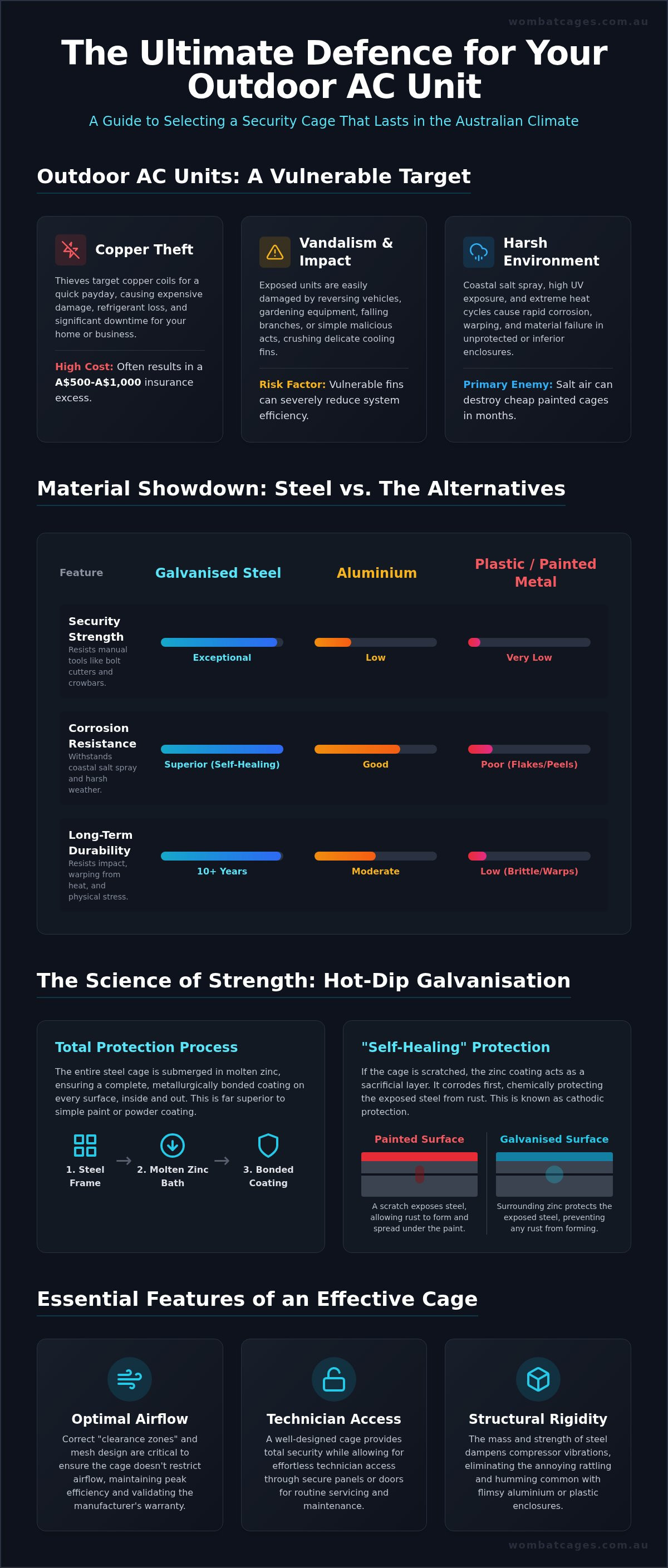
Outdoor condensers are soft targets. They sit in alleys or behind buildings, often completely exposed. This makes them easy prey for copper thieves looking for a quick win. A thief sees a fast payday in the copper coils. You see a massive repair bill. Vandalism isn't the only threat either. Gardening equipment, reversing vehicles, and falling debris can crush delicate aluminium fins in seconds. A galvanised steel AC cage provides the physical barrier needed to stop these threats before they start. It turns a vulnerable asset into a hardened target.
The High Cost of Copper Theft
The real damage isn't just the stolen metal. When a thief rips out copper lines, they dump the refrigerant gas. Replacing this gas is expensive and environmentally damaging. It often costs more than the copper itself. Then there's the insurance trap. Most Australian policies have a high excess for outdoor equipment. You might pay A$500 or even A$1,000 out of pocket before the insurance company pays a cent. For a business, the cost is even higher. Losing your HVAC system means immediate downtime. Customers leave. Staff can't work in the heat. Prevention is always cheaper than a claim.
Environmental Stressors on HVAC Equipment
The Australian environment is brutal on metal. If you live near the coast, salt spray is your biggest enemy. It eats through untreated enclosures in months. You need a material that can handle the chemical assault. This is where the coating matters. To understand the level of protection required, you should know What is galvanized steel? It's a process where steel is coated in zinc to prevent rusting. A galvanised steel AC cage uses this protective layer to survive decades of salt air and high UV exposure without structural failure.
Thermal expansion is another factor. Cheap plastic or thin aluminium enclosures can warp in the 40-degree heat of an Australian summer. This warping puts pressure on the AC unit or blocks critical airflow. Steel remains rigid. It doesn't sag or deform under the sun. It also provides superior impact resistance. A stray lawnmower stone or a heavy branch won't dent a heavy-duty steel mesh frame. It keeps the condenser core safe from physical trauma while maintaining the airflow required for manufacturer efficiency. It's about building things that last.
Galvanised Steel vs. Alternatives: A Security Comparison
Security is about time and resistance. A determined thief can eventually get through almost anything, but they want a fast job. Aluminium is light. It's easy to transport and easy to install. It's also easy to cut. A standard pair of bolt cutters will snip through aluminium mesh like wire. It offers almost no resistance to prying or leverage attacks. A galvanised steel AC cage is a different beast. Steel has the tensile strength to resist manual tools. It doesn't snap. It doesn't bend easily under a crowbar. It forces a thief to use power tools, which creates noise and draws attention.
Rigidity is another factor often overlooked. AC units are mechanical. They vibrate when the compressor kicks in. A flimsy aluminium or plastic enclosure will rattle. This creates a constant, annoying hum that can vibrate through your wall and into your living room. Steel has the mass to dampen these vibrations. It provides a stable, heavy-duty frame that stays quiet. If you're looking for high-strength security cages, steel is the only material that provides this level of structural integrity.
Galvanised Steel vs. Aluminium Cages
The weight of steel is its greatest security asset. It's harder to move and harder to manipulate. While aluminium is often marketed as a "rust-free" alternative, it lacks the hardness required for high-risk areas. Steel mesh is far more difficult to breach. The initial investment in a steel cage is slightly higher than a basic aluminium frame. However, the cost-benefit ratio is clear. You're paying for a barrier that won't need replacing after a single attempted break-in. It's a permanent solution for asset protection.
The "Self-Healing" Nature of Zinc Coatings
The "Hot-Dip" process is superior to sprayed-on finishes or powder coating. In a hot-dip plant, the entire steel frame is submerged in molten zinc. This ensures every corner, joint, and internal surface is coated. This is critical for the long-term durability of galvanized steel. Unlike paint, which flakes off when scratched, zinc provides cathodic protection. It's a sacrificial layer. If the cage gets nicked by a tool or a stray stone, the surrounding zinc chemically protects the exposed steel from rusting. It literally heals itself.
This chemical bond means zero maintenance for you. You don't need to touch up scratches or worry about peeling paint. In the harsh Australian sun, powder-coated finishes eventually crack and bubble. Once the seal is broken, the metal underneath rots. A galvanised steel AC cage avoids this entirely. You can expect a lifespan of 20 years or more, even in coastal environments. It stays functional and secure without any effort on your part.
Design Features of an Effective Galvanised Steel AC Cage
Good design is about balance. You need a physical barrier that stops a crowbar. You also need the condenser to breathe during a heatwave. An effective galvanised steel AC cage starts with a rigid frame. This frame prevents the mesh from sagging or deforming over time. If the mesh touches the condenser fins, it causes damage. A properly engineered cage maintains a clear zone around the unit. This ensures the structure stays solid without interfering with the machine's operation. It's about industrial-strength protection that respects the mechanical needs of the HVAC system.
Installation is the final step in the security chain. A cage sitting loosely on the ground is useless. It must be anchored. We bolt our structures directly to concrete pads or brick walls. This creates a unified barrier that is incredibly difficult to move. Security is also about the small details. We use tamper-proof fixings that resist standard wrenches and screwdrivers. This prevents a thief from simply dismantling the cage panel by panel. For commercial properties, multi-bay security cages provide a streamlined way to protect rows of units under one continuous, hardened structure.
Airflow and Efficiency
Airflow is the lifeblood of your air conditioner. Solid or "decorative" covers are a mistake. They trap hot air around the condenser. This forces the compressor to work harder to reject heat. It drives up your electricity bill. It also shortens the lifespan of the equipment. We use an open mesh design to maintain manufacturer-specified airflow. This provides a high open-area percentage. It keeps the system running at peak efficiency even when the mercury hits 40 degrees. Many HVAC installers will void a warranty if they see a unit inside a restrictive enclosure. An open mesh galvanised steel AC cage keeps the warranty intact and the machine cool.
Technician Access and Maintenance
A security cage shouldn't be a permanent tomb for your AC unit. Regular servicing is essential for performance. Our designs prioritise technician access. We include removable panels or hinged gates. This allows a mechanic to clean the coils or check refrigerant levels without cutting the cage away. It saves you money on labour during routine maintenance. If a technician has to spend an hour just getting to the machine, you're paying for wasted time. Our cages are built for utility. They provide total security when locked and effortless access when it's time for a service. It's a pragmatic solution for property owners who value both protection and functionality.
Selecting the Right Galvanised Steel AC Cage for Your Property
Selection starts with a tape measure. You need to define the clearance zone. Most manufacturers require at least 300mm to 500mm of space around the condenser for optimal performance. A galvanised steel AC cage must accommodate this gap. If the cage is too tight, heat builds up. If it's too loose, it wastes space and becomes an eyesore. Measure twice. Ensure your technician has enough room to reach the service valves without dismantling the entire structure. Practicality always comes first.
Assess your local risk level. A quiet suburban backyard might only need standard mesh to deter opportunistic vandals. A commercial alleyway in a high-crime area requires heavy-duty steel. The thickness of the mesh and the spacing of the bars dictate the level of resistance. Mounting surfaces also matter. Bolting into a thick concrete pad provides the best security. Brick walls are a secondary option but require specific masonry anchors to prevent the cage from being pried off. The goal is a permanent, immovable fixture.
Residential vs. Commercial Requirements
Residential setups usually involve a Single Split System Security Cage. These are compact. They sit neatly against a house wall. They provide peace of mind for homeowners worried about copper theft or accidental damage from lawnmowers. Commercial sites are different. They often have banks of units. Multi-bay security cages allow you to organise and secure large HVAC footprints under a single, unified structure. It looks professional. It simplifies security management. If your site has unique height or width requirements, custom sizes are the best way to ensure a perfect fit without compromising on strength.
Long-Term Asset Management
A security cage is an investment in property value. It shows potential buyers that you maintain and protect your assets. Integrate the cage into your regular property maintenance schedule. Perform a quick visual inspection every six months. Look for loose bolts or signs of heavy impact. Because of the zinc coating, you won't see rust, but checking the physical fixings ensures the structure remains rock solid. It's about common-sense prevention. If you're ready to secure your unit, you can enquire about our cage installation services to get the job done right.
The aesthetic of hot-dip galvanised steel is clean and industrial. It doesn't try to be something it isn't. It signals to everyone that this property is protected by a galvanised steel AC cage built for durability. It blends into modern commercial designs and looks purposeful on residential sites. It's the look of a property owner who values functional strength over temporary flair. This approach ensures your HVAC system remains an asset rather than a liability.
Why Wombat Cages is the Dependable Choice for AC Security
Security is only as good as the weakest link. You can buy the best materials, but if the design is flawed or the installation is sloppy, your asset remains at risk. We don't build generic garden fences or decorative screens. We focus exclusively on industrial-grade protection. A galvanised steel AC cage from Wombat Cages is a purpose-built barrier. It's designed to solve the two biggest problems facing Australian property owners: copper theft and environmental decay. We've spent years refining a product that is uncomplicated, rigid, and effective. It's a no-nonsense approach to asset protection that works.
Our expertise is specialised. We understand the mechanical requirements of HVAC systems. We know that a cage shouldn't make a technician's life harder. By choosing a team that focuses solely on this niche, you get a solution that has already accounted for airflow, vibration, and service access. We manufacture our cages to handle the specific challenges of the Australian environment. From the intense UV of the outback to the salt spray of our coastlines, our gear is built to stay standing. It's about Australian-made durability for Australian conditions.
The Wombat Cages Difference
The finish matters. We use a hot-dip galvanised process that provides maximum resistance to the elements. This isn't a thin coat of paint. It's a thick, metallurgical bond that won't flake or peel. Our designs are also technician-friendly. We've seen too many cages that have to be cut away just to change a filter or check a valve. We include removable panels that make servicing straightforward. The mesh itself is rigid. It doesn't rattle in the wind or sag over time. It provides a permanent, quiet perimeter for your condenser. This galvanised steel AC cage is a set-and-forget solution for your property.
Professional installation is the final layer of defence. A cage is only a deterrent if it's anchored correctly. Our installers ensure every bolt is fixed into a solid base, whether it's a concrete pad or a structural wall. We use specialised fixings that resist prying and tampering. This ensures the cage is as secure as the steel it's made from. You don't have to worry about the structural integrity or whether the unit will vibrate against the frame. We take care of the technical details so you don't have to.
Get a Quote for Your Property
Getting your unit secured is a simple process. You don't need to navigate complex catalogues or guess which size you need. Send us your unit model or the basic dimensions of the area you need to cover. We provide a clear, fixed quote for both the product and our professional installation services. We offer national delivery for those who want to handle their own setup, alongside our full-service installation for total peace of mind. Don't leave your HVAC system to chance. Protect your assets today with a Wombat Cage. It's the pragmatic choice for long-term protection.
Harden Your Property Against Theft and Corrosion
Securing an outdoor unit isn't just about adding a box. It's about choosing a material that survives the Australian coast and stops a crowbar. Hot-dip galvanisation provides that baseline of defence. It offers a sacrificial zinc layer that heals itself. This ensures your galvanised steel AC cage remains structural for decades. You've seen why aluminium falls short and why airflow is the critical factor for your compressor's health. It's a matter of functional strength over temporary flair.
Wombat Cages provides industrial-strength protection with a technician-approved design. Our cages maintain the necessary clearance to keep your warranty intact while offering a physical deterrent that thieves can't ignore. We offer professional installation Australia-wide to ensure every fixing is rock solid. Secure your air conditioner with a heavy-duty galvanised steel cage and stop worrying about copper theft or storm damage. It's a common-sense upgrade that pays for itself in peace of mind. Your equipment is too valuable to leave exposed.
Frequently Asked Questions
Will a galvanised steel AC cage void my manufacturer warranty?
No, installing a cage won't void your warranty as long as it doesn't restrict airflow. Most manufacturers require a specific clearance zone around the condenser to ensure it operates within its design limits. Our open-mesh designs ensure the machine breathes exactly as the engineers intended. If you maintain the required 300mm to 500mm gap, your warranty remains intact. Always check your specific unit's manual for their exact distance requirements before installation.
How much airflow does my air conditioner need when caged?
Your unit needs a clearance zone of at least 300mm to 500mm on all sides to operate efficiently. This space allows the fan to draw in enough air to reject heat effectively. A galvanised steel AC cage with an open-mesh pattern provides the highest open area percentage. This prevents heat buildup that can lead to compressor failure or high electricity bills during an Australian heatwave.
Can thieves cut through a galvanised steel cage?
Steel is significantly harder to cut than aluminium or plastic. A thief would need heavy-duty power tools or an angle grinder to breach the mesh, which creates noise and draws attention. Standard bolt cutters that easily snip through lighter materials will struggle with our rigid steel gauge. While no barrier is 100% impenetrable, steel acts as a powerful deterrent that forces thieves to look for an easier target elsewhere.
What is the difference between cold galvanising and hot-dip galvanising?
Hot-dip galvanising involves submerging the entire steel frame in molten zinc to create a metallurgical bond. This coats every internal and external surface. Cold galvanising is simply a zinc-rich paint sprayed onto the surface. It doesn't offer the same chemical protection or impact resistance. For long-term asset protection in the Australian climate, hot-dip is the only industrial standard that provides a self-healing finish against scratches.
Do galvanised steel cages rust over time?
No, hot-dip galvanised steel will not rust for decades. The zinc layer acts as a sacrificial barrier that prevents oxygen and moisture from reaching the steel underneath. Even if the surface gets scratched, the surrounding zinc protects the exposed metal through a process called cathodic protection. You can expect a lifespan of over 20 years without the need for painting or structural maintenance, even in harsh environments.
How do technicians access the unit for regular servicing?
Our designs include removable panels or hinged gates for effortless servicing. A technician doesn't have to dismantle the entire structure for a routine check-up. These access points allow a mechanic to clean coils, check refrigerant levels, or perform repairs without compromising the cage's security when locked. It saves you money on labour and ensures your maintenance schedule stays on track without any extra hassle.
Can the cage be installed on a wall-mounted unit?
Yes, we can secure wall-mounted units. We use specific masonry anchors to bolt the cage directly to the brickwork or structural frame of the building. This creates a hardened perimeter around the condenser, even if it's elevated. The installation process ensures the cage is level and secure to prevent any vibration noise from transferring through the wall and into your living space or office.
Is a galvanised steel cage suitable for coastal properties?
Yes, hot-dip galvanised steel is the best material for coastal properties. Salt air is highly corrosive to untreated metals and cheap powder-coated enclosures. The thick zinc coating on a galvanised steel AC cage is specifically designed to resist the chemical assault of sea spray. It provides the necessary durability to stay rust-free in suburbs near the ocean where other materials would fail within a few years.


