
Imagine waking up to a 40-degree heatwave only to find your outdoor unit has been ripped from the slab overnight. With copper prices sitting at roughly A$4.50 per pound in 2026, your air con is a high-value target for thieves with bolt cutters. You probably expect your policy to handle the mess, but does insurance cover stolen air conditioner units in a way that actually saves you money? The reality is often more complicated than a simple replacement check. It's frustrating to face a A$1,000 excess while your family swelters in the summer heat.
This guide shows you exactly how Australian home insurance handles these thefts and why the covered amount rarely tells the whole story. You'll discover the hidden impact of the 2026 refrigerant transition on installation costs and how to lock down your assets for good. We're looking at the hard facts of policy limits, premium increases, and the heavy-duty physical barriers that keep thieves away from your copper. Physical protection is a one-time cost; a stolen unit is a recurring nightmare. Let's make sure your home stays cool and your premiums stay low.
Key Takeaways
- Learn exactly how building insurance treats fixed split systems and find out: does insurance cover stolen air conditioner units in your specific situation?
- Calculate the real cost of a claim by comparing your excess against the price of 2026 refrigerant-compliant replacements.
- Identify the hidden financial impact of premium increases and the expensive "summer surcharge" that often follows a theft.
- Understand why hot-dip galvanised steel cages provide a permanent physical deterrent that stops copper thieves at the boundary.
- Move from a reactive insurance mindset to a proactive security strategy that guarantees peace of mind and long-term savings.
Defining Coverage: Is Your Air Conditioner Part of Building or Contents Insurance?
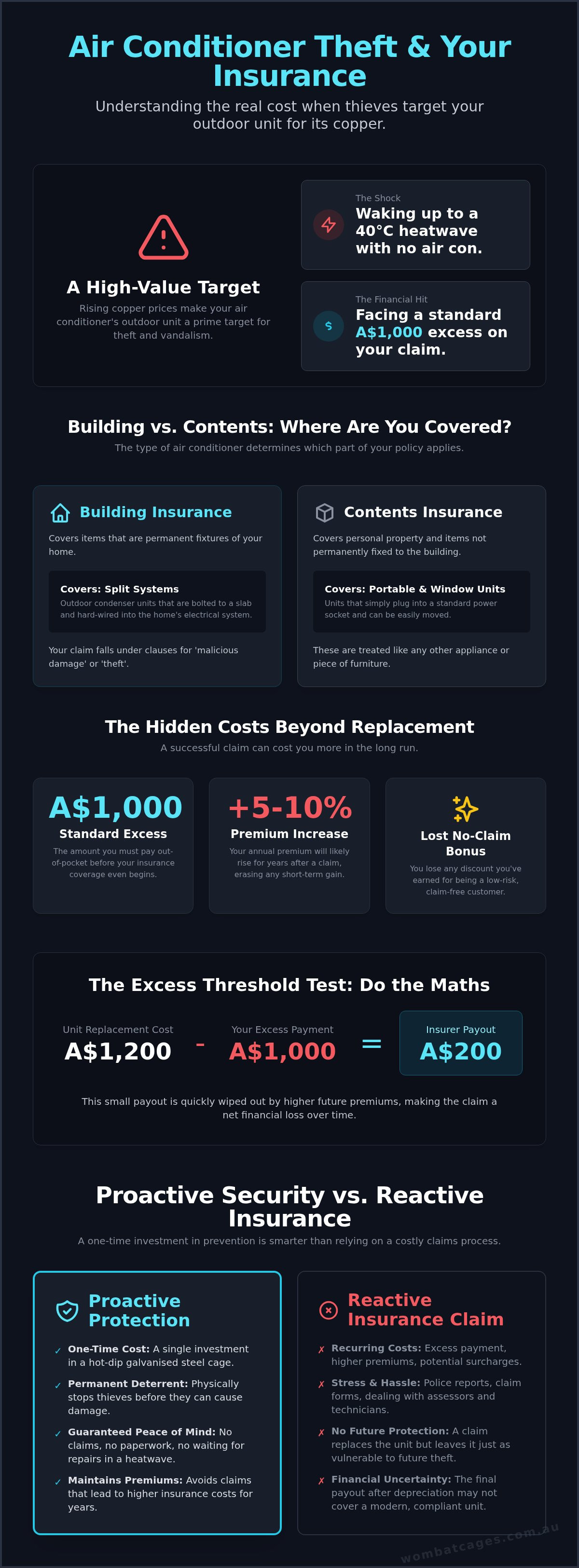
Understanding your homeowners insurance policy is the first step in defending your property. In Australia, the classification of your AC unit determines which part of your policy kicks in. Most modern homes use split systems. Because these are bolted to the wall and hard-wired into the electrical mains, they are typically considered 'fixed' parts of the building. This means your building insurance covers the external condenser unit against theft and vandalism. When a unit goes missing, the first thing most people ask is: does insurance cover stolen air conditioner units under a standard building policy? Usually, the answer is yes, but the unit must be a permanent fixture of the structure.
If you're using a portable floor unit or a window unit that just plugs into a socket, the rules change. These are usually classified as personal property and fall under contents insurance. It's a critical distinction for your claim. If your condenser is ripped off the slab, you're looking at a building claim. You need to check your Product Disclosure Statement (PDS) specifically for 'malicious damage' clauses. This covers you when someone intentionally damages your property during a theft attempt. Does insurance cover stolen air conditioner theft if the unit wasn't properly installed? That depends on your insurer's definition of 'fixed', so check your paperwork early.
Total Unit Theft vs. Copper Stripping
Thieves are often lazy. They might not want to haul a 50kg condenser unit over a fence. Instead, they use bolt cutters to strip the valuable copper piping and internal coils. This leaves you with a useless shell and a massive repair bill. Damage caused during these raids is usually covered under 'malicious acts' in most Australian policies. Copper theft is officially defined as a 'partial loss' claim. It's just as devastating as losing the whole unit because the system won't run without its copper veins. Thieves want the metal, not the machine.
Standard Exclusions to Watch For
Insurance isn't a blank cheque. Certain conditions will see your claim rejected immediately. If your property is unoccupied for more than 60 consecutive days, most insurers will void your theft coverage. You also need to show 'reasonable care' for your assets. If you leave a high-value unit in an unsecured, high-risk area without any physical protection, the insurer might argue you contributed to the loss. Finally, don't confuse theft with maintenance. Insurance won't cover a unit that failed due to wear and tear or rust. It only covers sudden, unforeseen criminal events.
Filing a Claim: When is it Actually Worth Your While?
Filing an insurance claim isn't always the smartest financial move. You need to weigh the immediate payout against the long-term cost of higher premiums. Most Australian homeowners find their systems covered under the dwelling section of the policy, but that doesn't mean the insurer writes a blank cheque. You first have to clear your excess. In 2026, the national standard deductible sits at A$1,000. If your unit is old and heavily depreciated, the actual cash value payout might barely cover that amount. Thieves don't care about your budget, but your insurer certainly does.
Losing your no-claim bonus is another hidden trap. Insurers reward loyalty and low risk. Once you file a claim for a stolen condenser, your risk profile changes. You could see your annual premium jump by 5% to 10% almost immediately. When you ask, does insurance cover stolen air conditioner theft, you must also ask if you can afford the higher bills for the next five years. Sometimes, paying out-of-pocket for a repair is cheaper in the long run. It's a pragmatic decision based on cold hard numbers.
The Excess Threshold Test
Run the numbers before you call your broker. If your excess is A$1,000 and the total replacement quote is A$1,200, you're only gaining A$200 from the insurer. That small gain will be wiped out by your next premium hike. It's a losing game. Always get a professional quote first. Keep all your original installation receipts and maintenance logs in a safe place. These documents prove the unit's value and condition, ensuring you get the maximum possible payout if you do decide to proceed. Preventative measures like securing your new unit can stop this financial headache before it starts.
Evidence Required for a Successful Claim
Insurers don't take your word for it. You need a paper trail. A police report is mandatory for every theft and vandalism claim in Australia. Call the local station and get a reference number immediately. Take clear, high-resolution photos of the damage. Capture the cut pipes, the empty slab, and any signs of forced entry to your yard. You'll also need the original purchase invoice or a detailed quote for a modern, A2L refrigerant-compliant replacement. Without this evidence, your claim will stall before it even reaches the assessor's desk. Does insurance cover stolen air conditioner units without a police report? Almost never. Evidence is your only leverage.
The Hidden Costs of Air Con Theft Beyond the Replacement Price
Replacing a unit isn't just about the hardware cost. Most homeowners ask, does insurance cover stolen air conditioner theft, thinking only of the A$6,500 to A$9,500 replacement bill. They forget the "Summer Surcharge." When the mercury hits 40 degrees, every HVAC technician is booked solid. You pay a premium for emergency call-outs. You pay more for labour. It's a seller's market, and you're the one sitting in the heat. These immediate out-of-pocket expenses often fall outside your basic coverage limits.
Downtime is the silent cost. Waiting for a replacement isn't a one-day job. In 2026, supply chains still face hiccups for specific high-efficiency compressor models. You could be living in a sweltering house for weeks. This isn't just uncomfortable. It's dangerous for the elderly and pets. It ruins your sleep and your productivity. Insurance won't pay for your lost sleep or the temporary fans you have to buy. The mental toll of a hot, vulnerable home is a price no one wants to pay.
The Impact on Insurance Premiums
Insurers track every claim. Your "Risk Rating" is a permanent file that follows your property. If a thief targets your outdoor unit once, the insurer sees a vulnerability. They view your home as a higher risk. This often leads to a premium hike of 10% to 20% at your next renewal. Multiple claims within a five-year window are even worse. Some Australian providers may eventually refuse to cover you for theft at all. You become "uninsurable" for the very thing you need protection against. Protecting your unit isn't just about the hardware; it's about protecting your financial reputation with your insurer.
Logistical Headaches and Tradie Shortages
Organising a replacement is a full-time job. You need multiple quotes for the insurer. You have to wait for the assessor. Then you have to wait for the parts. It's a cycle of phone calls and missed work days. The biggest stress is the "soft target" effect. Criminals know that a brand-new unit will likely be installed within weeks of the first theft. They often return to hit the same house twice. Does insurance cover stolen air conditioner units a second time? Yes, but your excess and premiums will make you wish you'd just secured the unit from the start. It's a cycle of vulnerability that only physical security, like solutions from Wombat Cages, can truly break.
Proactive Protection: Why a Security Cage Beats an Insurance Claim
Insurance is a reactive safety net. It only works after the damage is already done. While the question "does insurance cover stolen air conditioner units" is important, it ignores the reality of the aftermath. You are left with a hole in your wall, a A$1,000 excess, and a house that feels like an oven. A security cage changes the entire equation. It shifts your strategy from recovery to prevention. By installing a physical barrier, you stop the crime before it begins. It is a one-time investment that often costs less than a single insurance excess fee. You aren't just buying steel. You're buying the certainty that your home stays cool.
Criminals are opportunists. They look for "soft targets" where they can work quickly and quietly. A condenser unit sitting exposed on a slab is an invitation. A unit wrapped in hot-dip galvanised steel is a problem they would rather avoid. Most copper thefts are finished in under 10 minutes. If a thief sees a bolted-down cage, they move to the next house. It is that simple. You don't want a payout months after the fact. You want your unit to stay exactly where it is. Peace of mind comes from physical strength, not a policy document.
Visual vs. Physical Deterrents
Many homeowners rely on cameras or motion lights. These are visual deterrents. They record the crime, but they don't stop the bolt cutters. A thief wearing a hoodie doesn't care about a digital recording. They want the copper. A galvanised steel cage provides a physical solution that cameras cannot match. It blocks access to the pipes and the compressor. It turns a quick payday into a difficult, noisy job. Security lights might help, but they won't stop a determined thief in broad daylight. You need a permanent barrier that stands its ground 24/7.
Maintaining Unit Efficiency and Access
Some people worry that a cage will choke their system. Quality designs use an open mesh pattern. This ensures your unit maintains maximum airflow even during a 45-degree Australian summer. It won't overheat. It won't lose efficiency. We also prioritise technician access. These cages are built for the trade. AC professionals can still service the unit without removing the entire structure. The rigid steel construction withstands harsh coastal salt and attempted vandalism. It is industrial-grade protection that respects the mechanics of your system. Stop waiting for the next theft and secure your split system today with a professional enclosure.
Hardened Security with Wombat Cages: Total Peace of Mind
Insurance is a reactive policy. Wombat Cages are a proactive barrier. We don't deal in paperwork or fine print; we deal in hot-dip galvanised steel. These enclosures are purpose-built for the Australian climate and offer maximum rust resistance. Whether you live on the coast or in the dusty interior, our cages stand their ground. We offer custom configurations for every property. You might have a single split system at home or a massive multi-bay commercial setup. We secure them all. While you may still ask, does insurance cover stolen air conditioner theft, you'll sleep better knowing the unit is locked behind industrial-grade metal.
Our professional installation service ensures the cage is bolted directly to the wall or the ground. It becomes an immovable part of your property. This stops the "grab and go" theft style that has become so common in 2026. Thieves looking for a quick payday will see the cage and move on. They want an easy target, not a fight with a steel enclosure. A Wombat Cage is a one-time investment in asset protection. It's a permanent solution that keeps your home cool and your premiums low. We build things that last.
Why Galvanised Steel is Non-Negotiable
The Australian environment is brutal. Hot-dip galvanised steel doesn't just look tough. It survives the corrosive salt air of coastal suburbs and the baking heat of the outback. It won't peel or rust like inferior materials. The heavy-duty mesh is a critical feature. It prevents hand tools and bolt cutters from reaching your copper lines. The rigid frame acts as a "Dependable Guardian" for your HVAC investment. It's about structural integrity. You need a cage that can withstand both the weather and a determined vandal. We provide that specialized expertise.
How to Get Started with Wombat Cages
Securing your property shouldn't be a complicated process. We've made it straightforward for both residential and commercial owners. Our team provides national supply and installation, protecting assets across the entire country. We understand local conditions because we're Australian made. Don't wait for a theft to happen before you take action. Requesting a quote is a simple step toward total peace of mind. You can Secure your air conditioner with a Wombat Cage today and stop worrying about what does insurance cover stolen air conditioner claims. Focus on prevention and stay cool all summer long.
Secure Your Comfort Before the Next Heatwave
Relying solely on a policy document leaves your home vulnerable to the 2026 copper theft epidemic. While you now know the answer to does insurance cover stolen air conditioner units, you also understand the hidden financial sting of high excess fees and rising premiums. Insurance is a reactive safety net. It doesn't stop the sweltering downtime or the expensive "summer surcharge" from busy tradies. True protection requires a physical barrier that turns your property into a hard target for thieves.
A hot-dip galvanised steel cage is the most reliable way to defend your HVAC investment against bolt cutters and vandals. We provide custom-fit enclosures for all major AC brands, ensuring maximum airflow and easy technician access. With national installation and supply, we offer a permanent solution built for the harshest Australian conditions. Stop the cycle of claims and secure your peace of mind with a one-time investment in structural integrity. It's a pragmatic choice for any homeowner who values durability over paperwork.
Stop the thieves before they strike-get a Wombat Cages quote today. Lock down your cooling system now and stay comfortable all year round.
Frequently Asked Questions
Is copper theft covered by standard Australian home insurance?
Yes. Copper theft is typically covered under the theft or malicious damage sections of your building insurance. Because the copper piping is a fixed part of your split system, it is treated as part of the structure. You must provide evidence of the theft, such as a police report, to ensure the claim is processed successfully.
Will my insurance premium go up if I claim for a stolen air conditioner?
Expect your premium to increase. Insurers view any property that has been targeted by criminals as a higher risk. A single claim for a stolen unit can lead to a 10% to 20% jump in your annual bill. You also risk losing your no-claim bonus, which increases your long-term costs significantly.
Does insurance cover the cost of a temporary cooling unit while I wait for repairs?
Standard policies rarely cover temporary cooling. Most insurers only pay for the replacement of the fixed asset itself. You won't get reimbursed for buying portable fans or renting a temporary unit while you wait for a technician. This is why downtime is such a significant hidden cost during an Australian summer.
Can installing a security cage lower my home insurance premium?
Not all insurers offer an automatic discount for security cages. However, showing you have taken proactive steps to secure your property can help when negotiating your renewal. Preventing a claim is the only guaranteed way to stop your premiums from increasing. A galvanised steel cage is a one-time investment that protects your risk rating.
What should I do first if I discover my air conditioner has been stolen?
Call the police immediately. You need an official report number before you can even speak to your insurer. Once the report is filed, take clear photos of the cut pipes and the empty slab. This evidence is critical when you need to confirm: does insurance cover stolen air conditioner theft for your specific policy. Secure the area to prevent further vandalism.
Does building insurance cover the compressor and the condenser unit?
Building insurance covers both the compressor and the condenser unit. These are classified as fixed fixtures because they are bolted to the slab and hard-wired to the home. Portable units that plug into a wall socket are different. Those are considered personal property and fall under your contents insurance policy instead.
Is vandalism covered if the thieves didn't actually steal the unit?
Vandalism is covered. If a thief damages your unit while trying to strip the copper, it falls under malicious damage in most Australian policies. Even if the unit stays on the slab, the destruction of internal coils and pipes is a valid reason for a claim. You will still be responsible for paying your standard excess.
How much is the average excess for an air conditioner theft claim?
The standard home insurance excess in Australia for 2026 is A$1,000. Deductibles commonly range from A$500 to A$2,000 depending on your specific policy structure. You must pay this amount out-of-pocket before the insurer contributes a single cent toward your new unit. If the repair cost is close to your excess, paying for it yourself is often the better move.


