
That thirty-dollar mesh cover you bought online isn't protecting your air conditioner. It's just gift wrap for thieves. Most people think a fabric screen provides enough car park air conditioner protection to deter vandals. The reality is much harsher. With new HVAC systems costing up to twenty-two thousand dollars in 2026, a flimsy bit of polyester won't stop a thief with a pair of snips looking for copper. It's a high-stakes gamble with your property's comfort and your bank account.
You want your outdoor unit to look decent and stay safe without voiding your warranty. It's a common concern for Australian property owners. You need a solution that's tradie-tough but doesn't choke the condenser's airflow. We'll show you why standard aesthetic covers often do more harm than good by trapping heat and moisture. You'll discover how a hot-dip galvanised steel cage provides total security while keeping your system efficient. We are going to separate the marketing myths from the structural reality of asset protection. This is how you secure your peace of mind and your hardware for the long haul.
Key Takeaways
- Fabric and plastic covers are for dust, not defence. Learn why only heavy-duty steel stops copper thieves from stripping your unit.
- Airflow is vital for your unit's lifespan. See how open mesh designs protect your hardware without forcing the compressor to work harder.
- Copper theft isn't just a commercial problem anymore. Discover why car park air conditioner protection is now a necessity for suburban Australian homes.
- Not all metals are equal. Find out why hot-dip galvanised steel is the only material that survives harsh outdoor conditions without rusting or failing.
- Get the measurements right. Learn how to ensure enough clearance for both the machine and the service technician during future repairs.
What Is an AC Unit Protective Cover? Myths vs. Reality
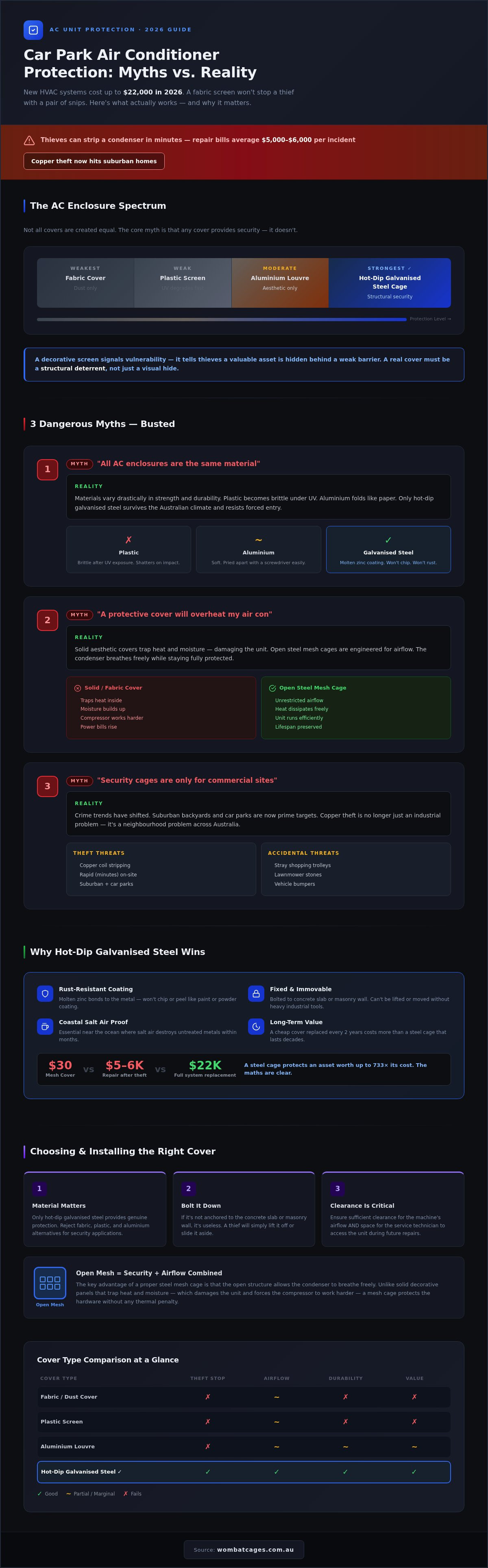
An AC enclosure isn't a single product category. It's a spectrum. At one end, you have fabric dust covers used during winter storage. At the other, you have heavy-duty steel cages designed for car park air conditioner protection. The core myth is that any cover provides security. This is false. Many property owners install decorative screens to hide an ugly unit. They believe a visual barrier equals a physical one. It doesn't. In fact, a flimsy screen can signal vulnerability to thieves. It tells them a valuable asset is hidden behind a weak barrier. A real protective cover must be a structural deterrent, not just a visual hide.
The external condenser is a critical part of the Heating, ventilation, and air conditioning (HVAC) system. It's also the most vulnerable. While most people focus on keeping the unit out of sight, the reality of 2026 requires a focus on keeping the unit in one piece. A structural barrier ensures your investment stays functional despite the environment around it.
Aesthetic Screens vs. Structural Security Cages
Louvred aluminium is the darling of home renovations. It looks clean. It hides the unit from the neighbours. But aluminium is soft. It offers zero resistance to a determined thief or a wayward vehicle. If a trolley or a car bumper hits that aluminium, it'll fold like paper. A structural security cage uses hot-dip galvanised steel. It's built to take a hit. These cages prioritise the safety of the unit over simple aesthetics. If a cover isn't bolted directly into the concrete slab or masonry wall, it's useless. A thief will simply lift it off or move it aside to reach the copper inside. Security starts with a fixed, rigid frame.
Why Australian Property Owners Are Investing in Protection
Crime trends are shifting. Copper theft is no longer just a problem for remote industrial sites. Suburban backyards and commercial car parks are now prime targets. Thieves can strip a condenser in minutes. The cost of the stolen metal is tiny compared to the five or six thousand dollars in repair bills property owners face. Car park air conditioner protection is also about the everyday accidents. A stray shopping trolley, a lawnmower stone, or a stray footy can flatten delicate cooling fins. Once those fins are crushed, your efficiency drops and your power bills rise. Vandalism is another factor. Keeping the fins safe from intentional damage or tampering requires a barrier that can't be bypassed with simple hand tools. A steel mesh barrier keeps the vandals and the accidents at bay.
Myth 1: 'All AC Enclosures Are the Same Material'
Choosing the wrong material is a costly mistake. Many retail options focus on lightweight convenience. They offer fabric or plastic covers designed to keep out leaves and dust. These are useless for car park air conditioner protection. A thief won't be stopped by a zip or a plastic clip. Even the aluminium screens often sold as "high-grade" fail the basic strength test. In the harsh Australian climate, these materials degrade. UV radiation turns plastic brittle. Coastal salt air eats through untreated metals. You need a material that can survive the environment and the local vandals simultaneously.
The Weakness of Aluminium and Plastic Screens
Aluminium louvres look great on a renovation show. In a car park or a vulnerable backyard, they are a liability. Aluminium lacks the shear strength of steel. A thief with a simple screwdriver can pry these slats apart with minimal effort. It's quiet work. Because police have observed a significant increase in the theft of copper coils, using a soft metal is essentially inviting trouble. Plastic is even worse. After a few years in the sun, it loses its flexibility. A single impact from a stray trolley or a footy will shatter it. The cost vs. value argument is clear. A cheap cover that needs replacing every two years is a bad investment. It doesn't defend the unit. It just hides the damage until it's too late.
The Case for Hot-Dip Galvanised Steel
Hot-dip galvanised steel is the gold standard for asset protection. The "hot-dip" process is critical. It involves immersing the steel in molten zinc to create a thick, rust-resistant coating. This coating bonds to the metal. It won't chip off like paint or powder coating. This is vital for units near the ocean where salt air destroys standard hardware. A rigid steel mesh cage is a heavy-duty barrier. It's designed to be bolted to the wall and the ground. This permanence is its greatest strength. It cannot be moved, lifted, or bypassed without heavy industrial tools. It provides the peace of mind that comes with knowing your condenser is safe. For those who need a "fit and forget" solution, galvanised steel cages offer the durability that flimsy alternatives simply cannot match.
Myth 2: 'A Protective Cover Will Overheat My Air Con'
A common fear among property owners is that an enclosure will suffocate their HVAC system. It's a valid concern if you're using the wrong product. Air conditioners don't actually generate "coolth." They work by extracting heat from inside your building and dumping it outside through the condenser coils. If that heat can't escape, it builds up around the unit. This forces the system to work harder to achieve the same result. Effective car park air conditioner protection must balance physical security with high-volume heat rejection. Without proper ventilation, you aren't just protecting your unit. You're killing it from the inside out.
The Danger of Solid or Tight-Louvred Enclosures
Solid-panel covers or decorative louvres with tight gaps are notorious for trapping heat. This creates a phenomenon known as high head pressure. When the refrigerant can't cool down properly, the compressor has to pump at much higher pressures to move the heat. This doesn't just spike your quarterly electricity bill. It puts massive mechanical strain on the compressor's internal components. Most HVAC technicians will tell you that heat is the primary cause of premature system failure. Using fabric "running" covers or solid boxes can also void your manufacturer's warranty. Most brands specify minimum clearance and airflow volumes. If you block that air, you're on your own when the motor burns out.
Open Mesh: The Solution for Airflow and Security
The solution isn't to leave the unit exposed. It's to use an open mesh design. This provides the best of both worlds. A well-designed steel mesh has a high percentage of "free area." This refers to the total open space that allows air to pass through unimpeded. You need a mesh aperture that's small enough to stop a hand or a pair of bolt cutters but large enough to let the fan breathe. Open mesh also allows for 360-degree ventilation. This is critical for multi-bay commercial systems where multiple units are grouped together. Heat build-up in these clusters can be extreme. An open-mesh cage also allows technicians to perform a visual inspection of the coils and fins without needing to unlock the unit. It's a practical approach to car park air conditioner protection that keeps your system efficient and your warranty intact.
Myth 3: 'Security Cages Are Only for Commercial Sites'
Residential property crime in Australia has evolved. It's no longer just about house break-ins. Thieves now target the expensive hardware sitting outside your home. Split systems in suburban backyards are prime targets for opportunistic thieves. These units are often hidden from the street but easily accessible from a side gate. This provides the perfect cover for a quick strip-down. While the term car park air conditioner protection usually brings to mind commercial buildings, the same industrial-grade security is now vital for homes. Commercial car parks are high-risk zones, but the logic of car park air conditioner protection applies just as strongly to a residential driveway or side passage. A security cage turns your unit into a hard target. Thieves want an easy win. If they see a bolted steel barrier, they move on to the next house. It's about making your property the least attractive option on the block.
The Rising Cost of Copper Theft
A thief can strip an outdoor unit in under five minutes. They are after the copper coils. They might get A$50 for the scrap metal at a dodgy yard. For the homeowner, the damage is catastrophic. You lose the refrigerant gas immediately. The delicate internal components are often mangled beyond repair during the process. The repair bill shock is real. A A$50 theft can easily cost you A$3,000 in mechanical repairs. Replacing a modern unit in 2026 can cost between A$7,500 and A$9,500 depending on the system size. This turns a minor theft into a major financial hit. Insurance claims for AC theft often carry high excesses that can exceed the value of the scrap metal stolen. You end up paying out of pocket for a crime that was entirely preventable with a simple physical barrier.
Protecting Against Vandalism and Accidental Damage
Security isn't just about crime. It's about the daily reality of life in an Australian backyard. A stray footy or a wayward lawnmower can flatten condenser fins instantly. Once those fins are bent, your unit's efficiency drops. It has to work harder to move air. This leads to higher electricity bills and a shorter lifespan for the compressor. Units near public footpaths or in multi-residential complexes face even higher risks. Vandalism or simple curiosity can lead to expensive tampering with the controls or wiring. Pets and local wildlife also cause frequent issues. Chewed wiring or damaged piping can shut down your entire system during a summer heatwave. A steel cage provides a permanent physical buffer. It keeps the kids, the dogs, and the vandals away from your investment. If you want to secure your home system with trade-quality hardware, invest in a single split system security cage to protect your asset.
Choosing and Installing the Right AC Protective Cover
Assessing your risk is the first step toward effective asset protection. A unit visible from the street is a target for opportunistic vandals. A unit tucked away in a secluded alleyway is a target for copper thieves who want time to work undisturbed. Both scenarios require car park air conditioner protection that acts as a physical deterrent. You aren't just buying a box. You're installing a security system for your HVAC hardware. The goal is to move the threat along to an easier target by presenting a hard, structural barrier that cannot be bypassed with basic hand tools.
Measuring Your Split System or Multi-Bay Unit
Measuring is where most DIY projects fail. Generic covers from international retailers often ignore the reality of Australian installations. You need to account for more than just the metal box of the condenser. Measure the total footprint including the external pipework and the wall brackets. If the cage is too tight, you create a nightmare for your service technician. A professional-grade cage allows for a service zone. This extra clearance ensures a tradie can reach the valves and electrical panels without dismantling the entire security system. For commercial sites, configuring cages for side-by-side units requires precise alignment. This maintains the necessary 360-degree airflow between the machines to prevent heat pockets from forming.
Professional Installation vs. DIY Brackets
The installation method determines the actual security level of your enclosure. A cage is only as strong as its fixings. If you use cheap DIY brackets or simple screws, a thief will pry the whole unit off the wall in seconds. Professional car park air conditioner protection involves bolting the steel frame directly into the concrete slab or masonry wall. Use tamper-proof dyna-bolts or chemical anchors. These tools ensure the cage won't budge under pressure. This turns the enclosure into a permanent part of the building structure. It makes the unit nearly impossible to remove without heavy industrial equipment. For full technical specifications on material grades and mounting options, check out our guide on the hot dip galvanised condenser cage. Integrating these cages into your property aesthetic is straightforward. While the focus is on strength, the clean lines of galvanised steel look professional and purposeful. It signals to everyone that you take asset protection seriously and won't tolerate tampering.
Secure Your HVAC Investment for the Long Term
Copper theft and accidental impact are growing risks that standard fabric covers simply can't handle. You've seen why lightweight aluminium and plastic fail under pressure. Real car park air conditioner protection requires the permanence of heavy-gauge galvanised steel. It's the only way to defend against vandals while ensuring your unit stays cool and efficient. This industrial approach to security is now a necessity for both suburban homes and commercial complexes across the country.
A proper security cage is designed for maximum airflow and technician access. It's a fit and forget solution that's trusted by Australian property managers for anti-theft protection. These cages are built from heavy-gauge galvanised steel to survive the harshest conditions without rusting or failing. Don't wait for a massive repair bill or a burnt-out compressor to prove the point. Secure your condenser now and keep your climate control running exactly as it should through every heatwave. You deserve the peace of mind that comes with a truly protected asset. Take the step to defend your hardware today.
Request a Quote for a Heavy-Duty AC Security Cage today and get the protection your system needs.
Frequently Asked Questions
Will an AC unit protective cover void my manufacturer’s warranty?
A security cage won't void your manufacturer's warranty as long as it doesn't restrict airflow. Most brands specify minimum clearances for heat dissipation. Because open mesh designs allow the fan to breathe normally, they meet these technical requirements. Fabric or solid covers are the real danger here. They trap heat and force the compressor to overwork, which is a common reason for warranty claims to be rejected by major HVAC brands.
Can I leave the cover on while the air conditioner is running?
You can leave a security cage on while the unit is running. These enclosures are designed for permanent car park air conditioner protection. Unlike fabric dust covers that must be removed before you hit the "on" switch, a steel mesh cage allows the system to function at peak efficiency 24/7. This provides continuous defence against copper theft without requiring any manual intervention from the property owner or manager.
How much airflow does a security cage actually allow compared to a screen?
Steel mesh cages provide a much higher percentage of free area compared to louvred screens. Louvres often create turbulence or trap pockets of warm air if they aren't perfectly angled. An open mesh design allows air to move freely from all directions. This is vital for maintaining the correct head pressure in your system. It ensures your electricity bills stay low and your cooling remains consistent during extreme Australian summer temperatures.
Are steel cages more expensive than aluminium louvred covers?
Steel cages are a more robust investment than aluminium screens. While aluminium might be lighter and initially cheaper, it lacks the structural integrity to stop a determined thief. Hot-dip galvanised steel provides a level of permanence that aluminium cannot match. It won't bend or pry apart with basic hand tools. You are paying for a long-term security solution rather than a temporary aesthetic screen that offers no real protection.
How do technicians access the unit for servicing if it’s inside a cage?
Technicians can easily access the unit through the mesh or by using specific access points designed into the cage. The open mesh allows for quick visual inspections of the coils and electrical components without removing the frame. Professional cages are installed with enough clearance to ensure a tradie can work on the system comfortably. This avoids the frustration of having to dismantle a security barrier every time a standard service is required.
Does a galvanised steel cage rust if I live near the coast?
Hot-dip galvanised steel is specifically designed to resist rust in coastal environments. The galvanisation process creates a thick metallurgical bond that is much tougher than standard paint or powder coating. It won't chip or peel when exposed to salt air or high UV levels. This makes it a fit and forget solution for properties located near the ocean where untreated metals or lower-grade alloys would fail within a few seasons.
Can a security cage help lower my property insurance premiums?
Installing a security cage may help reduce the likelihood of high-excess insurance claims. While every insurer is different, many recognise physical security measures as a way to lower risk. By preventing copper theft and vandalism, you avoid the financial hit of a system replacement that often falls under your policy excess. It's always a good idea to inform your insurance provider about your car park air conditioner protection to see if it qualifies for a premium discount.
What is the difference between a split system cage and a multi-bay cage?
A single split system cage is designed to wrap around one individual outdoor condenser. It's the standard choice for residential homes or small offices. Multi-bay cages are modular systems built for commercial sites where multiple units are installed in a row. These larger enclosures provide a continuous barrier for banks of condensers. They ensure that every unit in the group is equally protected from impact and theft without wasting space.


